Cost is almost certainly part of the conversation.
But the outsourcing market has matured significantly, and the decisions that drive results in 2026 look quite different from what they looked like even two years ago when we first wrote about trends in outsourcing.
Here, we’ve compiled 10 trends shaping software development outsourcing right now, with verified data and practical takeaways for CTOs and product leaders making decisions today.
Let’s dive in!
Key takeaways:
Specialized talent, not cost savings, is now the primary reason companies outsource. Deloitte’s Global Outsourcing Survey found 42% of executives cite talent access as their top driver, while cost fell from 70% to just 34% over 4 years. The implication is significant: the right question is no longer “how much do they charge per hour” but “do they have the depth we can’t hire locally”.
Agentic AI is the biggest shift hitting outsourced development in 2026. With 96% of enterprises already using AI agents in some capacity, well-implemented agentic workflows are shortening 3-month development cycles to 6 weeks. The catch is that it only works with strong senior engineering oversight.
The risks of outsourcing are consistent. Cybercrime costs hit $10.5 trillion in 2025, the average breach costs $4.44 million, and 60% of outsourced projects fail due to cultural incompatibility. Choosing a partner with ISO 27001 certification, clear AI governance policies, and documented quality standards upfront is how you avoid outcomes that derail most engagements.
According to Statista, the worldwide IT outsourcing market reached $588.38 billion in 2025 and is projected to hit $634.18 billion in value in 2026.
100+ projects delivered. We’re ready for yours. Let’s talk →
You’ll be talking with our technology experts.
That’s not a niche market quietly growing in the background.
It’s a major part of enterprise budgets, and the companies driving that spend have become significantly more sophisticated about what they’re actually buying.
So, if we had to sum up the state of software development outsourcing in a few words, it would be: healthyandgrowing.
Next, we’ll dig into the key trends behind that growth.
Key software development outsourcing trends for 2026
Here, we’ll cover the top trends in software development outsourcing in detail.
Talent access has overtaken cost as the #1 driver
For a long time, cost reduction dominated every conversation about outsourcing. That’s changing.
According to Deloitte’s 2024 Global Outsourcing Survey, access to specialized talent is now the top driver for outsourcing, cited by 42% of executives. Meeting customer demand ranks second at 35%.
Cost reduction has dropped to third place, with just 34% of companies naming it as the primary reason, down from 70% in 2020.
This reflects a fundamental change in how companies think about outsourced teams.
This shift also has practical implications for how you evaluate a partner. Here’s what matters most when you’re prioritizing value:
Strategic alignment – Make sure the partner understands your goals, not just your development backlog.
Depth of expertise – Look for proven experience in your domain and tech stack, not just availability.
Development maturity – Check how they handle code quality, security, and delivery processes.
But nearshore and onshore models are growing fast, particularly among companies that have experienced firsthand what offshore communication friction actually costs.
There’s a meaningful comparison between the three models:
Nearshore vs offshore vs onshore development: comparison
Category
Nearshore
Offshore
Onshore
Geographical proximity
Neighboring country
Distant country
Same country
Cost
Moderate
Lower
Higher
Communication
Relatively easy
Potential challenges
Easiest
Time zone alignment
Moderate to high
Low to moderate
High
Cultural closeness
Moderate to high
Varies
Very high
Offshore development looks cheaper on paper. But cultural gaps and communication issues tend to surface once your project is underway.
Cultural friction is a major factor when offshore engagements fail, alongside communication barriers and timezone gaps.
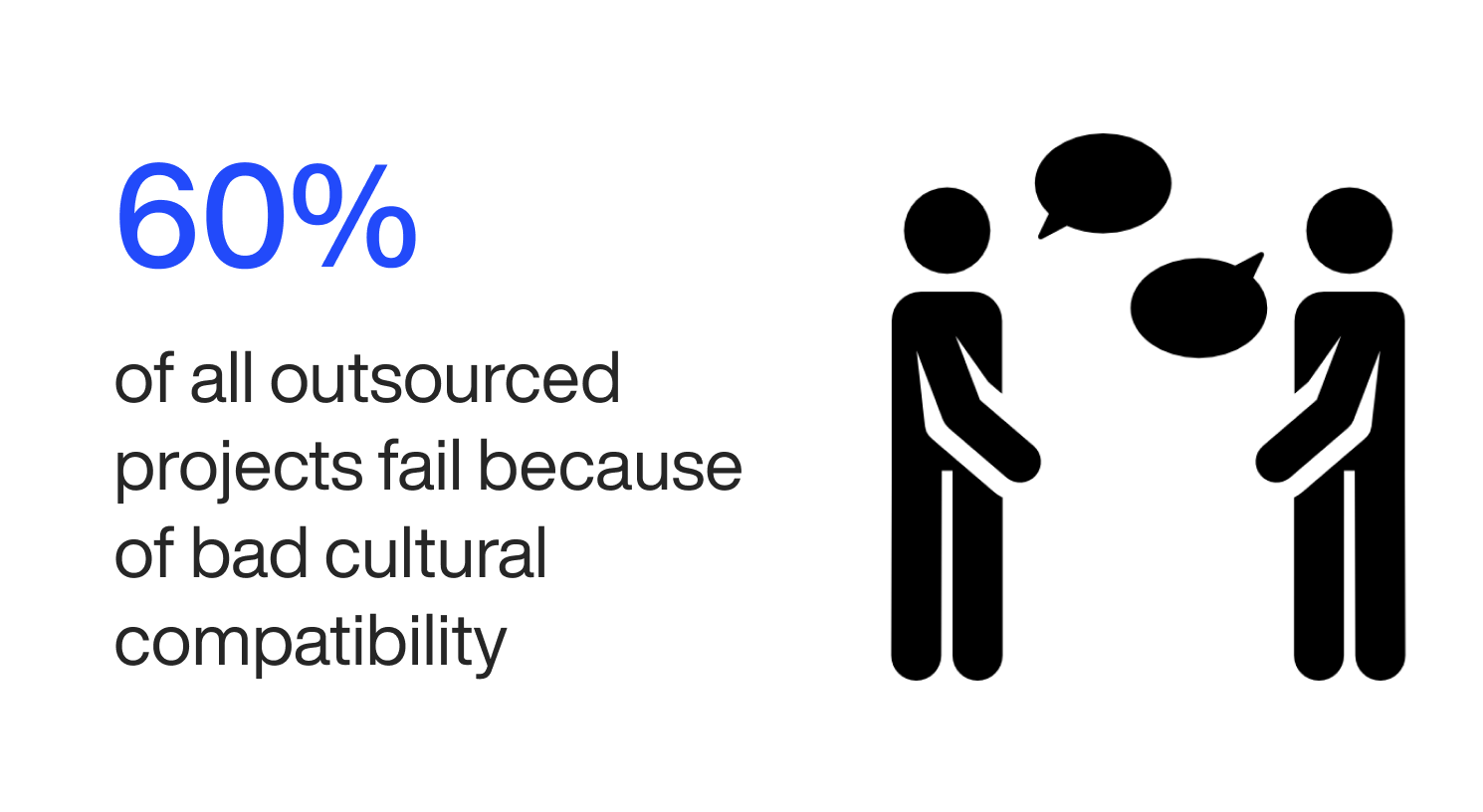
All told, 60% of outsourced projects fail because of bad cultural compatibility.
Nearshore outsourcing addresses most of those risks. Eastern Europe and Latin America have both established themselves as serious nearshore destinations.
Both regions offer strong technical talent, overlapping business hours with Western Europe and the US, and comparable cultural alignment to onshore teams.
In practice, this often means one primary partner handles core product development while separate specialists are brought in for specialized tasks like:
AI and machine learning
Security engineering
Cloud infrastructure and DevOps
QA
Each vendor is chosen for depth in a specific domain – or, simply put, they’re chosen because they’re very good at one thing instead of average at everything.
And if one relationship goes bad, your whole product isn’t at risk.
The catch is that it takes a lot of coordination for multisourcing to to work. Multi-vendor setups create real overhead on your end.
You need someone with technical authority who owns how the teams fit together. Without that, vendors will blame each other when things break at the seams.
It’s more work to manage than a single partner. But if your product is complex and you have the leadership to keep each vendor accountable, it’s usually worth it.
AI coding tools are now standard in professional development
A few years ago, AI coding assistants were a novelty.
Now they’re key infrastructure for most serious development teams.
Cursor — A full VS Code fork rebuilt around an AI-first workflow, with parallel agent execution and the largest developer community of any AI-native IDE.
OpenAI Codex — Available across CLI, IDE extension, and web. Surpassed 3 million weekly active users in mid-2026.
GitHub Copilot — The market leader by number of deployments, now with multi-file editing and pull request summarization.
Tabnine — The privacy-focused enterprise option; named a Gartner Magic Quadrant Visionary in 2026, with on-premises and air-gapped deployment options for teams with strict data governance requirements.
Kiro — AWS’s new agentic IDE, launched May 2026 as the replacement for Amazon Q Developer (which reached end-of-support in April 2026). Built around spec-driven workflows with structured specifications and automated hooks.
Beyond coding assistants, mature outsourced teams also use:
AI SAST tools — Snyk and SonarQube for automated security scanning in CI/CD pipelines.
AI documentation tools — Mintlify and Scribe to generate and maintain technical documentation automatically.
AI design tools — Figma AI and Claude Design for rapid prototyping and design-to-code workflows.
In short, the practical question when evaluating an outsourcing partner isn’t whether they use AI tools. Almost all credible teams do.
It’s whether they have the engineering culture and senior oversight to use them well.
Agentic development
This is the most significant trend to emerge in 2026.
According to OutSystems’ April 2026 research, 96% of enterprises are already using AI agents in some capacity, and 97% are exploring system-wide agentic AI strategies.
The change from AI as a coding assistant to AI as an active participant in the development process is well underway.
In practice, agentic AI in software development looks something like this:
Autonomous agents handling code reviews and flagging issues before they reach a human reviewer.
AI running regression test suites end-to-end after each build.
Documentation generated and updated automatically as code changes.
Sprint planning informed by AI analysis of velocity, complexity, and dependency data.
For outsourced teams, this changes the economics meaningfully. Development cycles that previously took 3 months can be completed in 6 weeks.
The important caveat is oversight. Experienced engineers are what make agentic AI work.
Without them, AI tools generate output that no one is validating, catching, or correcting.
94% of enterprises in that same OutSystems research flagged AI sprawl as a growing security and complexity risk. That’s not a fringe concern.
If your partner’s engineering bench is shallow, agentic tooling makes things worse, not better. The bar for senior talent goes up with agentic development
IBM’s 2025 Cost of a Data Breach Report puts the global average cost of a single breach at $4.44 million. In the United States, that figure rises to $10.22 million per incident, driven by regulatory exposure and litigation risk.
The moment an external team has access to your codebase, infrastructure, or data, your attacl surface expands.
The risks are concrete:
IP exposure: external teams access your source code, architecture, and product logic. Without proper controls, you’re exposing your core technical advantage.
Supply chain vulnerabilities: compromised dependencies or tooling in a partner’s environment can propagate into your product.
Data handling compliance: GDPR, CCPA, and HIPAA obligations don’t pause because the work is outsourced. Which rules apply depends on where your partner operates and what data they handle.
When evaluating a partner’s security posture, start with certifications.
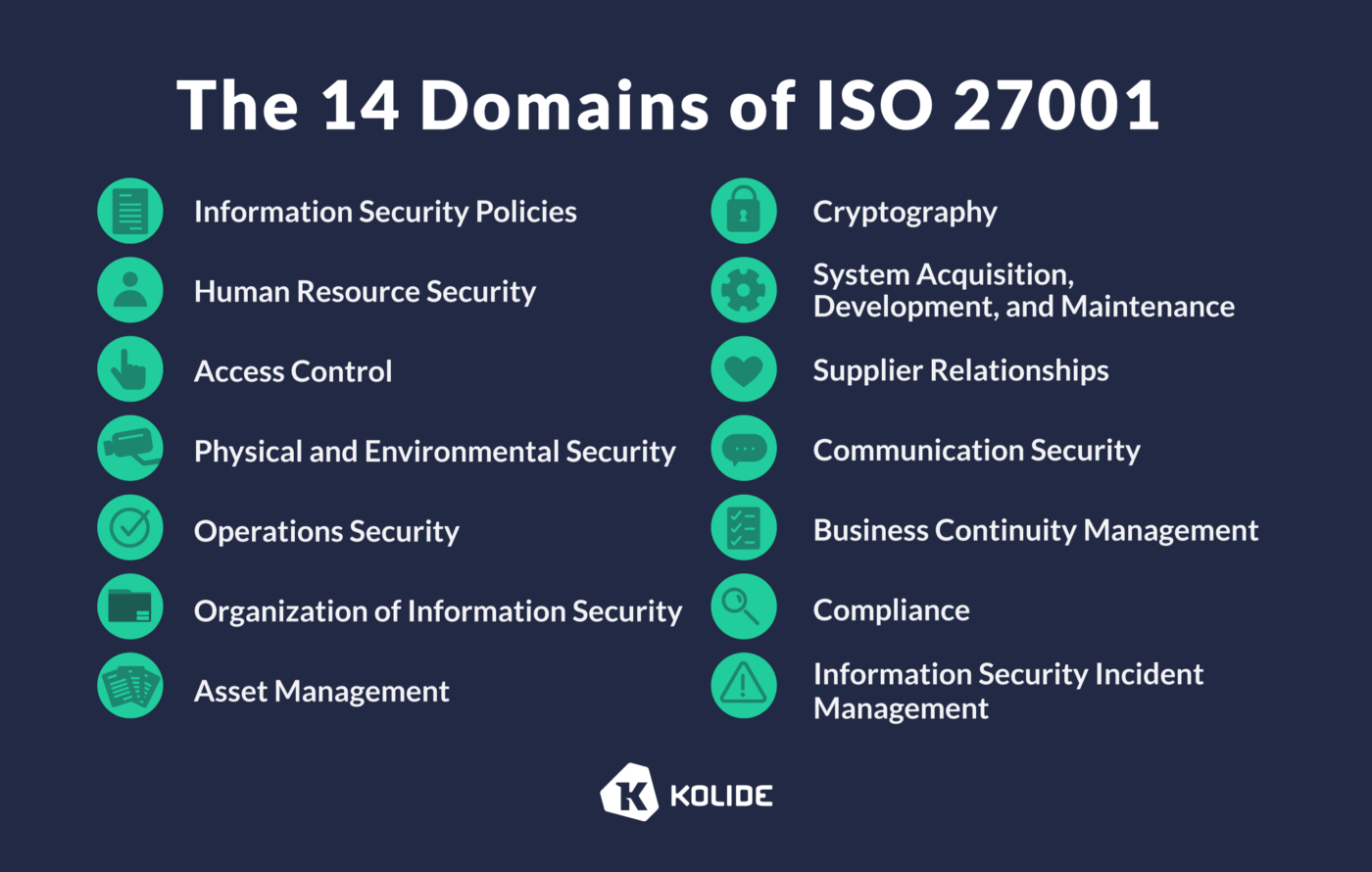
ISO/IEC 27001 is the baseline standard for information security management. It gives you a verifiable framework, not a vendor’s self-assessment.
IBM’s 2025 data found unsanctioned AI tool use added an average of $670,000 to breach costs. A partner without clear AI governance policies is a major liability.
If you’re buying from or selling into European enterprises, ESG (environmental, social, and governance) criteria are becoming part of the conversation.
It’s worth to make a quick distinction from the AI coding tools I covered in the previous section, since the two are often confused.
Tools like Claude Code, Cursor, and GitHub Copilot generate real source code in standard frameworks. You own it. You can deploy it anywhere.
Low-code and no-code platforms work differently: your app lives inside their ecosystem. The output isn’t portable.
And a newer category sits between these two: AI-native app builders like Lovable, Bolt.new, and v0 by Vercel. These generate real, exportable code from a text prompt, without requiring any engineering knowledge.
Lovable alone hit $500M in annualized revenue in 2026, which tells you something about the demand.
They’re genuinely useful for prototypes and internal tools, and unlike traditional low-code platforms, the output is code you actually own.
Here’s where low-code makes sense in outsourcing projects:
Strong fit: internal tools, workflow automation, MVP prototypes, data dashboards, and integrations between existing systems
Where it falls short: customized user experiences, performance-critical apps, and complex business logic that doesn’t map cleanly to platform constraints
The most-used platforms in use are Microsoft Power Apps (dominant in Microsoft 365 enterprise environments), OutSystems, Mendix, Retool for internal tooling, and Bubble for consumer-facing and no-code builds.
For an early-stage product or internal tool, low-code often gets you there faster.
For something with specific technical requirements, you need real code. A good outsourcing partner will make that call based on your situation, not their preferred tools.
Cloud-native development
Cloud-native development means building applications specifically for cloud environments, using architectures and tools designed to take full advantage of cloud infrastructure.
Rather than moving a traditional application to the cloud, cloud-native means designing for the cloud from the start.
Containers and Kubernetes — Packaging applications in isolated units that run consistently across any environment
Microservices architecture — Building applications as collections of small, independently deployable services.
Serverless computing — Running functions without managing the underlying server infrastructure.
Cloud-native development gives your product real advantages: it scales with demand automatically, your team can deploy individual services without touching everything else, and infrastructure costs reflect actual usage.
That said, it’s not the right fit for every product.
If your application is simple and usage is predictable, the cloud-native development is overkill.
But if you’re building enterprise software that handles large data volumes, complex integrations, or unpredictable scale, cloud-native architecture is usually the better long-term call.
Growing demand for specialized talent
The IT skills gap is one of the most consistent pressures on product and engineering teams.
AI coding tools have reduced that estimate from an earlier $6.5 trillion projection, but the underlying gap is still huge.
The roles most affected are exactly the ones where demand is accelerating:
AI engineers
Data scientists
Solution architects
Cybersecurity engineers
Cloud engineers
Outsourcing provides direct access to this talent without the full cost and lead time of in-house hiring. Here’s a comparison of the average hourly rates by role and region:
Average hourly development rates by role and region
Region
Software engineer
Solution architect
UX/UI designer
Project manager
Western Europe
$100–160
$130–220
$80–140
$100–160
Central Europe
$30–65
$45–90
$25–55
$35–70
Eastern Europe
$25–55
$40–70
$20–40
$30–55
Asia
$18–60
$30–85
$18–55
$25–70
North America
$80–150
$100–200
$70–120
$75–140
Latin America
$25–60
$40–80
$20–45
$30–65
Africa
$15–45
$25–65
$15–35
$20–55
A US-based company working with a solution architect in Eastern Europe pays roughly 2-3x less per hour.
Factor in the elimination of recruitment costs, training, benefits, and employer overhead, and the total cost difference is huge.
Traditional outsourcing runs on time-and-materials or fixed-price contracts: you pay for hours worked or agree a price upfront. Results are a separate conversation.
The reason is simple: executives who couldn’t demonstrate ROI from input-based contracts are pushing for terms that connect cost to outcomes.
A few things to understand before deciding if this model fits.
First, outcome-based contracts are hard to structure fairly.
Many technical outcomes have multiple causes, and an outsourced team can’t always control everything that affects a business metric.
The model also works better for well-defined deliverables, e.g. a migration with a clear success state or a product launch with measurable adoption targets, rather than for ongoing development.
You’ll find outcome-based mostly in large enterprise IT and managed services. Pure software development engagements are still mostly time-and-materials, but outcome-based pricing is becoming more common.
Common risks of outsourcing software development
Most outsourcing articles skip this part. That’s a mistake.
The risks are real, and knowing them upfront is how you avoid them:
Communication breakdown. Unclear expectations, underspecified requirements, and irregular check-ins are the most common root cause of project failure. Clear ownership, documented requirements, and agreed communication rhythms go a long way.
IP exposure. When an external team has access to your source code, architecture, and product logic, your core technical advantage is in someone else’s hands. Strong NDAs, clear IP clauses, and strict access controls aren’t optional.
Vendor lock-in. Over-reliance on a single partner, or on proprietary tools and architectures they control, makes switching painful. Well-structured contracts with IP transfer terms, clean documentation, and standard tech choices protect you here.
Hidden costs.Budget overruns are common. Scope changes, rework, and poor initial estimates all add up. Build a buffer into your budget and agree on a change management process before work starts.
Security and compliance risk. Bringing in an external team expands your attack surface. A partner without robust security practices creates real exposure, like we covered earlier.
Quality inconsistency. Without clearly defined standards, code quality can vary significantly. Automated testing requirements, code review processes, and agreed coding standards should be written into the engagement from day one.
Outsourcing works well when you choose the right partner and structure the engagement properly. Poor setup is usually the culprit if things go south.
Software development outsourcing trends: FAQs
The key benefits of outsourcing software development are:
Lower development costs
Access to a global talent pool
Faster development and time-to-market
Easy team scalability and flexibility
Access to domain knowledge and expertise
Lets you focus on your core business
Yes, you can maintain quality if you outsource development, as long as you choose the right partner and clearly communicate your requirements and expectations to potential partners.
Also, you need to have clear quality standards and communication protocols in place to find the right outsourcing partner.
To pick the right software development outsourcing company, you need to:
Review their portfolio and expertise
Evaluate their tech stack
Check their reviews
Look into their pricing
Also, you should pay attention to:
Cultural and language compatibility
Their quality and expertise
Security and IP protection
Need a reliable outsourcing partner?
Do you want to outsource development but you’ve been stung before by unreliable, low-quality outsourcing partners?
Well, you’re in the right place.
We’re a high-caliber, full-service software development company and we pride ourselves on the quality of our work.
We’ve worked with giants like Microsoft, Royal Caribbean, and Norfolk Southern to name a few – so, if you partner with us, you’ll be in safe hands.
If you want to learn more, feel free to reach out and our team will get back to you to set up a quick call to discuss your needs in more detail.
A seasoned software engineering executive, Marin’s role combines his in-depth understanding of software engineering processes (particularly mobile) with product and business strategies. Humbly boasting 20+ years of international experience at the forefront of telecoms, Marin knows how to create and deliver state of the art software products to businesses of all sizes. Plus, his skills as a lifelong basketball player mean he can lead a team to victory.
When he’s not hopping from meeting to meeting, you’ll find Marin listening to indie rock, or scouring the latest IT news.