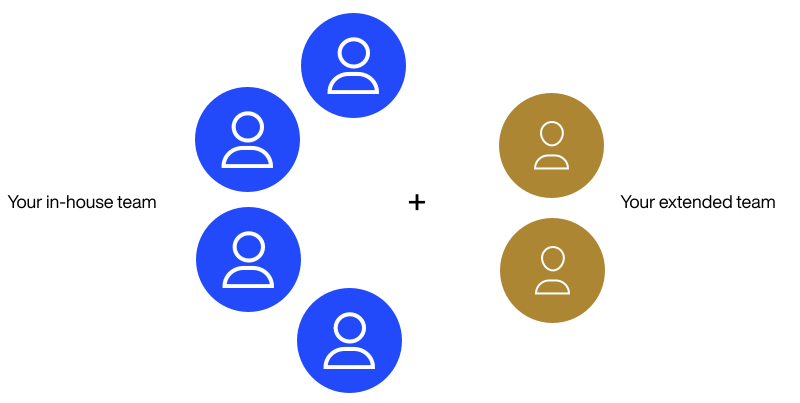
In-house development, like the name suggests, is when your internal development team builds and maintains your software.
Here’s a quick comparison between the two:
In-house vs. outsourcing software development: overview
Hiring model
Price
Development time
Expertise
Experience
In-house
Higher due to salaries, benefits, and infrastructure costs
Can take longer because of internal resource constraints
Limited to the expertise of your current team, but offers better domain knowledge
Deep understanding of your culture and processes
Outsourcing
Lower due to reduced overhead and lower labor costs
Usually shorter, because the team can start work immediately and is easier to scale
Experience working on a variety of projects across different industries
Depends on the vendor’s experience with similar projects
Outsourced development is more cost-effective and flexible, but it’s also inherently riskier because you have less control over the development process.
On the other hand, keeping development in-house will give you full control but comes with higher costs and is more difficult to scale.
And if your hiring process isn’t top-notch, hiring in-house talent can be just as risky as outsourcing to a low-quality vendor.
Now, let’s compare them in more detail.
In-house vs. outsourcing development: key differences
Here, we’ll analyze how in-house and outsourced development stack up across key categories.
Cost
We’ll start with the most important factor – cost.
Here, outsourcing is the clear winner.
In fact, lower costs are the main reasons why companies outsource development – according to a Deloitte survey, 70% of business leaders named cost as the main reason they outsource.
But, what’s the actual difference in cost between in-house and outsourced development? And why is outsourcing cheaper?
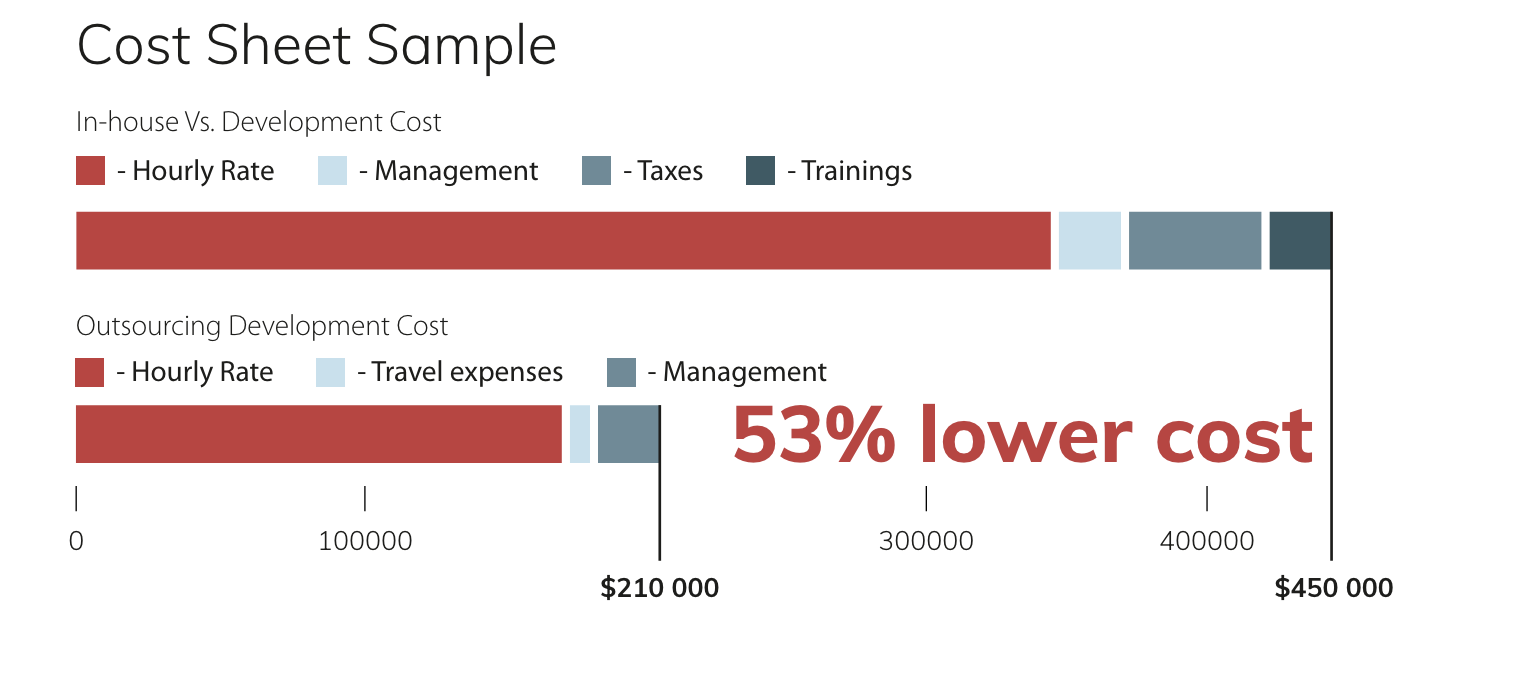
Existek ran a study and found that outsourcing development can cut costs by up to 53%:
Now, multiply that across the entire development team – that’s a lot of money, right?
But, when you outsource, especially to a region with lower labor costs, you won’t spend nearly as much on development.
Winner: Outsourcing
Control and quality
Great software quality should be non-negotiable.
In fact, it’s an absolute necessity – poor software quality costs U.S. companies $2.42 trillion every year.
Now, we’ve all heard the outsourcing horror stories – broken deadlines, buggy code that barely works, poor communication derailing projects, to name just a few.
But, with in-house development, you’refully in charge and you can set up your processes based on industry best practices and your specific needs.
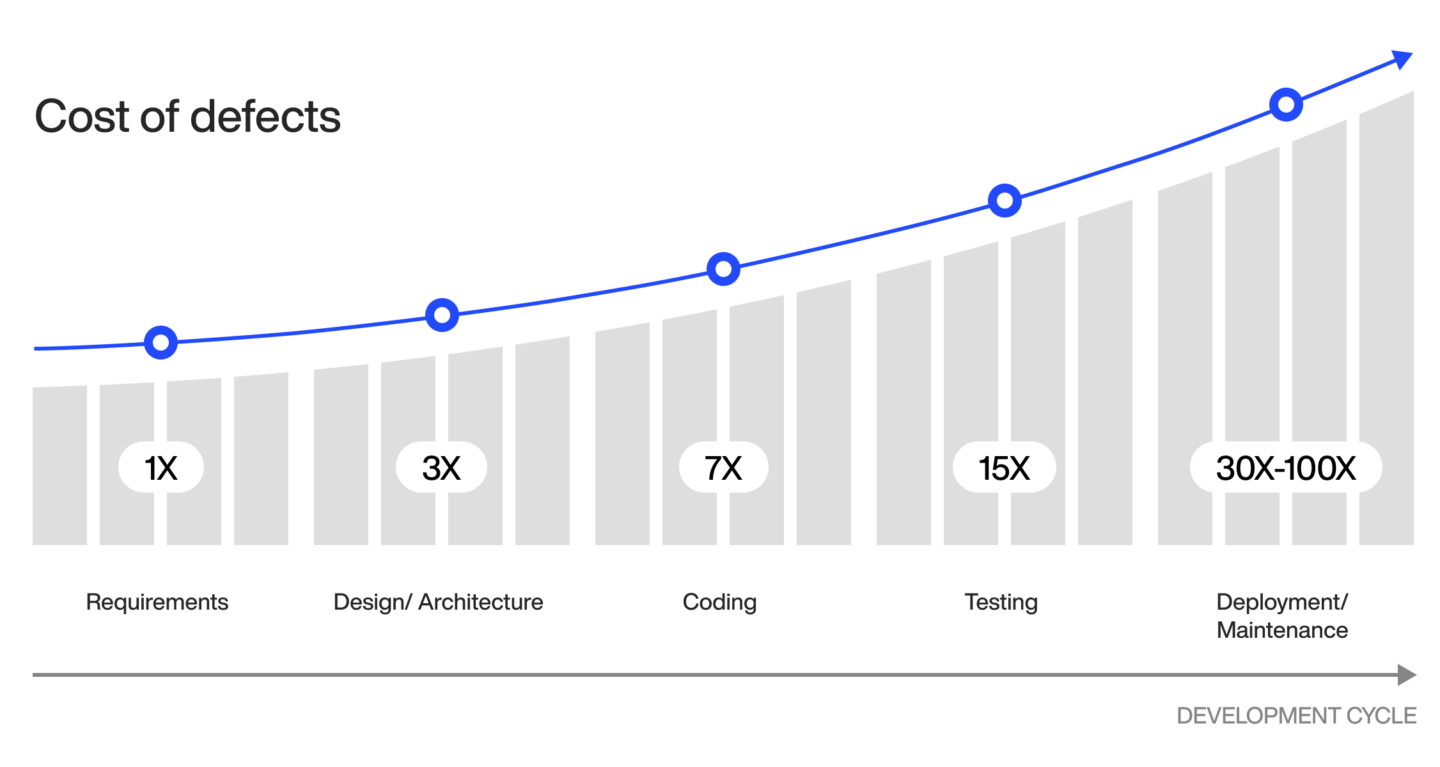
A great example is integrating QA engineers from the start of development. That’s because the sooner you find bugs or defects, the cheaper they are to fix:
Fixing bugs after deployment can be up to 100x more expensive than fixing them at the start of development. And with in-house development, integrating QA from the start is much easier.
But, they’re not your employees so you’ll naturally have less control over the development process.
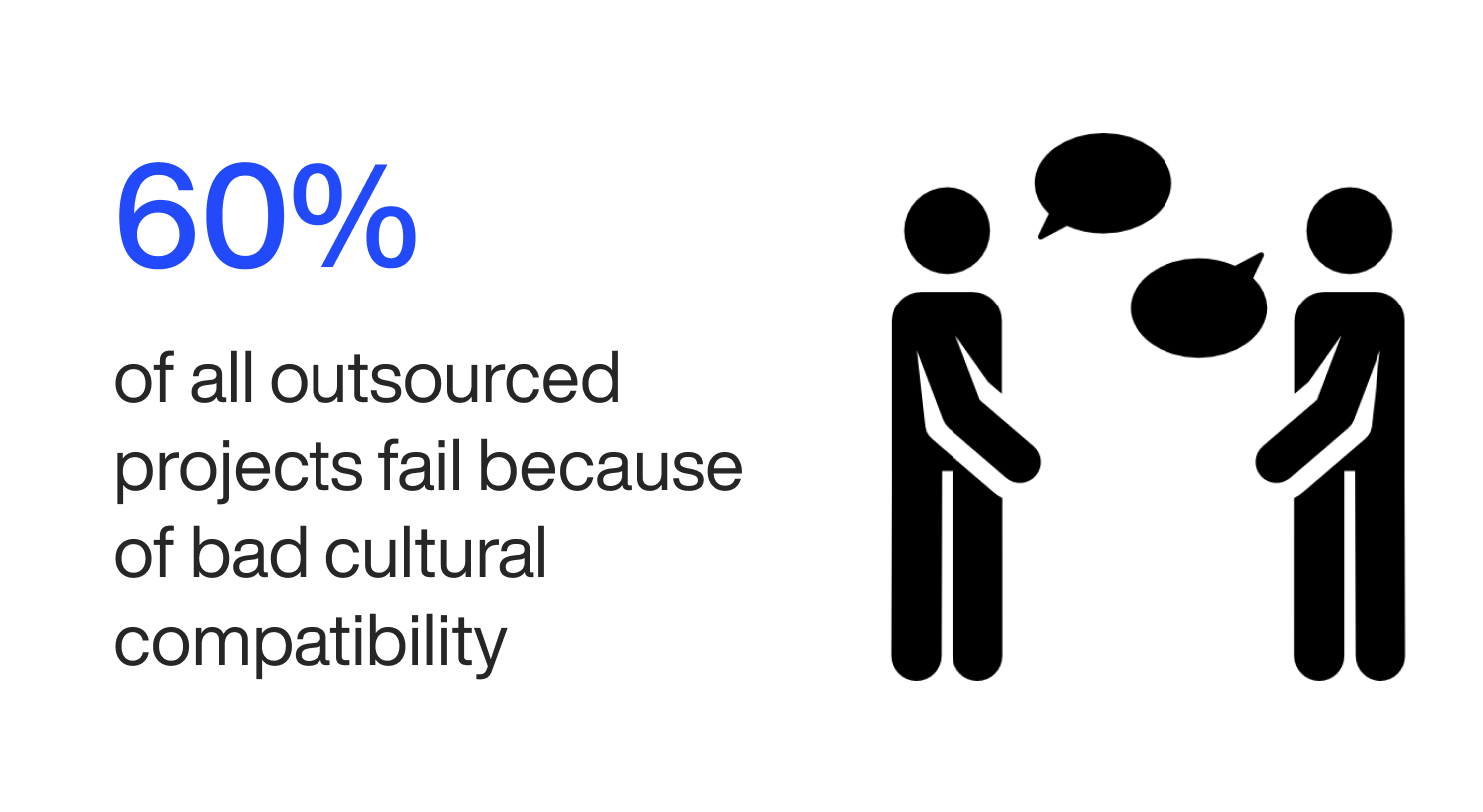
Also, there’s another important quality factor that’s often overlooked – culture and cultural compatibility. Poor cultural compatibility is one of the main reasons why outsourced projects fail:
For example, big cultural differences can create misunderstandings and delays which slow down development – and that’s a major quality risk.
But, with in-house development, you shape the culture of your team and how they approach development.
And that’s a great way to ensure high quality.
Winner: In-house development
Scalability and flexibility
Two other hugely important factors you need to consider when choosing between in-house and outsourced development are scalability and flexibility.
And here, outsourcing has the upper hand.
Hiring an in-house team takes a lot of time and resources – it takes an average of 35 days to find and hire a software engineer.
That’s just the average – if you’re looking for engineers with specialized skills, it can take a lot longer.
But, if you outsource development, you can have a ready-made team start development in a matter of weeks.
And outsourcing is much more flexible, too. Let’s say you just need a few experts with specialized skills – hiring them is a much simpler process when you outsource.
Another good example is if you’re a big enterprise and want to build an MVP for a new pilot project.
You can hire a small dedicated team to start and if your MVP gains traction in the market, you can easily expand the team to meet the new demand.
And if it doesn’t hit the mark, you simply scale down your commitment to the vendor and that’s it.
With an in-house team, this is much harder – you would need to hire and then lay off staff members, which carries a huge reputational risk.
Not to mention that it’s costlier and more time-consuming.
And that’s why if you’re not sure about future needs, you should outsource development.
Winner: Outsourcing
Talent pool
One of the biggest challenges you likely face is finding the right talent to hire.
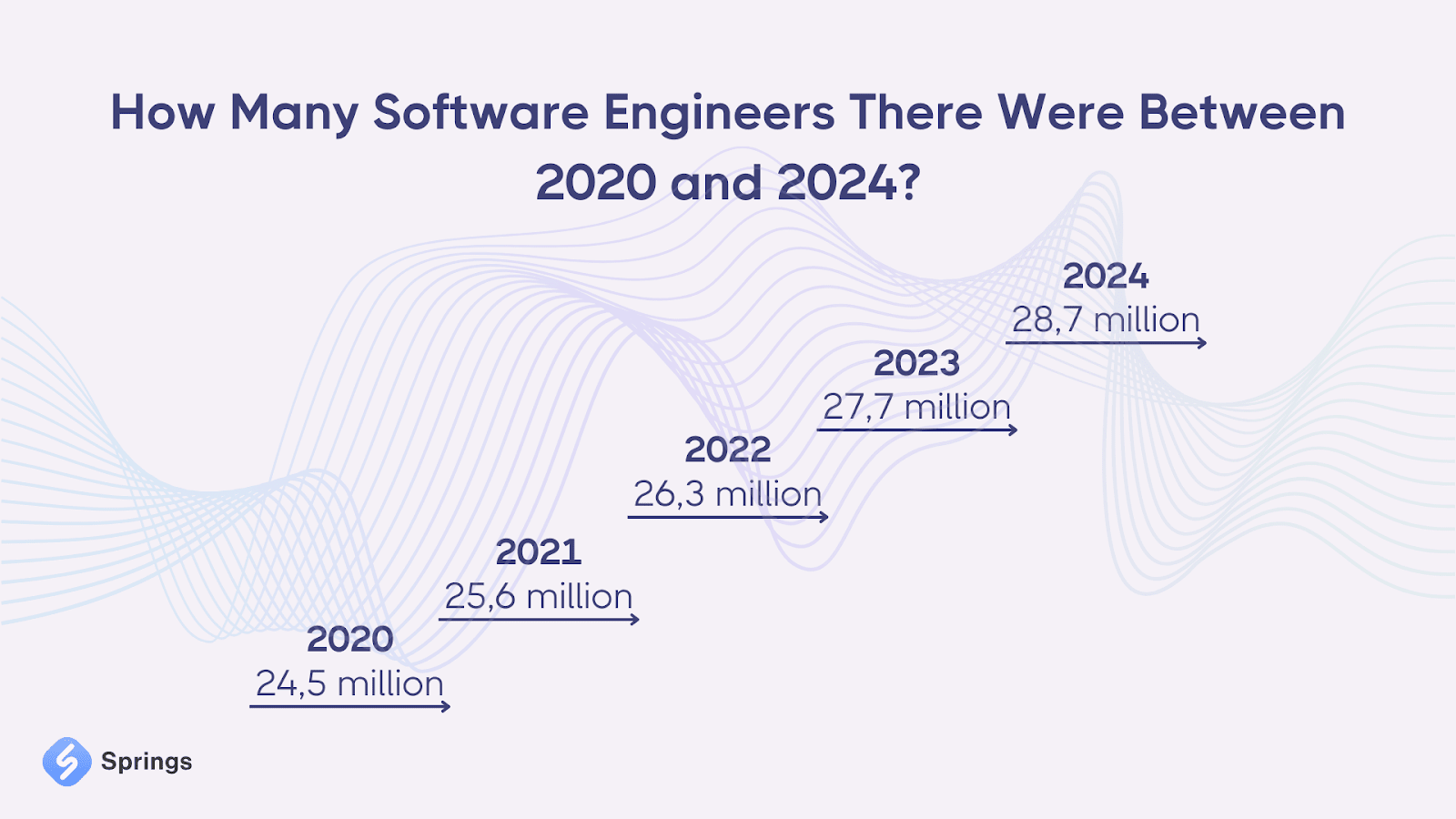
That’s no surprise – the IT skills gapis only getting bigger and it’s showing no signs of slowing down.
The stats prove it, too – 53% of companies struggle to recruit software developers because they lack the skills they need.
And when you hire in-house, you’re limited by geography and the talent in your local area.
But, when you outsource development, you can get access to a massive global talent pool.
They’ll be cheaper to hire, too, like we’ve discussed previously.
And you can’t beat that.
Winner: Outsourcing
When should you outsource software development?
Now we come to the big question – when exactly should you outsource development?
While it does come with a lot of benefits, it isn’t always the right fit.
So, here’s when outsourcing is the right choice:
You have budget constraints – if you’re on a tight budget, outsourcing development will help you save a lot of money and reduce your development costs
You need access to specialized talent – if you need talent with specialized skills and niche expertise, outsourcing development will help you find and hire them much more easily
You need to speed up development – if you need to get your product on the market quickly, outsourcing its development is your best bet
You need to quickly scale your team – outsourcing is the quickest and cheapest way to quickly scale your development team to meet new demand
You’re facing a shortage of local talent – if you can’t find the talent you need in your local area, outsourcing gives you access to a global talent pool
In a nutshell, you should outsource development if you have a limited budget and you can’t find the right talent in your local area.
When should you choose in-house software development?
In-house development, while pricier and less flexible, still has its advantages over outsourcing software development.
Here’s when you should keep development in-house:
You’re working on a mission-critical project – if your project is key to your business operations or involves sensitive, proprietary data, in-house development is less risky
You need full control over development – if you need full oversight over every step of the development process, from planning to execution, you should keep development in-house
You need immediate support – if your project needs constant iteration and immediate support, an internal development team will be able to respond faster
You want a team that knows your business – if you want to build a team that has deep knowledge of your product and business processes, in-house development is the way to go
You want stronger internal collaboration – if you need feedback and strong collaboration with internal stakeholders, an in-house team is the better choice
In short, in-house development is the better fit for long-term, mission-critical projects you need full control over, like projects that involve a lot of sensitive information about your business or users.
And it’s also the better choice if you need a team with deep knowledge of your processes and you want better internal collaboration between developers and other stakeholders.
Pros and cons of in-house software development
Pros
Full control over development
Cultural fit
Better communication
Deep knowledge of company processes
Cons
High upfront and ongoing costs
Difficult to scale
Risk of talent shortages
In-house vs outsourcing software development: FAQs
Yes, you can maintain quality if you outsource development, as long as you choose the right partner and clearly communicate your requirements and expectations to potential partners.
Also, you need to have clear quality standards and communication protocols in place to find the right outsourcing partner.
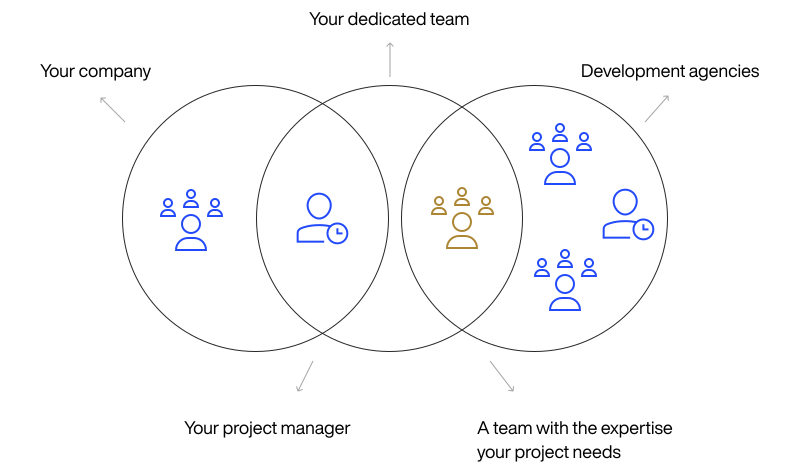
Of course, you can combine in-house and outsourced development, depending on your specific needs.
For example, you can outsource non-core and specialized tasks while your in-house team handles mission-critical parts of the project.
In fact, a hybrid model like that is the best of both worlds – you save money on development without sacrificing quality.
But, you need to make sure the company you choose can work well with your in-house team. Ask them if they have experience collaborating closely with clients’ in-house teams and how they handle working with them.
To pick the right software development outsourcing company, you need to:
Review their portfolio and expertise
Evaluate their tech stack
Check their reviews
Look into their pricing
Also, you should pay attention to:
Cultural and language compatibility
Their quality and expertise
Security and IP protection
If you go with outsourcing, you need to choose the right partner
Outsourcing development can be one of the most important strategic decisions you can make for your business.
But, to get it right, you need to choose the right development partner – and that’s easier said than done.
You need to make sure the company you hire can successfully handle development from start to finish and deliver a high-quality product.
Luckily, you’re in the right place.
We’re a high-caliber, full service software development company and we pride ourselves on fast delivery and rigorous QA standards.
If you want to learn more, feel free to contact us and our team will be happy to set up a quick call at your convenience.
A seasoned software engineering executive, Marin’s role combines his in-depth understanding of software engineering processes (particularly mobile) with product and business strategies. Humbly boasting 20+ years of international experience at the forefront of telecoms, Marin knows how to create and deliver state of the art software products to businesses of all sizes. Plus, his skills as a lifelong basketball player mean he can lead a team to victory.
When he’s not hopping from meeting to meeting, you’ll find Marin listening to indie rock, or scouring the latest IT news.
In this article, we'll discuss everything you need to know about outsourcing software development as a startup - the different types of outsourcing, its benefits, and how to pick the right development partner.