Writing the code for a new software product has never been cheaper. AI-assisted and no-code tools saw to that.
The hard part of minimum viable product (MVP) development in 2026 isn’t the code. It’s deciding what to measure and what you won’t build.
I’ve made those calls from both sides of the table. DECODE started out helping startups turn ideas into software. In 2014, Petar and I temporarily moved to London to work on-site with one of those startups.
Later, we built our own product, Shake, which now has 26M SDK installs. So I know how an MVP feels when it’s your own money on the line.
You might be a founder about to spend your first round. You might be a CTO who has to prove a new product before the board funds it.
Either way, this guide gives you a plain definition, a six-step build process, realistic cost and timeline ranges, and what to do once the data comes in.
Key takeaways
MVP development means building the smallest working version of a product that real users will rely on, so you can test your riskiest assumption before investing in development.
Once the data says keep going, the next milestone is finding true product-market fit.
AI-assisted and no-code tools made MVP code cheap. That makes scope discipline more important than ever. Every extra feature now feels free and dilutes the signal you need.
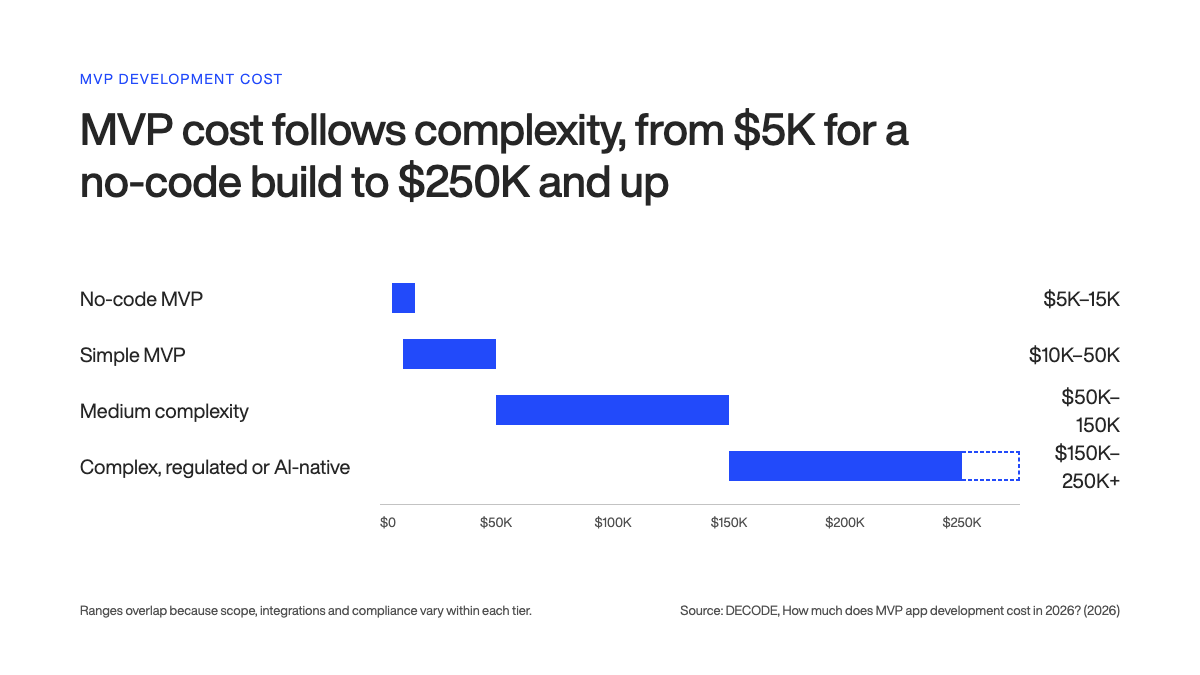
A simple MVP costs $10K–50K, a medium one $50K–150K, and a complex, regulated, or AI-native one $150K–250K+. The build typically takes six to eight weeks.
MVP development is the process of building the smallest working version of a product that real users will use, so you can test your riskiest assumption before committing the full budget.
You launch it to a defined group, measure what they do, and decide whether to scale, pivot, or stop.
The word “minimum” gets most of the attention. I’d put more weight on “viable.” If people can’t use the product to get a real job done, you won’t learn anything worth the money.
Frank Robinson of SyncDev gets credit for coining the term. SyncDev defines an MVP as “the unique product that maximizes return on risk for both the vendor and the customer.”
Eric Ries made the term popular. His 2009 definition is the one I use with clients: “that version of a new product which allows a team to collect the maximum amount of validated learning about customers with the least effort.”
Both definitions agree on one point: an MVP exists to reduce risk by teaching you something. The features only matter because they make that learning possible.
Key characteristics of a minimum viable product
A real MVP has five traits:
One core job. It solves one problem for one type of user, end to end.
Real users. People outside your company use it, ideally with their own data or money.
Usable quality. It works reliably. Rough edges are fine. Broken flows aren’t.
Measurable from day one. You track activation, retention, and usage from the first login.
A deliberate future. You decide up front whether the code is a throwaway or the foundation of the full product.
If your plan is missing any of these, fix that before you write a line of code.
What an MVP is not
An MVP isn’t a cheap version of the full product. It isn’t phase one of a long spec, and it isn’t an excuse to ship something buggy.
It also isn’t an investor demo that nobody can use. If a user can’t sign up and get value without you in the room, you’ve built a prototype.
MVP vs proof of concept vs prototype: what’s the difference?
A proof of concept (PoC) answers “can we build it?” A prototype answers “will people understand it?” An MVP answers “will people use it and come back?”
They usually come in that order, and you don’t always need all three.
Proof of concept
Prototype
MVP
Purpose
Test technical feasibility
Test the user experience
Test real demand and usage
Audience
Internal team, sometimes investors
Test users and stakeholders
Real users in the market
Fidelity
Rough, often no interface
Clickable, no working backend
Working product with a narrow scope
Typical time
A few days
A week or two
Six to eight weeks
What it proves
The technology works
People understand the flow
People want it enough to return
Our guide to PoC, prototype, and MVP covers when to use each. My rule is simple. Skip the PoC when the technology is proven. Skip the prototype only when the workflow is simple and familiar to your users.
Why build an MVP?
You build an MVP so the market can tell you you’re wrong while being wrong is still cheap.
Every month you build without user data raises the cost of the decision you’ll eventually have to make anyway.
Validating demand before committing the full budget
An MVP tests demand with a fraction of the budget. CB Insights studied 431 shut-down venture-backed startups and found that 43% cited poor product-market fit.
The same report found that 70% ran out of capital. It calls that “almost always the final cause of death, not the root problem.”
I read those numbers together. Running out of money is the symptom. Building something the market didn’t want is the cause, and an MVP is the cheapest test I know for it.
Wasted features make the problem worse. Pendo’s 2019 data found that 80% of features in the average software product are rarely or never used.
You can’t know in advance which features will matter. An MVP lets your users show you.
Raising funding from investors
An MVP gives investors evidence to evaluate.
Seed funding has grown tougher. Carta’s data shows that no seed cohort since Q3 2021 has reached a 30% Series A rate within two years. The best cohort, Q4 2019, hit 32.6%.
In that market, a long feature list impresses nobody. Investors weigh three signals:
Activation: do new users reach the core value quickly?
Retention: do they come back next week and next month?
Willingness to pay: will anyone pay, or commit to paying?
A small product with honest retention data makes a stronger case than a polished one with no data at all. Our guide to MVP development for startups covers the fundraising side in more depth.
Why established companies build MVPs too
Established companies have more to lose from a failed launch, so an MVP gives them the same protection it gives a startup. Their risks just look different:
Existing users who will notice changes and complain.
Brand risk if a half-working product carries the company name.
Compliance rules that apply from the first real user.
Legacy integration with systems that weren’t designed for new products.
Stakeholder sign-off from leaders who want evidence before they fund the full build.
We worked with a US wealth management firm that spent three months in discovery, then built an MVP that replaced more than a dozen tools.
With that many tools to replace, discovery kept the scope honest. You can read more about how enterprises approach MVPs in our dedicated guide.
How do you build an MVP? A step-by-step process
Building an MVP takes six steps. Here’s the short version of how to build a minimum viable product:
1. Run product discovery and define success criteria
2. Prioritize features
3. Choose your build approach
4. Design and build
5. Launch to a defined audience
6. Test, measure, and validate
Steps 1 and 2 decide whether the other four are worth doing. I’d give them more care than any line of code.
Step 1: Run product discovery and define success criteria
Write down how you’ll judge the MVP before anyone builds it.
Product discovery means talking to users, mapping the problem, and testing assumptions until you know which one carries the most risk.
Then put four things on one page:
Metric: the one number that shows the core job works, such as weekly active teams or completed transactions.
Threshold: the value that counts as success, set in advance.
Deadline: the date you’ll check it.
Decision: what you’ll do if you hit it (scale), miss narrowly (pivot), or miss badly (stop).
I insist on the decision line. Without it, teams relabel weak numbers as “promising” and keep funding something the data already rejected.
Discovery length depends on complexity. Our discovery runs up to 4 weeks for simpler products and 5–8 weeks for advanced ones.
The wealth management firm I mentioned needed longer because its MVP had to replace more than a dozen tools.
Pick one core job to be done and cut everything that doesn’t serve it. A job to be done is the outcome a user hires your product for, such as “send an invoice and get paid.”
Here’s three methods that can help you decide:
MoSCoW: sort features into must have, should have, could have, and won’t have. Your MVP ships the musts only.
RICE: score each feature on reach, impact, confidence, and effort, then rank by score.
User story map: lay out the user’s journey from left to right, then draw a line under the thinnest slice that completes it.
I prefer story maps for MVPs because they force you to finish one journey end to end. MoSCoW and RICE work better later, once you have usage data to feed them.
Write the “won’t have” list down and share it with everyone involved. It will save you more arguments than any other document in the project.
Step 3: Choose your build approach: custom, no-code, or AI-assisted
Match the build approach to what you’re testing and what happens to the code afterward.
You have three main options:
No-code: tools like Bubble for simple web apps, or Webflow for landing-page tests. Fastest and cheapest for demand tests and simple workflows. They hit limits quickly with complex logic, integrations, or compliance.
Custom: engineers write the code by hand. Slower to start, but you own everything and can build on it.
AI-assisted: engineers use AI coding tools to build custom software faster. You keep full ownership at a lower cost, as long as experienced people review the output.
Before you pick, decide whether this MVP is a throwaway or a foundation. A throwaway tests demand, and you rebuild if it works. A foundation becomes the first version of the real product.
Either answer is fine. Skipping the decision is what gets expensive.
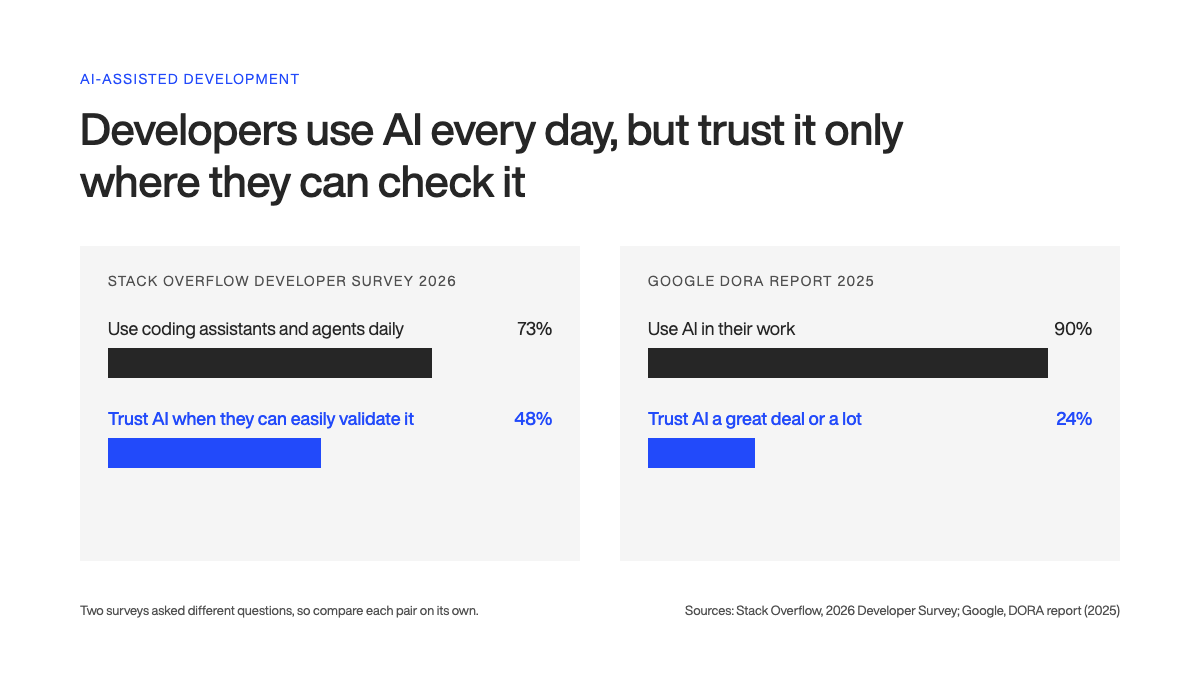
AI changes the math, but developers trust it on their own terms. Stack Overflow’s 2026 survey found that 73% of respondents use coding assistants and agents daily.
Their trust is conditional. 48% trust AI when they can easily validate its answers, and only 16% extend that trust to most tasks that aren’t important work decisions.
It found 90% AI adoption among developers, but only 24% trust AI “a great deal” or “a lot.” The report calls AI “a mirror and a multiplier.” It amplifies good engineering practices and bad ones alike.
The speed gains are also hard to pin down. A METR study in early 2025 found that experienced developers were 19% slower with AI while believing they were 20% faster.
METR’s February 2026 update says developers are likely faster with today’s tools, but calls its evidence for the size of that gain “very weak.”
Here’s my take. When building gets cheaper, adding “just one more feature” feels free. It isn’t, because every feature dilutes the signal you’re trying to read.
If you’re weighing this option, read our guide to using AI to build your MVP. And if you’re still choosing a format, from landing pages to concierge MVPs, see the common types of MVP.
Step 4: Design and build
Spend your engineering care on decisions that are expensive to reverse, and cut corners everywhere else. That split is the biggest quality call in any MVP build.
Get these right from the start:
Data model: how you structure your core entities. Changing it later touches every feature.
Authentication and identity: how users sign in, and how you’ll add single sign-on (SSO) or user roles later.
Multi-tenancy: how multiple customers share one system safely. Adding tenant isolation after launch is painful and risky.
Hosting region and data residency: where your data lives. EU and regulated customers will ask on day one.
Core integration contracts: the interfaces with payment providers, enterprise resource planning (ERP) systems, or internal tools.
These corners are safe to cut:
Admin interfaces: use a database tool or a basic internal page.
Automation: handle some tasks by hand until volume justifies code.
Scaling: build for hundreds of users, and plan for more later.
Polish: keep the design clean and usable, and skip the animations.
I’ve seen this split go wrong in both directions.
Teams that cut a corner on identity or tenancy pay for it twice. Teams that hand-build admin dashboards spend weeks on screens no customer ever sees.
Design still matters for the core flow. A clear interface tells you whether users get the value. A confusing one tells you nothing, because you can’t tell if people left over the idea or the interface.
Step 5: Launch to a defined audience
Launch to a specific group you can reach and measure. That might be a few dozen design partners, one customer segment, or one internal department.
Before launch, check three things:
Your analytics track the metric you defined in step 1.
Users have a direct way to send feedback, such as in-app reporting or a shared channel.
Someone on the team owns talking to users every week.
Mobile app MVPs add steps you don’t fully control: app store review, device testing, and release cycles. For MVP app development, I’d use TestFlight on iOS and Google Play’s closed testing track on Android to reach early users before a public launch.
A cross-platform framework like React Native or Flutter lets one team ship to iOS and Android at once. That’s how we delivered rightvybe, a UK fintech, as a cross-platform MVP in five months.
Step 6: Test, measure, and validate
Compare your results to the thresholds you set in step 1, then make the decision you wrote down. Every earlier step exists so you can make this call with confidence.
You build the smallest thing that tests an assumption, measure what users do, and learn whether to keep going. In agile terms, each loop ends with evidence as well as finished work.
Weigh behavior above opinion. Interviews tell you why users act a certain way. Usage data tells you what they do.
You need both, but when they disagree, I trust the usage data.
Then make the call:
Scale: you hit the threshold. Invest in the next stage.
Pivot: you missed, but users showed you a different need. Change one core assumption and run another loop.
Stop: you missed badly and found no signal. That’s a good outcome, because you spent months instead of years.
The range is wide because cost follows risk. A demand test for a consumer idea and a regulated fintech platform are both MVPs, but they carry very different obligations.
What drives MVP cost
Five key factors determine where your MVP lands in that range:
Cost driver
What pushes cost up
How to keep it in check
Scope
More user roles, flows, and platforms
One core job, one user type
Integrations
Payments, ERPs, legacy systems, third-party APIs
Handle some flows manually where the test allows
Compliance
Healthcare, finance, and data protection rules
Bring compliance into discovery from the start
Team seniority
Higher hourly rates for senior engineers
Fewer rework cycles and better irreversible decisions
Discovery depth
More upfront time and cost
Less wasted build time later
Discovery is the cost founders most want to cut. I’d protect it hardest, because it’s the cheapest place to find out you’re building the wrong thing.
Typical MVP timelines
A typical MVP timeline has two phases:
Scoping or discovery:MVP scoping takes 2–4 weeks. Full product discovery runs up to 4 weeks for simple products and 5–8 weeks for advanced ones.
Build: six to eight weeks on average.
Our standard commitment is a working MVP within three months, and size alone doesn’t slow a project down.
For Norfolk Southern, a Class I US railroad, a team of 20 built a capacity-planning platform in six weeks.
Larger scopes take longer, especially when the MVP replaces existing systems. If someone promises a complex, regulated MVP in two weeks, ask what they’re leaving out.
Should you build your MVP in-house or outsource it?
Build in-house if you already have the right people with free capacity. Bring in an outside team if you don’t, or if hiring would take longer than the build itself.
You have senior engineers who aren’t committed to the core roadmap.
The MVP depends on deep knowledge of your internal systems.
The product is core intellectual property you want your own people to own from day one.
You can staff product, design, engineering, and quality assurance (QA) without new hires.
The catch is capacity. An MVP squeezed between your team’s usual work tends to drag on, and a slow MVP loses much of its learning value.
When an outsourced or dedicated team makes sense
An outsourced or dedicated team works best when:
You need to start in weeks instead of waiting out a hiring cycle.
You lack specific skills, such as mobile, AI, or compliance-heavy backend work.
You want a team that has run the MVP process many times before.
Your internal team needs to stay focused on the existing product.
If you outsource, choose a partner that challenges your scope instead of quoting whatever you send.
Ask how they decide what not to build. Ask who reviews AI-generated code. You can read about our approach to MVP development to see how we answer both questions.
What are the most common MVP development mistakes?
Nearly every MVP mistake I’ve seen comes from forgetting that an MVP exists to learn. Agile Alliance lists several classic MVP pitfalls, and they match what I see in practice:
Treating the MVP as the smallest feature set. Cutting features without a learning goal gives you a small product and no answers.
Confusing learning with earning. An MVP tests assumptions. A marketable product earns revenue. Mixing the two goals weakens both.
Cutting quality too far. If the product breaks, users leave, and you can’t tell whether they rejected the idea or the bugs.
Ignoring feedback. Teams collect the data, then build the original roadmap anyway.
Skipping success criteria. Without a threshold set in advance, every result looks “promising.”
Building too much. Pendo’s feature adoption data is a reminder that users ignore the features they don’t need.
And here are some best practices to follow to avoid these mistakes:
Define your metric, threshold, deadline, and decision before you build.
Pick one core job and one user type.
Protect the decisions that are expensive to reverse, and cut the rest.
Launch early to a defined audience.
Review usage data and talk to users every week.
Decide on throwaway or foundation before the first sprint.
Every item on both lists comes back to scope discipline. With AI making code cheaper, that discipline is now the core skill in MVP development.
What are some examples of successful MVPs?
The best-known MVPs tested demand with very little product. Each team picked the cheapest test that could prove or kill the idea:
Dropbox: Drew Houston posted a demo video showing how the product would work. The beta waitlist went from 5,000 to 75,000 overnight.
Buffer: Joel Gascoigne tested demand with a landing page and a pricing page, then built a minimal product. Buffer got its first paying customer within four days of launch.
Airbnb: the company started as “Airbed & Breakfast,” with two hosts welcoming three guests to their San Francisco home. The first guests arrived in October 2007.
Zappos: the founder photographed shoes in local stores and posted them online. When an order came in, he bought the pair at full price and shipped it.
None of these teams needed a full product to learn the one fact that mattered.
We faced the same question with Shake: what to ship first, and what could wait. You’ll find more MVP examples in our dedicated roundup.
What comes after an MVP?
After a successful MVP, you move from learning to earning, then to growth. Three milestones mark the way.
Minimum marketable product (MMP)
A minimum marketable product is the first version you can sell to a broader market.
The idea grew out of the minimum marketable feature, a concept the book *Software by Numbers* introduced in 2004.
The MMP adds what paying customers expect: billing, onboarding, support, and the reliability work you skipped in the MVP.
Minimum lovable product (MLP)
Brian de Haaff of Aha! describes the minimum lovable product as “what it will take for customers to love you, not tolerate you.”
I find the MLP useful as a check once the core job works. In a crowded market, “usable” won’t win customers on its own.
Reaching product-market fit and scaling the MVP
Marc Andreessen defines product-market fit as “being in a good market with a product that can satisfy that market.”
Sean Ellis offers a practical test. Ask users how they’d feel if they could no longer use your product. If 40% or more say “very disappointed,” you’re close.
Superhuman used that test to move its score from 22% to 58%. That’s the kind of data-led iteration an MVP sets up.
Scaling the MVP is where your step 3 and step 4 decisions pay off.
If you built a foundation and got the irreversible parts right, you extend it. If you built a throwaway, now’s the time to rebuild properly, with real usage data guiding the architecture.
MVP development: FAQ
Yes. No-code works well for demand tests and simple workflows, and a no-code MVP typically costs $5K–15K.
It struggles with complex logic, heavy integrations, compliance, and scale. If you expect the MVP to become your real product, a custom or AI-assisted build gives you a safer foundation.
In 2026, an MVP build typically takes six to eight weeks, after 2–4 weeks of scoping or discovery. No-code MVPs can move faster, while complex or regulated products take longer.
No. A beta is a release stage: the product is close to finished, and testers look for bugs and usability issues. An MVP has a different purpose: testing whether the core idea works at all.
You can release an MVP as a beta, but a beta of a finished product isn’t an MVP.
The right company depends on your product, so judge partners on criteria over rankings. Look for senior engineers, a structured discovery phase, MVP experience in your industry, clear rules for reviewing AI-generated code, and a willingness to cut your scope.
MVP development in 2026 rewards the teams that decide early. Write down your metric, threshold, deadline, and decision before you build. Protect the choices that are expensive to reverse. Then launch to people you can learn from.
AI tools have made development faster and cheaper. The thinking around the build still takes judgment, and that judgment decides whether your MVP teaches you anything.
That’s the part we focus on. Our senior teams run discovery, set success criteria with you, and use AI under close engineering supervision. Each team works on one project at a time, so the people building your MVP stay focused on it.
If you’d like a second opinion on your scope, we’re always happy to talk it through!
Marko started DECODE with co-founders Peter and Mario, and a decade later, leads the company as CEO. His role is now almost entirely centred around business strategy, though his extensive background in software engineering makes sure he sees the future of the company from every angle.
A graduate of the University of Zagreb’s Faculty of Electrical Engineering and Computing, he’s fascinated by the architecture of mobile apps and reactive programming, and a strong believer in life-long learning. Always ready for action. Or an impromptu skiing trip.