When CTOs tell me why they’re looking at outsourcing, it usually comes down to capacity. Their roadmap needs five more senior engineers, and they can’t find them in their local market.
When those teams build a shortlist of outsourcing destinations, Croatia is often missing from it.
I think that’s a mistake, and I’ll declare my bias upfront. I co-founded DECODE in Zagreb with two fellow engineers from the University of Zagreb, and I’ve spent my whole career running a company hiring, mentoring and shipping software with Croatian developers.
So here’s my case for why you should outsource software development to Croatia, built on actual data rather than clichés.
I’ll also tell you where Croatia isn’t the right fit, because that’s just as useful when you’re choosing between onshore, nearshore and offshore options.
Key takeaways
Croatia’s ICT workforce grew by about 42% between 2020 and 2024, to more than 74,000 people, and 90.9% of employed people with an ICT education hold a university degree.
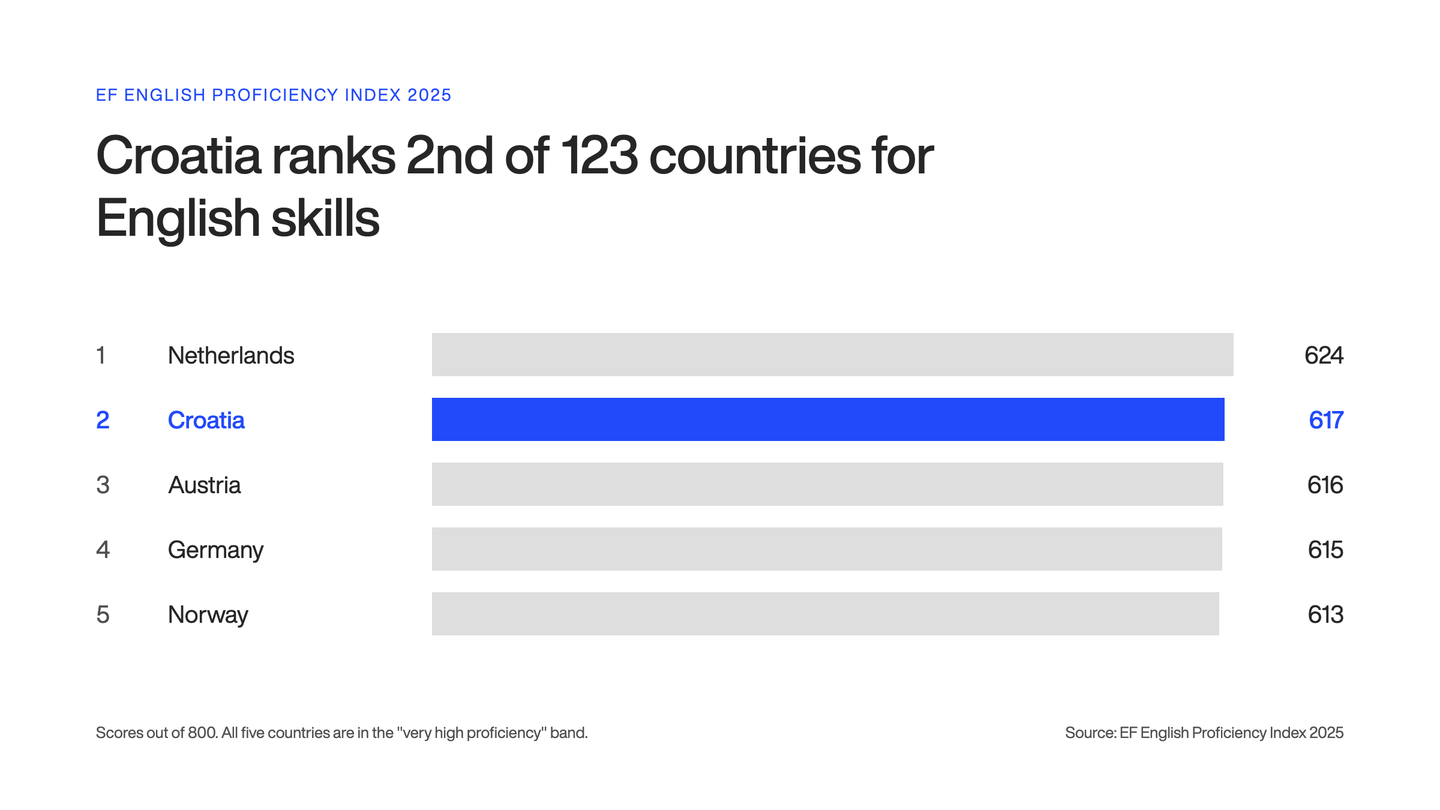
Croatia ranks 2nd of 123 countries in the 2025 EF English Proficiency Index, behind only the Netherlands.
Croatia shares a time zone with Germany, the Benelux, Switzerland and Scandinavia, and has a workable daily overlap with the US East Coast.
Rates are competitive but rising fast, so Croatia makes the most sense when you’re paying for senior output rather than chasing the lowest hourly price.
Croatia’s talent pool is small by European standards, but it’s highly educated and growing quickly. That combination is exactly what you want when you need senior engineers who can own complex work.
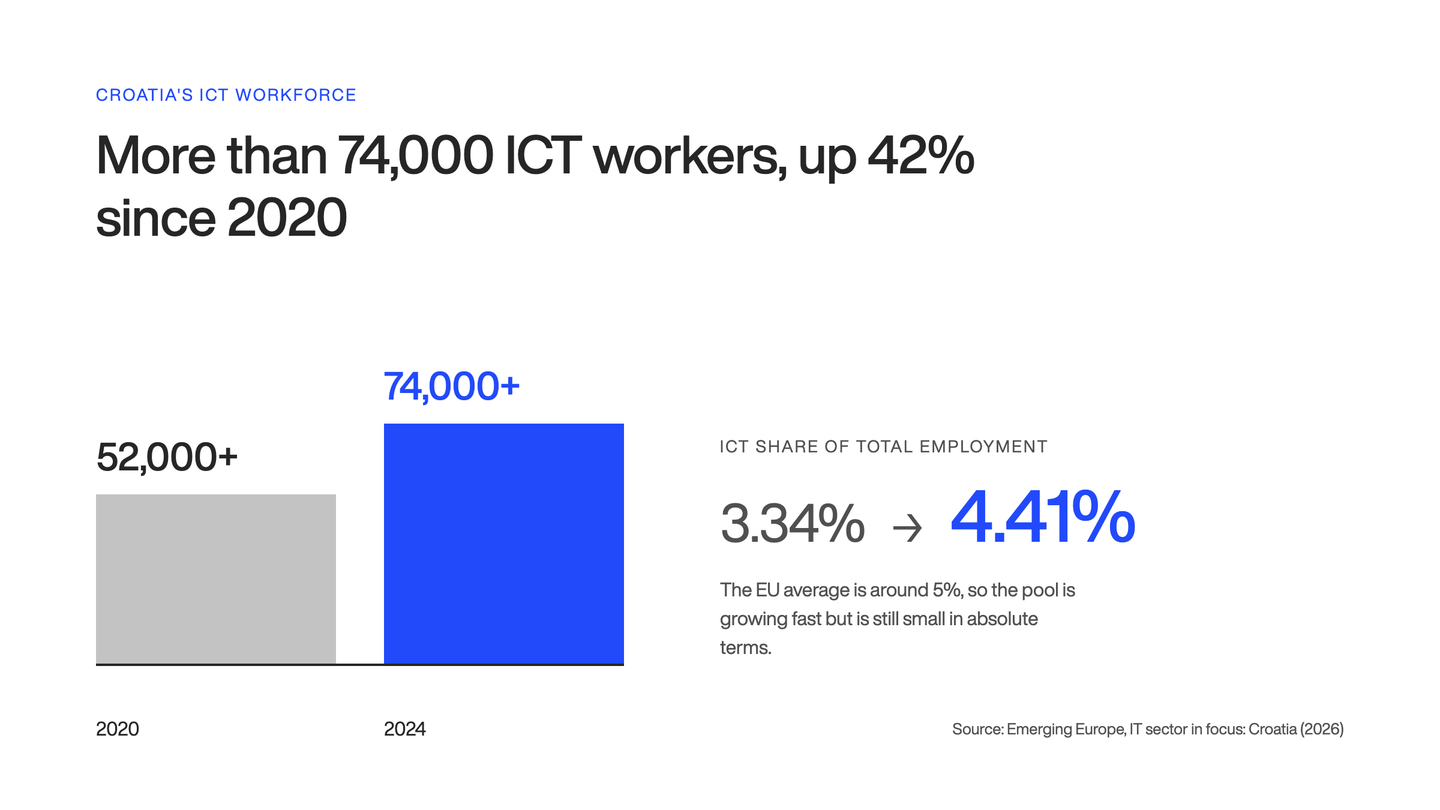
Croatia had more than 74,000 ICT workers in 2024, up from just over 52,000 in 2020. ICT’s share of total employment rose from 3.34% to 4.41% over the same period.
I want to be honest about scale here. The EU average share is around 5%, so Croatia isn’t a place where you’ll hire 300 engineers in a quarter. If you need a massive delivery center, look elsewhere.
What Croatia offers instead is depth. In 2025, 90.9% of employed people with an ICT education in Croatia had a university degree.
The employment rate for ICT-educated people rose by 13.4 percentage points between 2016 and 2025, to 96.4%.
Put simply, if you trained in computing here, you’re working.
Croatian schools push STEM subjects early, and it shows in competitive programming. Croatia has won 114 medals at the IOI (the International Olympiad in Informatics), including 16 golds, which puts it 12th all-time. Among the top 15 countries by total medals, Croatia has the most medals per capita.
Nobody hires based on this criteria, obviously. But when a country of under 4 million people keeps producing teenagers who can solve olympiad problems, the university pipeline behind them is strong.
100+ projects delivered. We’re ready for yours. Let’s talk →
You’ll be talking with our technology experts.
Education gives you raw material. Seniority comes from shipping hard things for years.
At DECODE, we’re a team of 90+ people across Zagreb and Düsseldorf. We hire only the top 1.5% of applicants who go through our recruiting process, and 42% of our engineers hold an M.S. in Computer Science.
My advice: when you evaluate a Croatian partner, ask how many of the engineers on your proposed team have five or more years of production experience. The education numbers are a good start, but the team in front of you is what matters.
Some of the best English skills in the world
Croatia ranks 2nd of 123 countries in the 2025 EF English Proficiency Index (EF EPI), with a score of 617. That’s up from 11th place the year before, and only the Netherlands ranks higher.
I rank this above hourly rates when I think about what makes outsourcing work.
Strong English skills matter most in the uncomfortable moments:
Pushing back on a feature that will create technical debt
Explaining why an estimate just doubled
Flagging a security risk to a stakeholder who isn’t technical
Writing documentation your in-house team can pick up without a translator
Croatian children start learning English in first grade, so by the time engineers reach your standup, they’ve used it for most of their lives.
Croatians are also multilingual beyond English. According to the 2024 Special Eurobarometer, 76% of Croatians can hold a conversation in at least one foreign language, compared to 59% across the EU. And 24% can do it in two.
If you’re based in Germany, Austria or Switzerland, you may find engineers who also speak German. That helps in the informal moments around the work, even when every meeting runs in English.
EU, eurozone and Schengen membership: legal, financial and compliance certainty
Croatia has been an EU member since 2013. It adopted the euro and joined Schengen on 1 January 2023. For clients, that removes a whole category of risk.
If you’re based in the eurozone, you pay in euros. There’s no currency exposure to hedge and no surprise swings between the contract you signed and the invoice you receive.
Your contracts and IP sit under EU law, the same framework your legal team already knows.
An EU-based team builds under GDPR by default. It shapes how we design data flows, logging and access control from day one, instead of becoming a retrofit before launch.
Croatia also transposed the NIS2 cybersecurity directive through its Cybersecurity Act. The EU AI Act is in force too, with its high-risk rules now scheduled to apply from December 2027. If you’re building AI features for European users, a team that follows these rules every day saves you expensive rework.
We’re also ISO 27001 certified, which matters for clients in regulated industries. That said, I’d never tell you a partner’s location replaces your own compliance work. It just means your partner speaks the same language as your compliance team.
If you’re in the UK, the US or Canada, you don’t get the currency benefit. But if you sell into Europe, a team that already builds under GDPR and NIS2 makes your product easier to launch there.
Easy real-time collaboration and travel
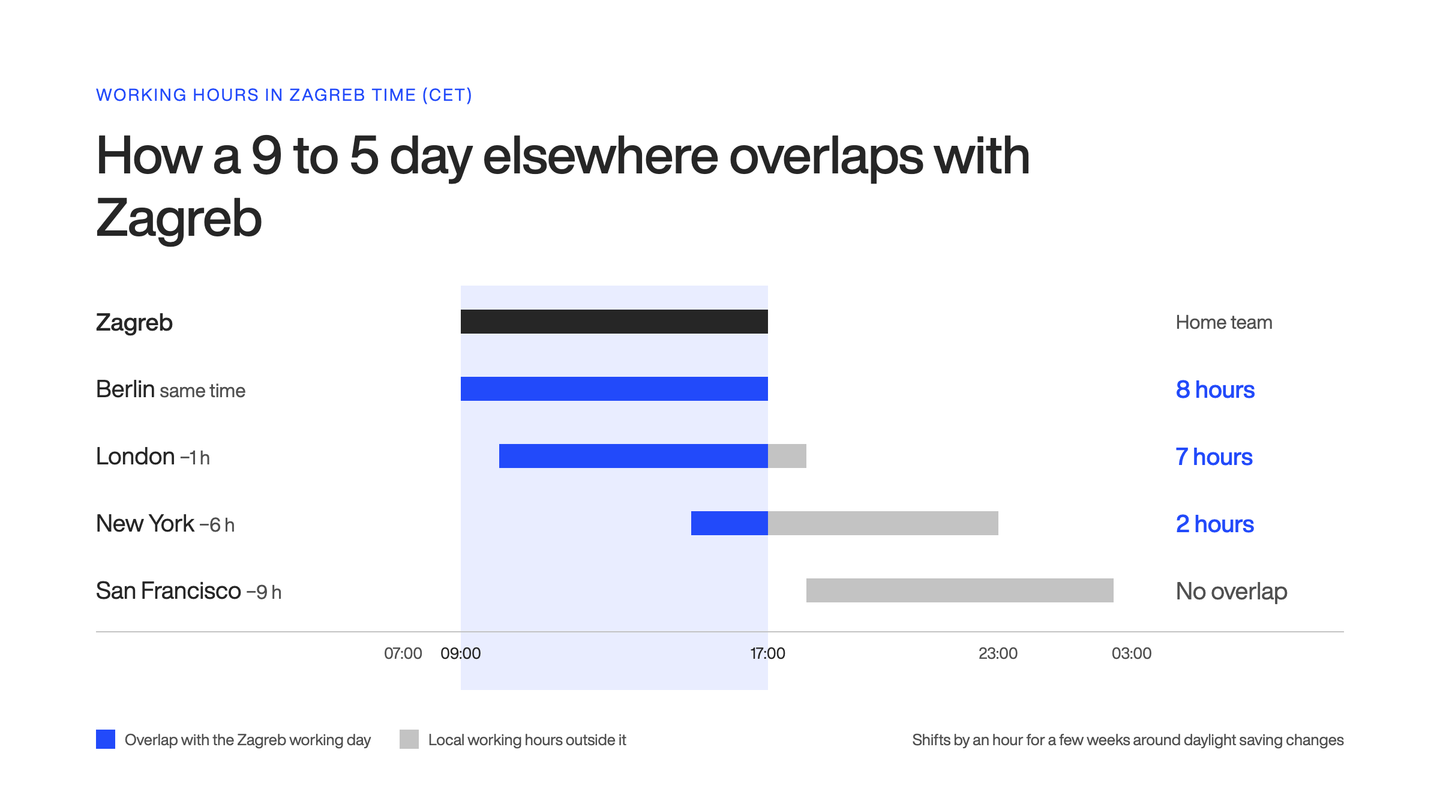
Croatia runs on Central European Time (CET), the same time zone as Germany, Spain, the Benelux, Switzerland and Scandinavia.
The UK, Ireland and Portugal are one hour behind, and Finland, the Baltics and Greece are one hour ahead.
That means a Croatian team is never more than an hour away from any EU capital. Your standup is their standup.
New York and Toronto are six hours behind Croatia (five for a few weeks around daylight saving changes). A 9am start in Boston lands at 3pm in Zagreb, which leaves room for a daily sync and quick questions.
I’ll be direct about the West Coast. San Francisco is nine hours behind, and that overlap is thin. It works with a mature async process, but I won’t pretend it’s the same experience.
Getting here in person is just as easy. Most Western European hubs are a one to two hour flight from Zagreb. Since Croatia joined Schengen, there are no passport checks when you fly in from another Schengen country.
I strongly recommend an in-person kickoff for any long engagement, and Croatia makes that cheap and easy.
It’s also one of the safest countries in the EU. In 2023, only about 1.5% of people reported crime, violence or vandalism in their area, against an EU average of about 10%.
Time zones make collaboration possible. Process makes it work. Our teams run daily standups, weekly check-ins and bi-weekly demos, and you get direct access to the whole team, not just a project manager.
That’s what makes long partnerships last. Our average client collaboration runs 4.5 years.
We’ve worked with Metaswitch for over 9 years, starting by scaling their mobile team from 0 to 21 senior engineers in 45 days. We’ve also delivered for US East Coast clients like Royal Caribbean and Norfolk Southern, across a six-hour gap.
A proven tech ecosystem
Croatia has a track record of building global tech companies, and that matters more than any ranking. Companies that compete globally set the bar for engineering practice, and they train the senior engineers who move on to build more.
A few examples:
Infobip, a cloud communications platform with about 3,500 employees, more than 1,500 of them in Croatia and Bosnia and Herzegovina, earns 53% of its revenue in the US.
Photomath, the math learning app built in Zagreb, was acquired by Google in a deal that closed in 2023.
Nanobit, a mobile game studio, was acquired by Sweden’s Stillfront for up to $148 million.
Rimac Group, the electric hypercar and technology company, is the majority owner of Bugatti Rimac.
Behind these names is a broad base. In 2024, Croatia had 7,278 IT companies (in programming and data processing). Reinvantage’s IT Competitiveness Index places Croatia 12th of 32 countries.
We’re proud to say we’ve contributed to that ecosystem ourselves.
We spun off Shake, our bug reporting tool, into a sister company that now serves clients like Ford and Qantas. Building our own product taught us to think like product engineers, and we look for that mindset in every engineer we hire.
Competitive rates for senior work
Croatia is still more affordable than Western Europe, but I’d push back on anyone selling it as a budget destination. The value comes from senior engineers who need less hand-holding, and that shows up in total cost, not in the hourly rate.
Rate data varies a lot by source. One vendor survey from Cleveroad puts Croatian developers at $37 to $74 per hour, compared to $50 to $99 in Germany and $200 to $300 in Switzerland. Take any single survey as one data point, since agency rates depend heavily on seniority and scope.
Official labor cost data shows the wider picture. In 2025, EU hourly labor costs averaged €34.9, and Germany’s were about €43.3. Croatia sits well below both, but its labor costs rose 11.6% in 2025, the second fastest increase in the EU.
The same trend shows up in tech salaries. Average gross ICT salaries in Croatia reached €2,463 in 2024, 42% higher than in 2020.
If the cheapest possible rate is your main criterion, Croatia probably isn’t your best choice, and I’d rather tell you that now. Wages here are rising, and good partners pay their engineers accordingly.
Where Croatia wins is the total cost of delivery. Here’s what I’d factor in:
Rework: Senior engineers who push back early prevent the expensive fixes later.
Management overhead: Teams that communicate clearly in English need less oversight from your side.
Currency risk: Euro invoicing removes it completely for eurozone clients.
Legal and compliance costs: EU contracts and GDPR by default mean fewer surprises in procurement.
Add those up, and the hourly rate becomes only one line in a much bigger calculation.
For a deeper look at how cost fits into partner selection, our guide to choosing an outsourcing company covers the full picture.
Is Croatia the right outsourcing destination for you?
If you’ve been stuck between a hiring market that can’t keep up and outsourcing options that feel like a gamble, you’re not alone. Many CTOs reach that same point, and what they need is senior engineers who can take ownership without constant supervision.
That’s what we’ve built in Zagreb and Düsseldorf. We hire only the top 1.5% of applicants, and each team works on one project at a time, so the people building your product focus only on your product. We’ve delivered for Microsoft, AT&T, Royal Caribbean and Norfolk Southern.
You can work with us through team extension, where our senior engineers join your existing team, or a dedicated team that takes full ownership of a product or workstream. With build-operate-transfer, we build and run a team in Croatia, then hand it over to you.
Whichever model you choose, you get everything this article describes: educated senior engineers, excellent English, EU legal certainty and a working day that overlaps with yours.
Marko started DECODE with co-founders Peter and Mario, and a decade later, leads the company as CEO. His role is now almost entirely centred around business strategy, though his extensive background in software engineering makes sure he sees the future of the company from every angle.
A graduate of the University of Zagreb’s Faculty of Electrical Engineering and Computing, he’s fascinated by the architecture of mobile apps and reactive programming, and a strong believer in life-long learning. Always ready for action. Or an impromptu skiing trip.
What actually drives software development outsourcing costs? From regional rates to tech stack choices, here are the 7 key cost factors explained for 2026.