What do Slack, Microsoft, Google, and hundreds of other successful tech companies have in common?
They outsource their software development.
Outsourcing isn’t just for companies that want to cut costs, though it’s still an excellent strategy for that.
Partnering with a remote development team can also help you ship products faster, access specialized skills, and scale without the overhead of growing an in-house team.
The global IT outsourcing market reached $588 billion in 2025, which tells you this is no longer a fringe strategy. It’s how most competitive companies build software.
But outsourcing isn’t one-size-fits-all.
There are three distinct models: onshore, nearshore, and offshore. Choosing the right one for your project makes a significant difference to your outcomes, costs, and working experience.
This article explains how each model works, when to use each one, and how to think through the decision for your specific situation.
Key takeaways:
There’s no single best outsourcing model. Onshore works for highly regulated projects and tight in-person collaboration. Nearshore offers the best balance of cost savings and real-time communication. Offshore maximizes cost reduction but requires an async-first workflow and more rigorous planning.
Nearshore gives you most of the offshore cost benefit without the coordination headaches. Central and Eastern European teams typically cost 40-55% less than Western European or US rates, while overlapping time zones and shared business norms make day-to-day collaboration straightforward.
Where your partner is based affects legal and compliance risk too. EU-based nearshore partners operate under GDPR and EU contract law, which gives European buyers clear, enforceable IP protection and consistent data handling obligations from day one.
Onshore outsourcing means hiring a development team within your own country, but not necessarily in the same city.
In larger countries like the US, there may be a few hours of time zone difference, but typically enough schedule overlap that this isn’t a practical problem.
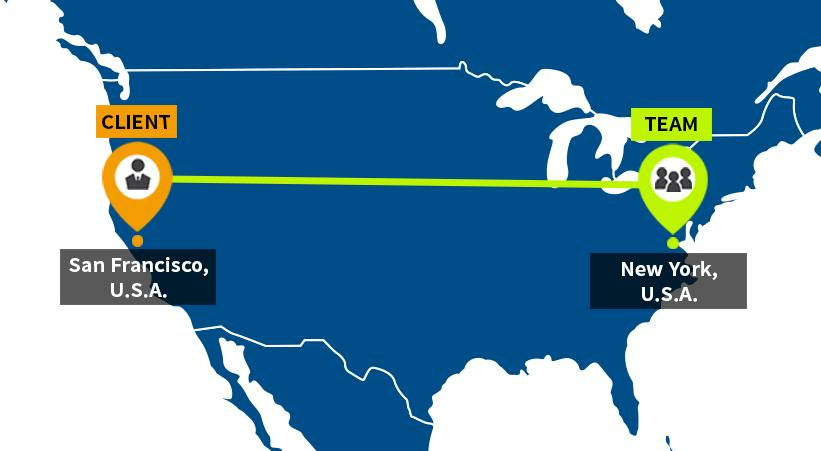
A company in San Francisco hiring a developer based in New York is a straightforward example.
The main advantage of onshoring is easier, faster collaboration.
Because the client and team share the same country, they usually share similar working hours, cultural norms, business customs, and language.
You can request time-sensitive changes in the morning and reasonably expect results by the afternoon. Over time, this means faster iteration cycles and shorter time-to-market.
The main limitation of onshoring is talent access. You’re restricted to your home country’s developer pool, which may not have the specialization you need.
If you’re building a fintech platform in a market without deep fintech engineering talent, onshoring won’t solve that problem.
Costs can also be harder to reduce when your options are geographically limited.
For companies testing outsourcing for the first time, onshoring is a lower-risk entry point.
You get the benefits of an external team without introducing time zone, language, or cultural complexity.
What is offshore outsourcing?
On the opposite side of the outsourcing spectrum, there is offshoring.
Offshore outsourcing means hiring a development team in a country that is geographically distant from your own, typically one in a different region of the world entirely.
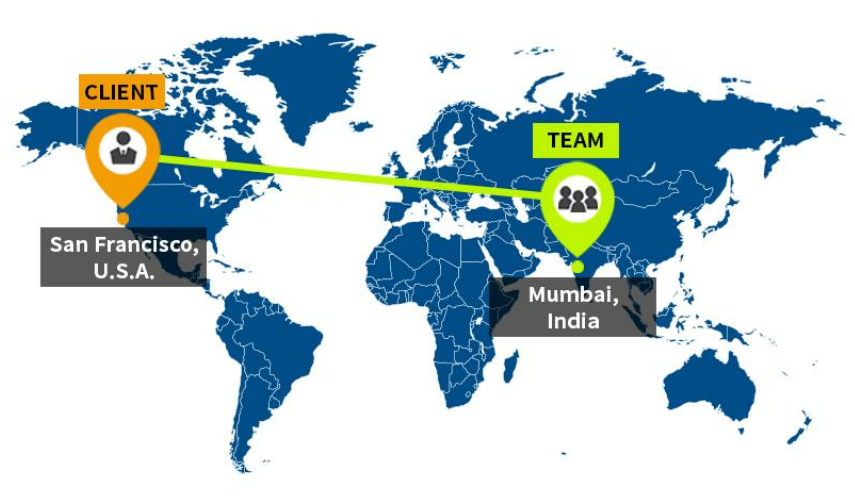
A client in San Francisco, US, hiring a developer from Mumbai, India, is a good example of offshoring.
Offshoring is the most common form of outsourcing, and the one people often think of when they hear the word.
The primary draw is cost.
Software engineers in Central and Eastern Europe typically charge $25–65/hr, while comparable US-based engineers command $100–150/hr.
For companies offshoring to regions like South or Southeast Asia, the savings can be even more pronounced, with engineers in India or Vietnam typically billing at $18–40/hr.
You also gain access to a much broader talent pool. If your product requires a very specific technical background, AI infrastructure, embedded systems, or niche domain expertise, offshoring dramatically expands the field of candidates.
The time zone gap is often cited as a problem, but it can be managed.
Assigning work to an offshore team at the end of your working day means development continues while your local team sleeps.
Done well, this creates a near-continuous development cycle.
That said, real-time coordination is harder across large time zone gaps. Language fluency varies significantly across markets. Legal and IP enforcement can also be weaker in some jurisdictions, which creates risk if your contract isn’t built carefully.
Infrastructure quality is another variable. Some offshore destinations have connectivity or tooling limitations that can slow collaboration and delivery.
What is nearshore outsourcing?
Nearshoring is the middle ground between onshore and offshore outsourcing. Here, you hire a developer in a nearby country.
The time zone between the client and provider must be around three hours or less to be considered nearshoring.
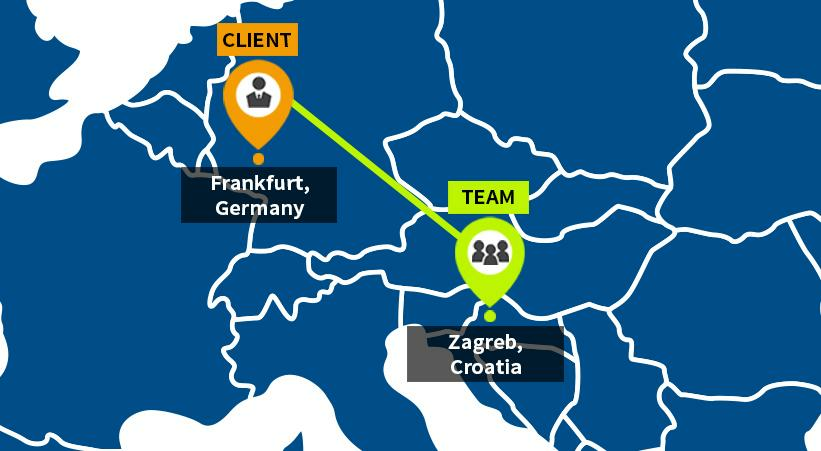
For instance, a German company hiring the DECODE team in Croatia is a great example of nearshoring.
Nearshoring offers the best of both worlds, having the benefits of offshoring and onshoring, without many of the drawbacks.
Neighboring countries often share cultural references, business norms, and sometimes even a working level of each other’s languages. That cuts down on miscommunication and makes onboarding faster.
But proximity only gets you so far.
The right nearshore partner depends on language proficiency, technical talent, legal compatibility, and a shared way of working.
A country can be two hours away and still feel miles apart if those things don’t line up.
For European buyers, Central and Eastern Europe has become the dominant nearshore region, not because it’s cheapest, but because it consistently delivers strong technical quality at 40–55% lower cost than Western European or US rates.
For US buyers, Latin America serves a similar function, with Mexico and Colombia being the most active destinations.
How do onshore, nearshore, and offshore compare?
Now that we’ve covered each model, here’s how they compare across the most important categories.
Cost and developer rates
Offshoring to regions like South or Southeast Asia typically offers the lowest absolute rates.
Nearshoring to Central and Eastern Europe delivers 40–55% savings vs. US rates, based on the same rate differential covered in the offshoring section above.
Onshoring offers the least cost flexibility, since you’re competing within your own local market.
Factor
Onshore
Nearshore
Offshore
Typical cost vs. local rates
At or near parity
40–55% lower
40–70% lower
Time zone overlap
Full
Partial to full
Limited or none
Communication speed
Fast
Fast to moderate
Slower in real time
Talent pool breadth
Limited to home country
Regional
Global
Legal/IP risk
Low
Low to moderate
Moderate to high
Infrastructure quality
High
High
Variable
That said, cost differences aren’t always predictable.
You can find strong developers at competitive rates in your own country, and the best offshore or nearshore firms are not cheap.
How do time zone and communication speed differ?
Onshore teams offer the fastest turnaround on time-sensitive requests.
Nearshore teams in a 1–3 hour offset can cover most of the working day together and still have schedule overlap.
Offshore teams in a 6–12 hour gap work largely asynchronously, which can be productive for well-scoped tasks but makes real-time problem-solving harder.
How does talent pool depth affect your options?
Offshore outsourcing gives you the widest access to niche skills.
Nearshoring limits your pool to a region, but established tech hubs like Poland, Romania, and Croatia produce deep technical talent across most software disciplines.
Onshoring constrains you to your home market.
What legal and IP protections apply?
Onshore outsourcing operates under the same legal jurisdiction as your business, making IP protection, contract enforcement, and data compliance straightforward.
Nearshore partners in the EU operate under GDPR and EU contract law, which provides a strong baseline for data protection and IP enforcement.
Offshore jurisdictions vary considerably, so due diligence on contract law and enforcement is critical before signing.
How does infrastructure quality compare?
Onshore and nearshore partners in developed markets typically offer equivalent infrastructure to your own team: fast, reliable internet and access to the same tooling.
Offshore destinations in developing markets can present connectivity and tooling gaps, though this has improved substantially in recent years.
Which outsourcing model is right for your project?
There’s no single correct answer. The right model depends on your budget, the skills you need, how closely you need to collaborate in real time, and where your company is based.
Answer six quick questions to see which model fits you, then read the details for each one below.
Outsourcing model picker
Onshore, nearshore or offshore: which fits your project?
Answer six quick questions and see which model fits how you work, and why.
Where is your company based?
US or Canada
UK or Ireland
Elsewhere in Europe
Somewhere else
How closely do you need to work with the team day to day?
Very closely: daily standups, live reviews and quick answers
A few shared hours a day is enough
Mostly async is fine
What matters most in this decision?
Keeping costs as low as possible
A balance of cost, quality and collaboration
Skills we can't find locally
Working side by side, in person
How strict are the rules on your data?
Our data must stay in our own country
Strict, but covered by regional rules like GDPR
Standard data protection is enough
Have you outsourced development before?
No, this would be our first time
Yes, we've done it before
How well defined is the work?
Clearly defined, with detailed specs
Mostly defined, but details will change
Still evolving, we'll shape it as we go
A team in a nearby country, usually within three hours of your time zone. You get a big saving on local rates and still share most of your working day.
For a US or Canadian company, nearshore usually means Latin America, for example Mexico, Brazil or Argentina. Developers there typically bill $25-60 an hour.
For a UK company, nearshore usually means Central and Eastern Europe, for example Poland, Romania or the Czech Republic. Developers there typically bill $25-65 an hour.
For a European company, nearshore usually means Central and Eastern Europe, for example Poland, Romania or the Czech Republic. Developers there typically bill $25-65 an hour, under the same EU rules as you.
Look for partners in neighboring countries, ideally no more than three hours from your time zone.
A partner in your own country. You pay local rates, but you get the easiest collaboration, the same laws and the option to meet in person.
In the US, developers at established agencies typically bill $100-150 an hour.
In the UK, developers at established agencies typically bill $100-130 an hour.
In Western Europe, developers at established agencies typically bill $100-160 an hour. In Central and Eastern Europe, local rates are closer to $25-65.
Expect to pay local market rates, which are usually the highest of the three models.
A team in a distant country. You get the biggest cost savings and the widest talent pool, in exchange for less real-time overlap.
For a US or Canadian company, offshore usually means Asia or Europe, for example India, Vietnam or Poland. Developers in India and Vietnam typically bill $18-40 an hour.
For a UK company, offshore usually means Asia or Latin America, for example India, Vietnam or Brazil. Developers in India and Vietnam typically bill $18-40 an hour.
For a European company, offshore usually means Asia or Latin America, for example India, Vietnam or Brazil. Developers in India and Vietnam typically bill $18-40 an hour.
Offshore means a team several time zones away. Plan for async workflows and a few fixed hours of overlap.
Close call. Some companies split the work: for example, a local expert onshore, design nearshore and backend development offshore.
Not sure which model fits? The short version: onshore when you need in-person work or your data must stay in the country, nearshore when you want savings and shared working hours, offshore when cost is the main goal and your team can work async.
A quick orientation based on the decision guide in this article, not a final answer. Rates are average 2026 hourly ranges for software engineers at established agencies. Your answers stay in your browser.
You need frequent in-person collaboration or on-site presence
Your project involves highly regulated data where domestic jurisdiction is mandatory
You’re piloting outsourcing for the first time and want to minimize variables
Your home market has the specialized talent you need at an acceptable cost
When is nearshoring the right fit?
Choose nearshore outsourcing when:
You need meaningful cost savings without sacrificing real-time collaboration
You’re based in Europe or North America and want a team with strong timezone overlap
Legal alignment and data protection standards matter (EU partners for EU buyers)
You want access to deep technical talent without the coordination friction of a large time zone gap
For most mid-market European companies, nearshoring to Central and Eastern Europe typically delivers the right balance of cost, quality, and working alignment.
When does offshoring work?
Offshore outsourcing makes sense when:
Cost reduction is the primary objective
Your workflow can accommodate async-first collaboration
You need very specific skills that aren’t available in your region
Your project is well-scoped enough that real-time coordination is less critical
What about hybrid outsourcing?
Some companies use multiple models simultaneously.
If you’re based in London, you might hire a subject matter expert from the UK (onshore), a design agency in Poland (nearshore), and a backend development team in India (offshore).
This approach lets you optimize each part of the work independently, rather than forcing a single model across everything.
Why should you outsource your app development to Croatia?
Croatia has become one of the more sought-after nearshore destinations in Europe, and the reasons are concrete.
The country’s tech workforce has grown to nearly 70,000 specialists, with employment in the IT sector rising 42% between 2020 and 2024.
Eastern Europe as a region is well-established as a software development hub, where many of the world’s leading tech companies source engineering talent. Croatia sits at the productive end of that spectrum.
Croatia’s ranking in the EF English Proficiency Index 2025 speaks to the ease of working with Croatian teams: the country ranks 2nd in the world, behind only the Netherlands. Communication friction is minimal.
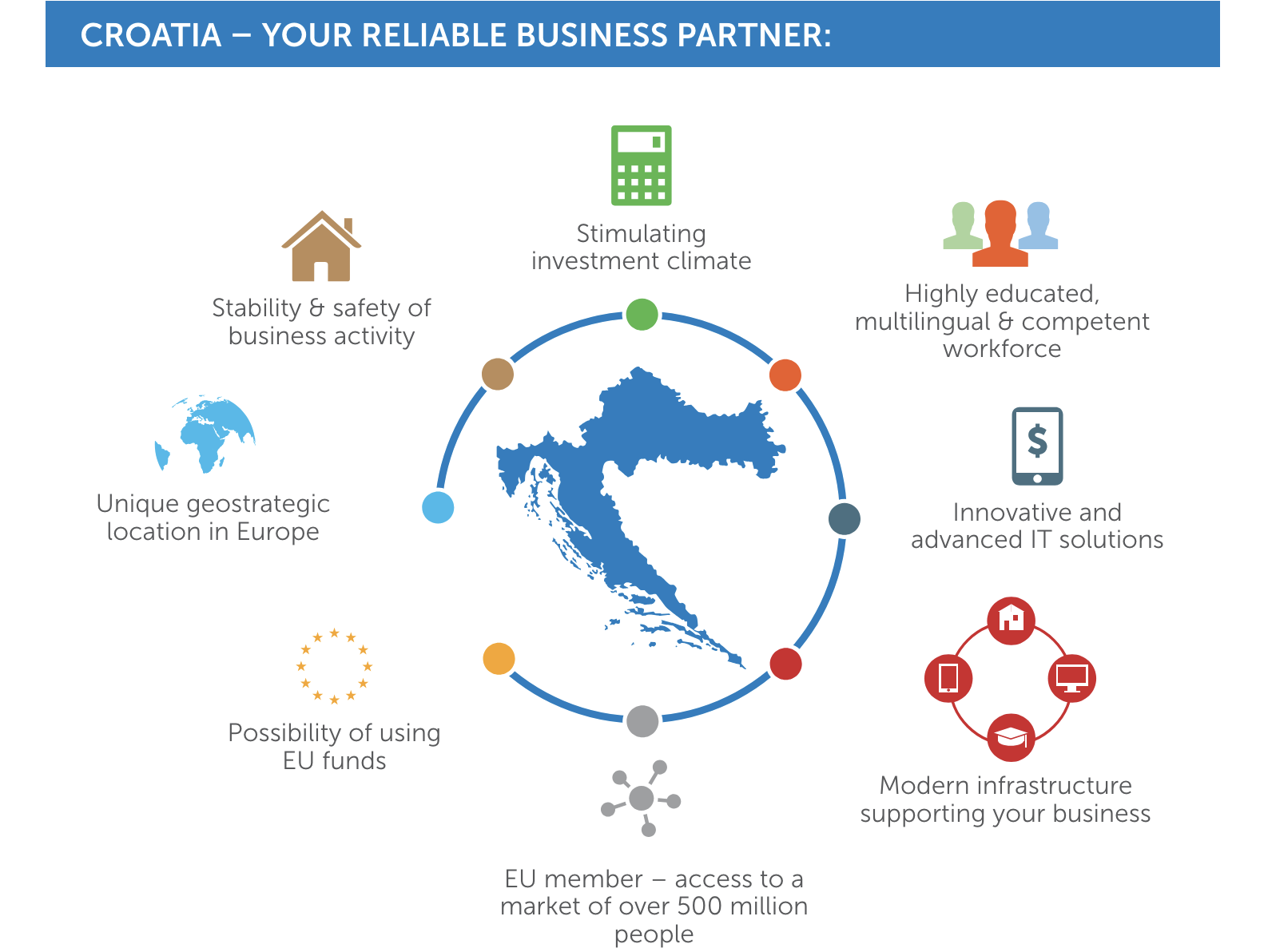
Croatia is a full EU member, which matters for European buyers specifically. EU membership means your outsourcing partner operates under GDPR, EU contract law, and IP frameworks that align with your own.
Data handling obligations are clear, enforceable, and consistent with what your legal team expects.
For CTOs and engineering leaders managing sensitive data or working in regulated industries, this is a meaningful risk reduction compared to non-EU offshore destinations.
Looking for a reliable development partner?
If you’ve done the research on outsourcing models and you’re now evaluating partners, you already know that the model is only part of the decision. Who you work with matters more.
DECODE is an agentic-first software development company based in Zagreb, Croatia, with a team of 90+ engineers.
We work with mid-market product companies across Europe and North America. Our clients include Microsoft, AT&T, Royal Caribbean, and Norfolk Southern.
Our 1-team-1-project policy means your project gets a dedicated team, not engineers split across five accounts.
We’re ISO 27001 certified, based in the EU, and we work inside European data protection and IP frameworks as standard.
If you’re building something complex and you need a team that’s technically strong, well-organized, and easy to work with across time zones, you’re in the right place.
Marko started DECODE with co-founders Peter and Mario, and a decade later, leads the company as CEO. His role is now almost entirely centred around business strategy, though his extensive background in software engineering makes sure he sees the future of the company from every angle.
A graduate of the University of Zagreb’s Faculty of Electrical Engineering and Computing, he’s fascinated by the architecture of mobile apps and reactive programming, and a strong believer in life-long learning. Always ready for action. Or an impromptu skiing trip.