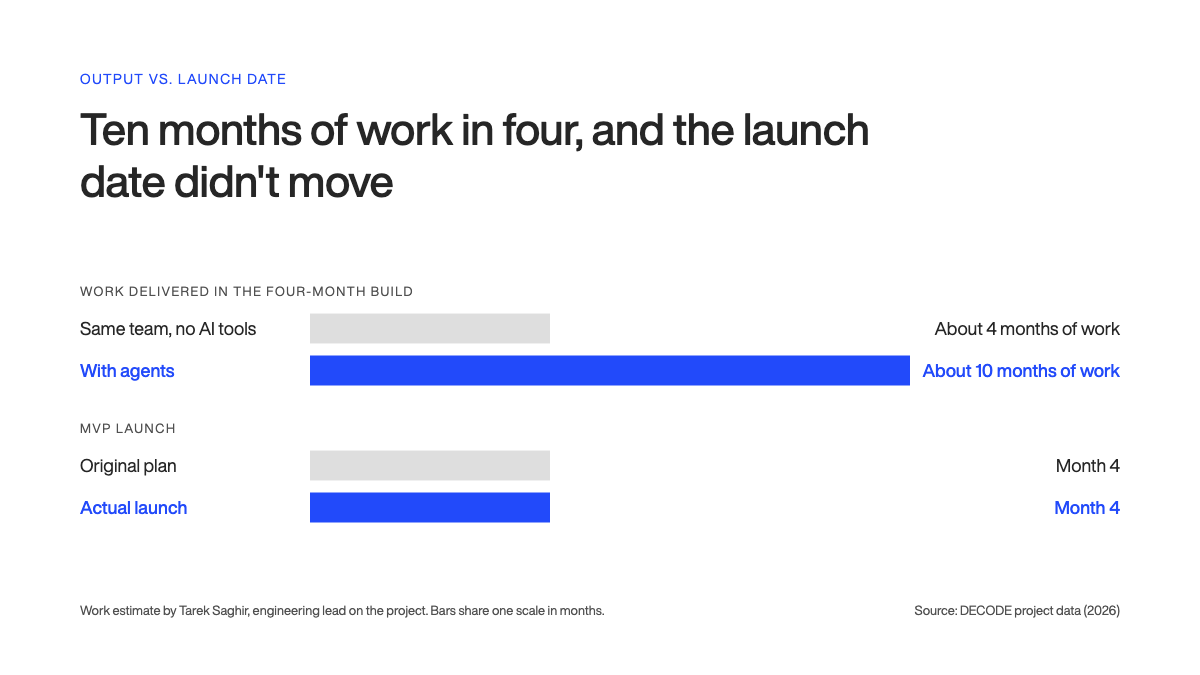
On this project, our team shipped roughly ten months of work in four. The MVP still launched on the date in our original plan.
Both of those statements are true, and the gap between them changed how we build software at DECODE.
The project was an AI concierge app for a European hotel group, built between mid-February and early June 2026.
It was one of our first fully AI-native client projects.
While it ran, a small internal task force was rebuilding our development process around AI agents, and this project is where several of those changes got their first real test.
The outcomes are in the case study. This article covers the decisions behind them.
Key takeaways:
We delivered an AI concierge MVP for a European hotel group in four months, and it reached around 2,500 installs in its first month from in-room QR codes alone.
Tarek, our engineering lead on the project, estimates the same team would have needed about ten months for this scope without AI tools.
A thin gateway over the client’s existing systems let us add AI without replacing their property management, CRM, or knowledge base.
The setup we tested here, from repo rules to a review agent to an onboarding skill, is now the base of how we run new projects.
The client runs hotels, resorts, and camps across several brands.
Their guest data, content, and operations sat in separate systems, and guests reached them through several different channels. That created three problems that impacted their bottom line:
Guests often couldn’t find simple answers on their own, and many wouldn’t call the desk to ask.
Guests already earned loyalty points and got offers by email, but there was no direct way to offer dining, treats, and experiences during a stay.
The client couldn’t see how guests engaged, or tie that engagement back to revenue.
We agreed on three goals: more app downloads, more in-hotel purchases, and a better guest experience.
Then we audited their property management, CRM, operations, and knowledge base systems, and turned the presales estimate into a defined scope with dated milestones.
What we built
The MVP puts everything a guest needs into one app.
That includes an AI concierge, personalized content based on the guest’s reservation, daily in-stay offers, an activities calendar, housekeeping and maintenance requests, a loyalty program, and in-app billing.
The architecture choices matter more for a mid-market reader than the feature list, so I’ll focus there.
A thin gateway over existing systems
The project is a monorepo with three applications: a hybrid mobile app, a Node.js backend gateway, and Payload CMS for content.
The gateway is deliberately thin. It pulls data from the client’s existing systems and stores very little of its own.
This is the decision I’d defend hardest. The client didn’t have to replace anything to get an AI product.
Their systems stayed the source of truth, the app became a new layer on top of them, and the gateway gives them groundwork to modernize those systems later.
For most mid-market companies, that’s often the difference between a project measured in months and a migration measured in years.
An AI concierge built on the call center’s knowledge base
The concierge uses retrieval-augmented generation (RAG).
Before it answers, itlooks up the relevant content in the hotel group’s own knowledge base, stored in PostgreSQL with pgvector.
That knowledge base is the same one the call center uses, and it stays in sync.
Want AI that works with the systems you already have? We’ll build it on top of them. Let’s talk →
You’ll be talking with our technology experts.
We also built an evaluation and prompt-testing loop around it.
I don’t consider an AI feature finished until we can measure how it answers.
A concierge that sounds confident and gives a guest the wrong check-out time would do far more damage than no concierge at all.
How we built it
We were reworking our development process while this project was running, so several of these pieces got their first test here.
Together, they form what we call the project harness: the rules, tools, and agents that shape how AI works inside a codebase.
Project rules that live in the repo
Rule files, coding standards, skills, hooks, agents, and MCP servers, which connect the agent to outside tools, were all versioned with the code.
Every engineer and every coding session got the same setup.
Nothing depended on one person’s local configuration.
A new engineer cloned the repo and started with the same agent setup as everyone else.
A backlog generated with AI
We generated the full backlog through an AI and Jira workflow.
Engineers reviewed and adjusted it, but they didn’t write it ticket by ticket. That freed their time for the decisions that needed it.
Review and testing in every session
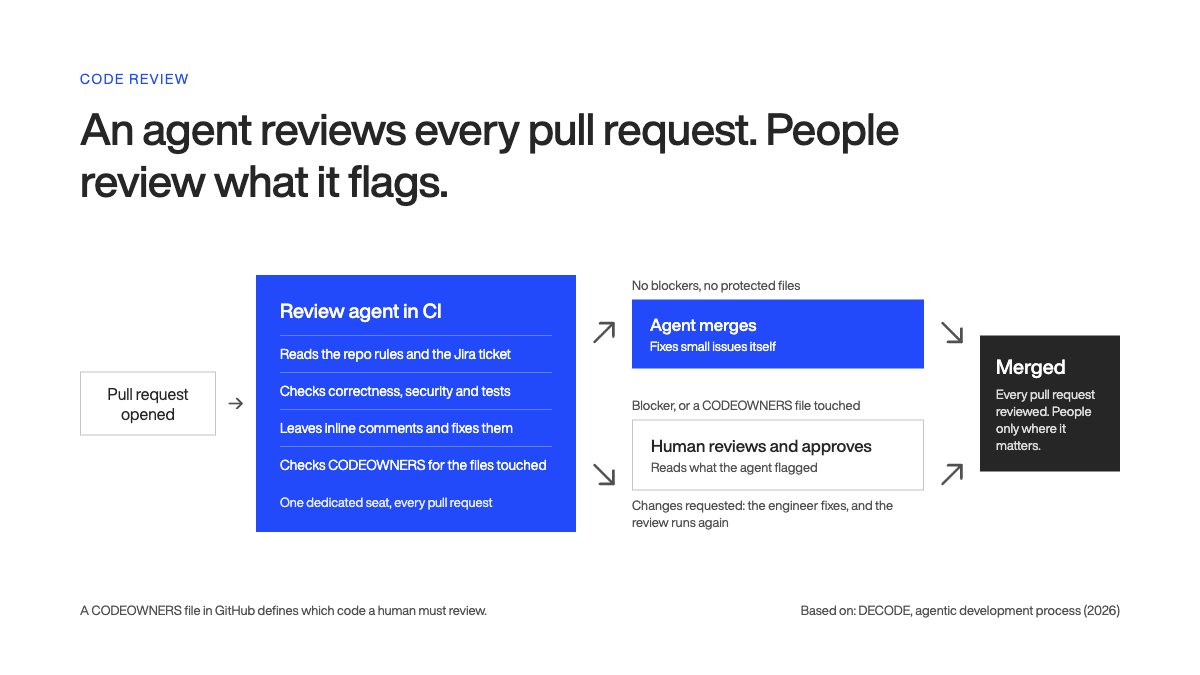
Every pull request went through a review agent.
It read the repo’s conventions and the ticket, reviewed the change, and left inline comments that it then addressed.
A CODEOWNERS file in GitHub defined which parts of the code a human had to review.
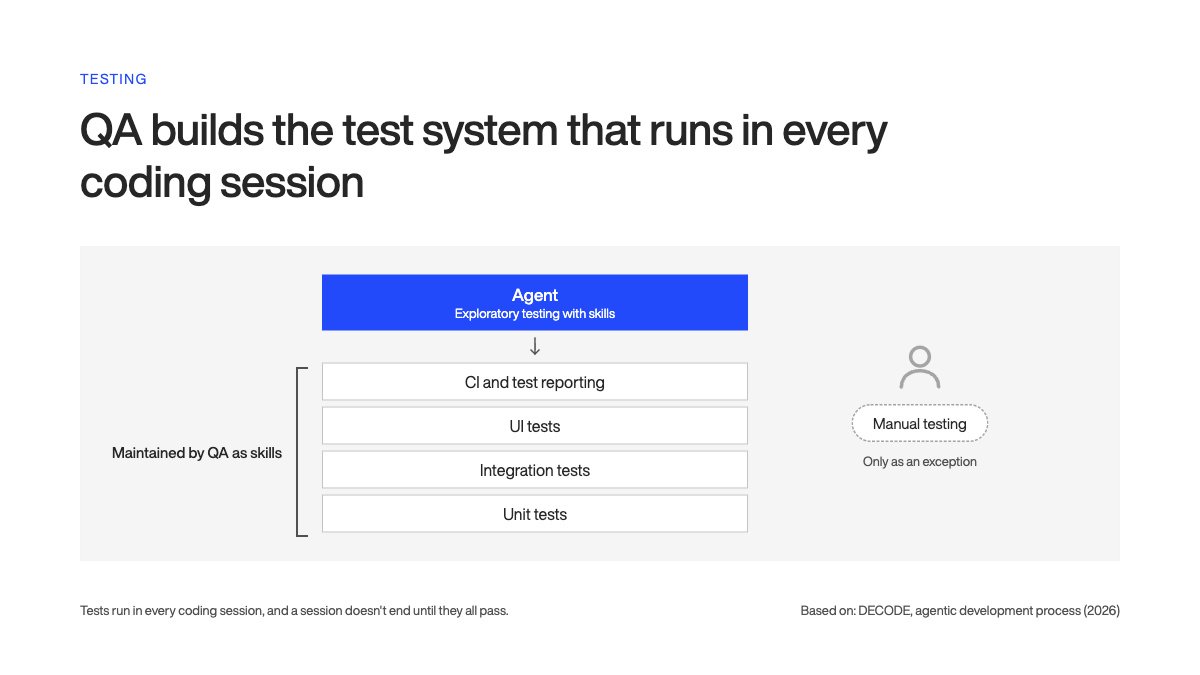
Our three QA engineers maintained skills for unit, integration, and UI tests.
Those tests ran in every coding session, and a session didn’t finish until they passed.
Every feature went through the review agent and QA before release.
Here’s my view on this. AI makes writing code cheap, so review and testing become the expensive part.
If you don’t build them into the process, you just move the bottleneck.
Decisions and docs that keep themselves current
Every important decision, whether a person or an agent made it, became a short architecture decision record (ADR). Each one lists the context, the options, the decision, and the consequences.
The agent read these at the start of each session and wrote a new one when it made a decision itself.
Each coding session also updated the docs and ADRs it touched, and documentation published automatically on every change.
In my experience, this is one of the most effective ways to keep the agent working with the right context.
Onboarding as a skill
A new engineer typed “onboard me.” The skill read the onboarding document in the repo and walked them through it section by section.
It checked their access live, asked a control question after each section, and ended with a summary of what was still open.
New engineers on the project were fully productive within a week.
Most of the questions they’d normally take to colleagues got answered before they even had to ask.
One engineer per feature, end to end
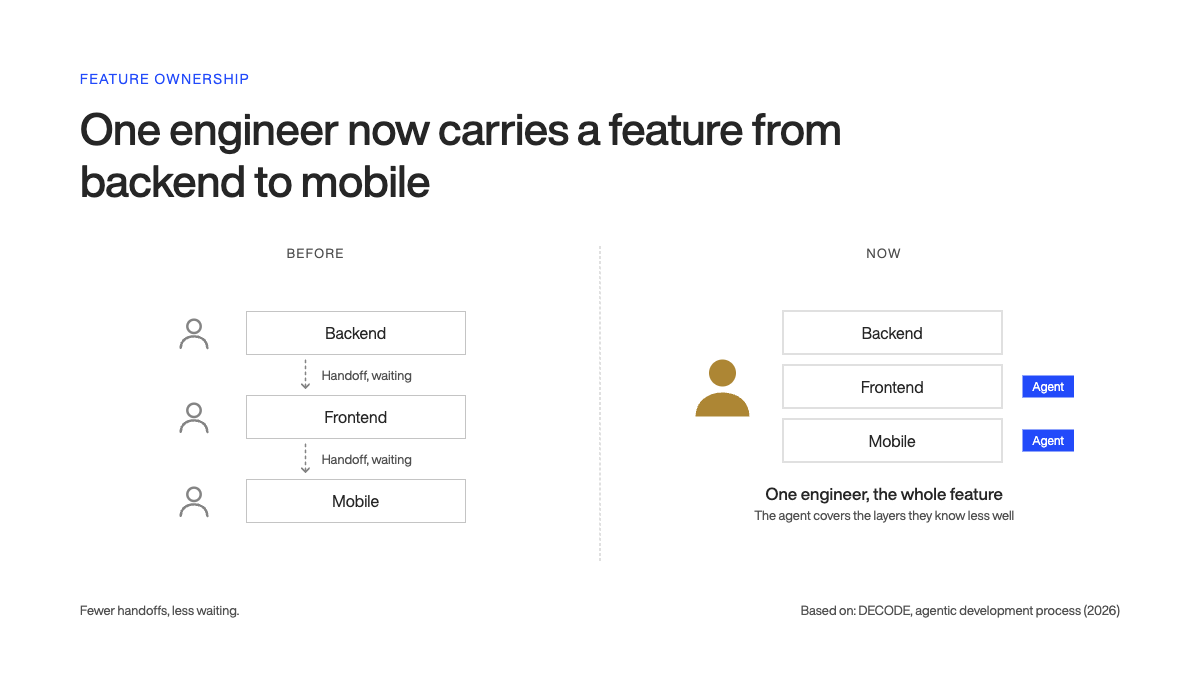
Senior engineers owned each feature from backend through frontend to mobile.
With the harness in the repo and the agent covering the stacks they knew less well, one person could carry a feature the whole way.
That cuts handoffs, and handoffs are where projects lose time. Fewer people passing work between layers means fewer chances to drop it.
Why faster engineers didn’t mean an earlier launch
Tarek’s estimate is the headline number: about ten months of work for this team, done in four. And I stand by it.
The team was far more productive. Quality held up too, since every feature cleared both the review agent and QA.
But the MVP landed on its original date.
The speed showed up as more product inside the same four months. The launch date didn’t move.
The main reason is: The bottlenecks were never in typing code. They sat in design handoffs, review, testing, and context switching. Making coding faster didn’t touch them.
Some of our fixes arrived mid-project, so they helped, but they couldn’t reshape a plan that was already set.
That was the most useful thing this project taught us. Faster engineers give you more capacity. Only a different process turns that capacity into an earlier launch.
How this project changed our process
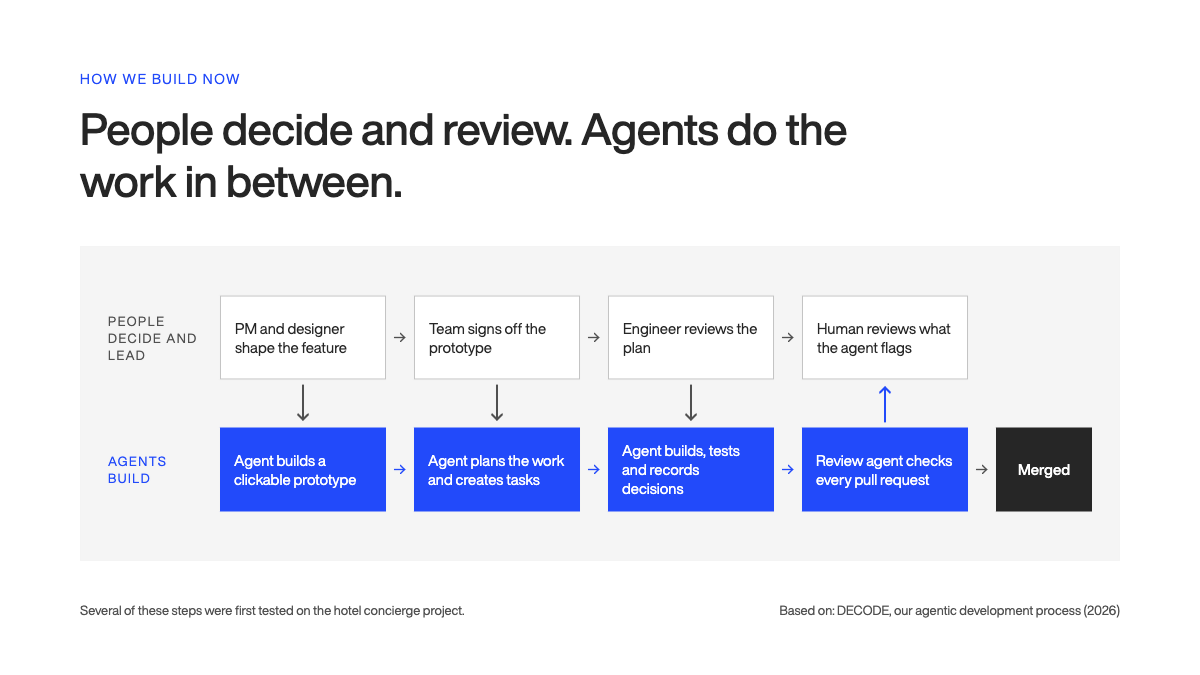
The task force took what we learned here and built a process around agents instead of adding agents to the old one.
People decide and lead. Agents do the work in between, inside rules the repo defines.
Our next project ran that process from day one. I’ll leave its numbers for its own article.
The hardest part wasn’t technical. Our teams had to change habits, and that doesn’t happen overnight.
In my experience, the engineers who are already excited about AI should show the skeptics what works.
But what really makes it stick is a company culture that gives people time to learn and room to share what they find.
We’re now moving the harness from individual repos into a project template and a Claude plugin, so every new project starts with it in place.
What this means if you’re planning an AI build
If you’re a mid-market company weighing a custom AI product, here’s what I’d take from this project:
Ask how the gains reach your schedule. Faster engineers are easy to promise. Ask what changed in planning, review, and testing to make your project finish sooner.
Keep your existing systems. A thin integration layer gets you an AI product without a risky migration. Replace a system only when there’s a business case for it.
Ground the AI in your own content. An AI product built on the same knowledge base your staff already trust stays accurate as that content changes.
Expect measurement from day one. An evaluation loop for AI answers should ship with the product.
None of this requires you to understand agents in depth. It requires a partner who can explain where the speed goes.
AI concierge app development: FAQs
Every pull request goes through a review agent first, and a CODEOWNERS file defines which parts of the code a person must review.
Senior engineers own each feature end to end. On this project, every feature also passed our QA team before release.
Not necessarily. Ours answers from the hotel group’s existing knowledge base, the same one their call center uses, and stays in sync with it.
The answers are only as good as that content, so it’s worth reviewing what’s in it before you build.
The project rules, decision records and documentation live in the repo with the code.
Any new engineer, on our team or yours, starts with the same setup and can use the onboarding skill to learn the project section by section.
Looking for a partner to build your AI product?
If you’re planning an AI product, you’ve probably heard plenty of promises about speed. The harder question is how that speed reaches your launch date, and who’s checking the work along the way.
We’re a senior engineering team that builds with agents every day, inside a process we’ve rebuilt around them.
Our engineers make the decisions, our agents do the heavy lifting, and every change goes through review and testing before it ships.
With us, you’ll get a team that knows where AI saves time and where people still need to be in charge.
Mario makes every project run smoothly. A firm believer that people are DECODE’s most vital resource, he naturally grew into his former role as People Operations Manager. Now, his encyclopaedic knowledge of every DECODEr’s role, and his expertise in all things tech, enables him to guide DECODE's technical vision as CTO to make sure we're always ahead of the curve.
Part engineer, and seemingly part therapist, Mario is always calm under pressure, which helps to maintain the office’s stress-free vibe. In fact, sitting and thinking is his main hobby. What’s more Zen than that?