An AI agent that works in a demo has proven one thing: it can succeed once, on inputs someone picked.
Working in production a harder question. Can it succeed on the thousandth run, with messy data and real permissions, at a cost you can defend?
If you’ve watched a promising agent pilot stall somewhere between the board demo and the first real users, you’re familiar this gap.
I’ve seen it enough times to have a firm view on where it comes from. Weak measurement and thin engineering around the model cause far more failures than the model itself.
That engineering is what agentic AI consulting should cover. Here’s how I define it, and the eight areas I’d expect any serious engagement to handle.
Key takeaways
Agentic AI consulting is hiring outside experts to help you plan, build, and run AI agents, so they work reliably in production.
It usually covers agent or workflow fit, tool design, permissions and decision boundaries, evals, tracing and observability, cost and latency budgets, human escalation, and staged rollout.
It’s a good fit when your agent works in the demo but not with real users, you can’t say how often it gets a task right, costs keep climbing, or you haven’t decided what it may do without approval.
You should come out of it with an agent in production, an eval suite that shows how reliably it performs, and a clear owner after launch.
Agentic AI consulting is hiring outside experts to help you plan, build, and run AI agents that work reliably in production. It covers deciding where agents fit, designing them, testing them, and running them day to day.
It covers agent vs. workflow fit, tool design, permissions, evals, observability, cost and latency budgets, human escalation, and staged rollout.
That goes well beyond strategy or choosing an AI model.
You’ll also see it called AI agent consulting. Either way, it’s narrower and more technical than general AI consulting, which usually covers AI strategy, data readiness, and use-case roadmaps across a business.
Agentic AI consulting starts where that roadmap ends: building the agent and keeping it running in production.
Stuck between AI agent demo and production? Let’s talk →
You’ll be talking with our technology experts.
The term has a second meaning too. Some people use it for consulting firms that run agents internally to speed up their own delivery.
That’s a different topic, and this article is about the first meaning.
So what makes AI “agentic”? An agentic system is goal-directed. It plans multi-step work, calls tools, and acts with limited supervision.
Most agent projects fail because nobody measured the right things before launch. Gartner predicts over 40% of agentic AI projects will be canceled by the end of 2027.
The reasons listed are escalating costs, unclear business value, and inadequate risk controls.
Read those three reasons closely. None of them says the underlying AI model wasn’t smart enough. Each one is a measurement gap.
If you skip a budget cap per task, you’ll watch costs climb. If you never define success, you can’t prove value. If you never test the agent on bad inputs, you have no real risk controls.
Multi-step work makes this worse. Here’s some illustrative math: if an agent gets each step right 95% of the time, a 10-step task succeeds end to end only about 60% of the time. Anthropic warns about exactly this potential for compounding errors.
The tau-bench study showed the same pattern. Leading function-calling agents solved under 50% of tasks, and consistency across eight runs fell below 25% in retail.
Newer models score higher, but one lesson still holds: one successful run tells you very little.
Vague tool names and loose parameters lead to wrong calls and malformed arguments. Treat every tool like a public API: clear names, typed schemas, and error messages the agent can recover from.
Permissions and decision boundaries
Decide up front what the agent can do without asking. Only 21% of organizations have a mature governance model for agentic AI, and decision boundaries are one of the main gaps.
I’d apply least privilege from day one. Keep read and write access separate, and require approval for anything irreversible, like payments, deletions, or outbound emails.
Evals before launch
Evals are the center of the whole framework, and I don’t sign off on a launch without them. An evaluation harness is a set of real tasks with graded outcomes that you run against every change.
Measure pass^k, the chance the agent succeeds on all k attempts at the same task. Report pass^1 and pass^8 side by side. The gap between them tells you how much to trust the agent.
Tracing and observability
You can’t fix what you can’t replay. Tracing records every step: the prompt, the tool call, its arguments, the result, and the token count. Without it, a production failure becomes guesswork.
Carry one trace ID through every tool call and review a sample of traces each week. Then turn every real failure into a new eval case, so the same bug can’t ship twice.
Cost and latency budgets
Agents trade latency and cost for better task performance, so set limits before you build. Define a token cost ceiling per task and a latency target for your slowest users.
On LaviniAI, a real-time voice assistant, we built for sub-800ms responses across multiple LLM providers. Routing each step to the right model keeps you within budget and avoids lock-in.
Human escalation paths
Every agent needs a clear way to hand off to a person. Define the triggers: low confidence, repeated tool failures, or policy-sensitive requests. The handoff should carry the full context, so the human doesn’t start from zero.
Human-in-the-loop design works best when escalation feels routine, and I’d rather see an agent escalate too often early on than guess.
Staged rollout
Never switch an agent on for everyone at once. Start in shadow mode, where the agent processes real inputs but a human makes the final call.
Then move to a canary rollout for a small share of traffic, and widen only when eval scores hold. Keep a feature flag that reverts to the previous version or the manual process in minutes.
Together, these eight areas turn an impressive demo into a system you can operate.
What an agentic AI consulting engagement looks like
A good engagement moves in three stages, and each one earns the next:
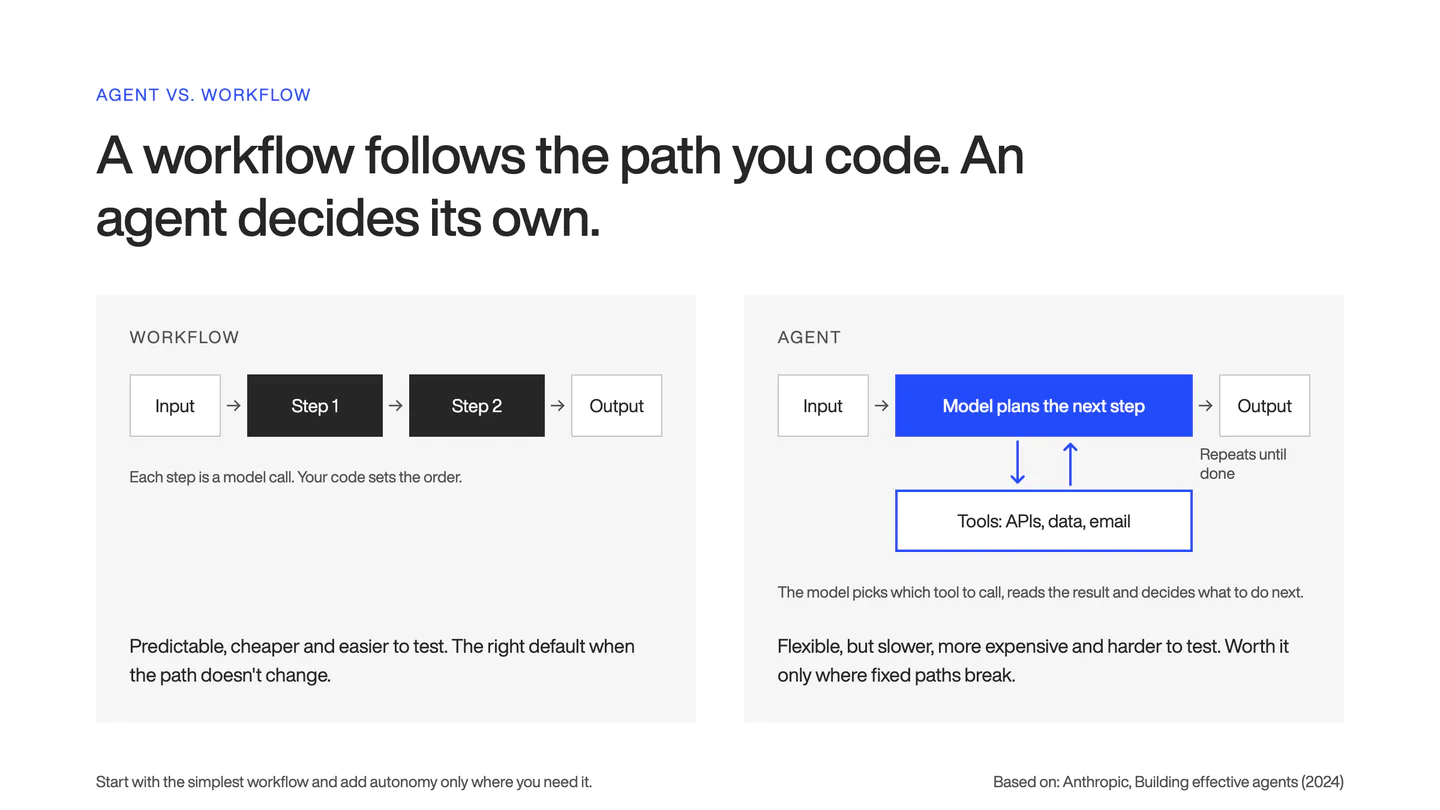
Discovery and use-case fit. Map the workflow, decide if it needs an agent, and define what success means in numbers.
Pilot on one workflow. Build the agent for a single workflow, with the eval harness and tracing in place from the start.
The part I care most about is that the same engineers advise and build your agentic AI systems. Advice that never has to survive production is cheap to give.
Decidr is a good example of our experience in this space. We built core components of their agentic AI business operating system, including an AI chat and document search agent, a content generator, and a sales and CRM tool.
How to choose an agentic AI consulting partner
The best way to judge an AI agent consultant is to ask for evidence of their engineering chops. These are the questions I’d ask:
1. Can you show me your eval harness? A real partner can open one and walk you through it.
2. How do you report consistency across repeated runs? Listen for pass^k or something close to it, not a single accuracy number.
3. What’s your tracing stack? They should name tools and show what a trace looks like.
4. What’s the rollback plan? You want a specific mechanism and a time to recover.
5. Who owns the agent in production? If the answer is “your team, after handover,” find out exactly what that handover includes.
Gartner found that only about 130 of the thousands of vendors that call themselves agentic are the real thing. These five questions sort them out quickly.
Looking for an engineering partner for AI agents?
If your agent works in the demo but you’re not confident it’ll hold up with real users, you’re not alone. Most teams hit this point once the pilot is done.
We’re a software development company with senior engineers who build AI agents with evals, tracing, and rollback in place from the first sprint.
Our teams work on one project at a time. We don’t hand you a strategy deck and walk away.
If you have a workflow in mind, tell us about it. We’ll give you an honest view on whether it needs an agent, and what it would take to run it reliably.
Mario sorgt dafür, dass jedes Projekt reibungslos läuft. Als überzeugter Verfechter der Ansicht, dass die Menschen bei DECODE die wichtigste Ressource sind, wuchs er ganz natürlich in seine frühere Rolle als People Operations Manager hinein. Heute ermöglicht ihm sein enzyklopädisches Wissen über die Rolle jedes DECODErs und seine Expertise in allen technischen Belangen, die technische Vision von DECODE als CTO zu leiten und sicherzustellen, dass wir stets einen Schritt voraus sind.
Teil Ingenieur und scheinbar auch Teil Therapeut, bleibt Mario immer ruhig unter Druck, was hilft, die stressfreie Atmosphäre im Büro aufrechtzuerhalten. Tatsächlich ist Sitzen und Nachdenken sein Haupt Hobby. Was könnte Zen-artiger sein als das?
AI consulting explained: what it covers, who needs it, what an engagement looks like, what it costs, and how to choose a partner that can actually build
Lemon.io CEO Aleksandr Volodarsky on the software engineer skills that matter in the AI era, why senior demand doubled, and the skills software engineers should focus on building.