Your team is almost certainly using them whether you’ve formally rolled them out or not.
So, the question now isn’t whether to adopt.
It’s what the productivity gains actually mean when you translate them from individual developer output to team-level delivery, hiring decisions, and velocity.
Most articles on the benefits of AI in software development topic speak to developers: faster autocomplete, fewer context switches, better documentation.
Of course, those are great!
But in my experience, if you’re a CTO or VP Engineering, they only matter if they result in something your business can measure.
In this article, we’ll cover the 7 key benefits of AI in software development, what the data actually shows, and what it means for how your team should operate.
Let’s dive in!
Key takeaways:
Theproductivity gains are real, but they depend on your foundations. AI amplifies what’s already working in your engineering org. Teams with solid delivery practices see measurable improvements after adoption. Teams without them don’t.
Security has the clearest ROI and the most overlooked risk. IBM’s 2025 data shows AI-assisted security operations cut data breach costs by 34%. But Veracode found 45% of AI-generated code fails standard security tests. The same tools that help fix vulnerabilities faster can introduce more of them if you don’t have strong review practices in place.
The benefit you get depends entirely on where your actual bottleneck is. If your sprints slip because of review cycles, writing code faster won’t help. If your team is working from unclear requirements, AI just gets you to the wrong outcome sooner. Diagnose the bottleneck first.
Why engineering leaders are asking this question right now
Adoption has moved faster than anyone predicted.
84% of developers are now using or planning to use AI tools in their workflows, up from 76% the prior year, according to the Stack Overflow 2025 Developer Survey.
These aren’t early-adopter numbers. This is the baseline shifting across the industry.
Looking for an AI-native development partner? Let’s talk →
You’ll be talking with our technology experts.
What that means for you: the companies that will outpace you on delivery aren’t necessarily those with bigger teams or bigger budgets.
They’re the ones that have turned developer-level productivity gains into real, consistent delivery improvements.
The 2025 DORA report is clear on this: AI makes strong engineering teams better. It doesn’t fix the ones that aren’t.
Teams with solid delivery foundations shipped more. Teams without them didn’t.
That gap is already opening up across the industry. And it keeps growing.
The benefits of AI in software development
Here, we’ll cover the key benefits in detail, including what the data actually shows and where the gains are real.
Faster code generation and delivery
The most-cited figure is GitHub’s 2022 controlled study, where developers using GitHub Copilot completed tasks 55% faster.
That number does deserve context, though.
The tasks were isolated, the code was greenfield, and the developers knew they were being measured. Real delivery conditions are much messier.
McKinsey’s modelling found 20–45% productivity gains in code generation and refactoring tasks from generative AI.
Even at the conservative end, that’s a meaningful change in what your current headcount can ship.
Real enterprise data looks more conservative but more credible.
GitHub and Accenture’s 2024 randomized controlled trial across Accenture’s developer organisation found an 8.69% increase in pull requests per developer, a 15% increase in PR merge rate, and an 84% increase in successful builds.
Code quality didn’t drop. More code shipped through continuous integration (CI). That’s the result that matters.
For engineering leaders, the implication is direct: if your team can ship a feature set in significantly less time, you now have a real choice on your hands.
Accelerate the current roadmap. Take on adjacent scope. Or bank the capacity as buffer.
You get to decide where the extra time goes.
Lower cognitive fatigue for senior engineers
Cognitive fatigue is one of the most expensive and least-measured dragson your team’s output.
When your senior engineers spend their day on repetitive code, jumping between tasks, and hunting for documentation, they have less capacity for the decisions that actually move your product forward.
The GitHub/Accenture enterprise study we referenced earlier also found that 70% of developers reported noticeably less mental effort on repetitive tasks when using Copilot, and 54% spent less time searching for information or examples.
That second figure matters most for your senior engineers.
They’re the ones your team turns to for context and architecture guidance, and they’re now spending less time on work a tool can handle.
When engineers stay in deep work longer without the constant pull of repetitive tasks, the effect adds up across a sprint, and across a quarter.
Faster vulnerability remediation
Most security backlogs grow for the same reason: finding vulnerabilities is fast, fixing them is slow.
Manual remediation takes your engineers’ time and competes with everything else they already have on their plate.
AI-assisted tooling is starting to close that gap.
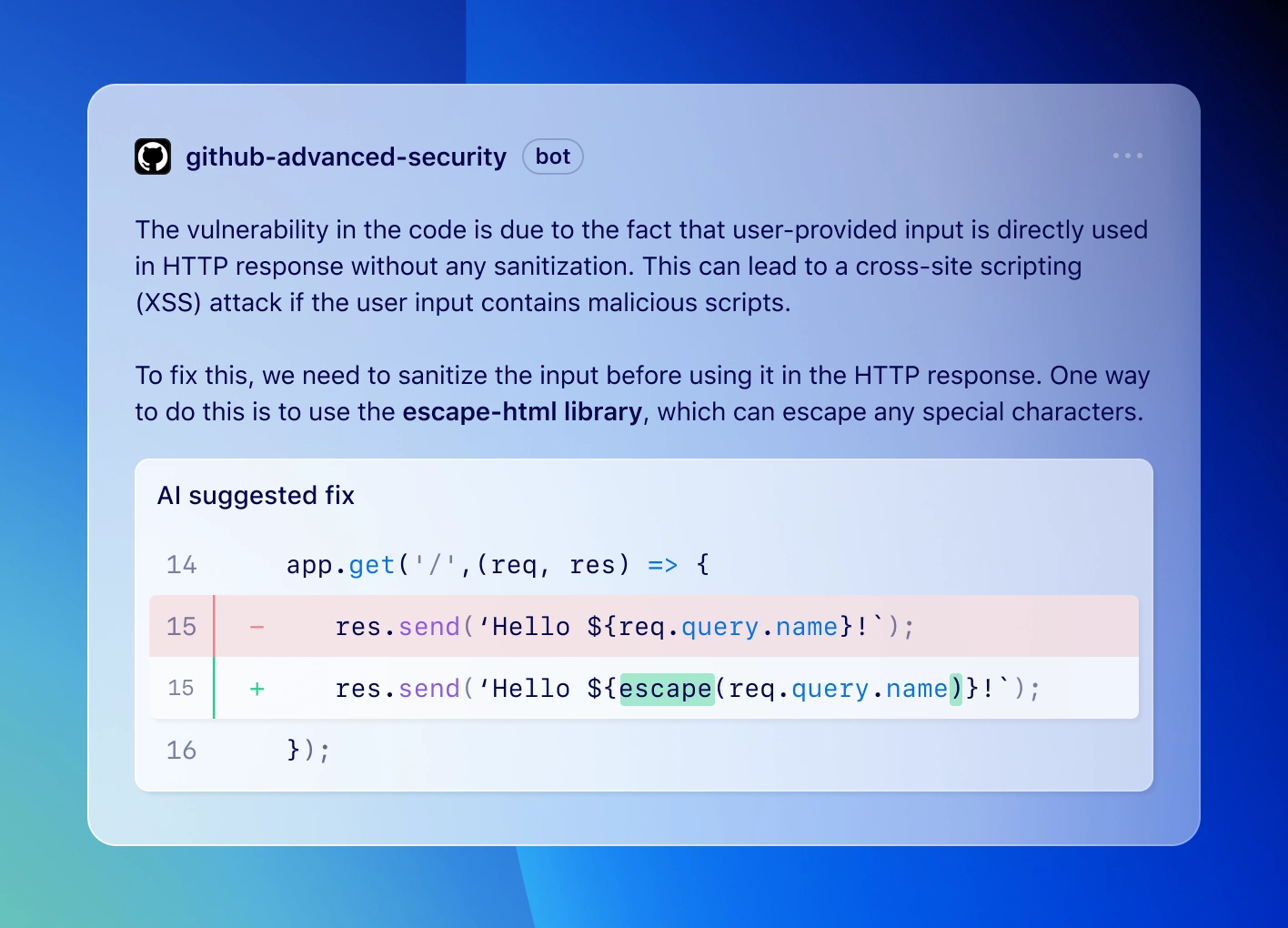
GitHub Advanced Security’s Copilot Autofix, for example, cuts median fix time from 1.5 hours to 28 minutes, more than 3x faster than manual remediation.
It covers dozens of vulnerability classes across the most common enterprise languages, generating fixes developers can review and commit directly in the pull request.
That’s not just a developer quality-of-life improvement.
It directly affects how quickly you can release and how long you stay exposed between finding a vulnerability and shipping the fix.
Reviewing a generated fix takes a fraction of the time it takes to write one from scratch, so the backlog shrinks without adding headcount to the security team.
If your team is under pressure to close findings faster, that’s where the gain shows up.
Lower cost of security incidents
IBM’s 2025 breach report found that organizations using AI and automation extensively in security averaged $3.62M in breach costs, compared to $5.52M for those not using these tools.
That’s a $1.9M differenceper breach, a 34% cost reduction.
That’s a number you can put in front of your finance team.
The global average breach cost is $4.44M. Organizations with AI-assisted security operations are coming in well below it.
Faster fixes and lower incident costs make security one of the clearest areas where AI in software development pays for itself.
Reduced code review and documentation overhead
Code review and documentation are two of the most time-consuming activities in any engineering organization.
They slow delivery down, pull your best engineers out of focused work, and tend to be where teams cut corners when deadlines get tight.
With AI handling routine pattern checks, your senior engineers focus on architecture, logic, and edge cases.
AI generates documentation inline, which means it actually exists by the time the code ships.
The same GitHub/Accenture study from earlier found that 90% of developers felt more fulfilled with their job when using Copilot, and 95% enjoyed coding more.
That’s the signal that the right people are spending their time on the right work.
Expanded team capacity without new hiring
The conventional response to roadmap pressure is to hire more people.
Senior engineering oversight isn’t optional here. If you need to scale capacity without the time and cost of hiring, a dedicated development team is one way to do that.
Lower knowledge concentration risk
One of the quieter benefits of AI in software development is what it does to key person risk.
When most of your system knowledge lives with one engineer, you carry real delivery risk every time they’re on leave, in interviews, or off the team.
AI tooling, if you set it up well, gives your whole team access to context that used to live in one person’s head.
Engineers can navigate unfamiliar parts of the code faster and get answers from the tool instead of waiting for a colleague.
It doesn’t replace deep expertise, but it spreads access to it more evenly.
For teams running lean with highly specialized engineers, that’s a meaningful reduction in risk, even if you can’t really quantify it.
Where AI in software development still falls short
The credibility-destroying move in any article on this topic is to present AI adoption as pure upside. It isn’t.
The most relevant warning flag for engineering leaders is code churn.
Code churn is code that gets written and then immediately modified or deleted. At elevated levels, it’s a proxy for code that shouldn’t have been written the way it was.
Veracode’s 2025 GenAI Code Security Report, which tested code generated by over 100 AI models, found that 45% failed standard security tests, and that AI-generated code contains 2.74x more vulnerabilities than human-written code.
So, while AI can help lower the cost of security incidents, AI-generated code is definitely not secure by default.
The review burden is growing too: Faros AI’s analysis found review time rose 91% on high-adoption teams, as engineers absorb the cost of checking AI output they can’t fully trust.
The implication is direct: AI code generation without strong review practices introduces technical debt faster than manual development.
If your team is using Claude Code, Cursor, GitHub Copilot, or similar tools without a solid review process, you may ship faster now and slow down later as poor decisions pile up.
Choosing the right AI code review tools is one of the more concrete steps you can take to close that gap before it widens.
AI tools also don’t know your system by default.
They generate plausible code, not correct code. Plausible code that doesn’t fit your architecture, your data model, or your security requirements is worse than no code at all.
The faster the generation, the faster the accumulation of decisions that looked fine in isolation and are painful in aggregate.
None of this is an argument against adoption. It’s an argument for adoption with guardrails.
How to evaluate these AI benefits for your specific situation
Translating the industry data into your specific situation requires honesty about where your actual bottlenecks are.
If your team is blocked by review cycles, AI-assisted code generation won’t help until you fix your review process.
If your slowdowns come from unclear requirements, AI tooling accelerates the production of code against the wrong spec.
And if you’re losing time to security remediation late in the cycle, the IBM and Veracode figures we covered are directly relevant to you.
Ask yourself these questions?
Where do your sprints most commonly slip? Is the bottleneck in writing code or in reviewing and shipping it?
What percentage of your senior engineers’ time goes to activities that AI tooling could reduce?
What’s your current code churn rate, and do you have the review discipline to keep it from rising as AI adoption increases?
What does your technical debt profile look like, and will faster code generation make it better or worse?
The 83% of developers who said AI will significantly change their roles in the next five years aren’t wrong about that.
But getting there takes more than installing a tool.
I believe the teams that will be miles ahead in 18 months are the ones that treat AI adoption as an engineering discipline from the start.
Benefits of AI in software development: FAQs
Not for the majority of companies at the moment.
AI increases the effective capacity of your existing team, but the gains require experienced engineers to supervise, review, and make architectural decisions.
The better frame is: AI changes what you need to hire for and when.
Increased code churn and technical debt accumulation.
Without strong review practices, AI-generated code can introduce quality issues faster than your team can catch them.
The code churn data covered earlier in this article is the clearest signal: without governance, AI tools generate technical debt faster than teams can clear it.
Track sprint velocity, code churn rate, time to review, and time to production.
Subjective developer satisfaction data is also useful but shouldn’t be your primary signal.
Productivity gains at the developer level only matter if they translate to throughput at the team level.
Looking for a development partner who builds with AI the right way?
If you’re weighing how AI-assisted development fits into your engineering operation, you’re probably past the “should we use it” question and into the harder ones: what does responsible adoption look like, who supervises the output, and how do you make sure faster generation doesn’t mean messier code?
At DECODE, we’ve built agentic engineering into how we work. Not as a feature we market, but as how our senior engineers operate.
Our teams use AI to shorten development timelines, and our review processes are designed around AI’s specific failure modes.
Every line of code is owned by a senior engineer. Nothing ships without a real person standing behind it.
We work with CTOs and engineering leaders at SaaS and software companies who need high-caliber developers without the overhead of hiring and onboarding.
If your roadmap has more in it than your current team can carry, that’s the problem we’re built to solve.
Skilled in React Native, iOS and backend, Toni has a demonstrated knowledge of the information technology and services industry, with plenty of hands-on experience to back it up. He’s also an experienced Cloud engineer in Amazon Web Services (AWS), passionate about leveraging cloud technologies to improve the agility and efficiency of businesses.
One of Toni’s most special traits is his talent for online shopping. In fact, our delivery guy is convinced that ‘Toni Vujević’ is a pseudonym for all DECODErs.
A practical guide for engineering leaders on integrating AI into your software development workflow without compromising code quality, speed, or security.
How to build security into your AI development workflow without slowing your team down. Controls, processes, and policies that actually work in practice.