You don’t need to be a software engineer to make AI work for your business. But you do need a plan.
AI is no longer something only tech companies deal with.
88% of organisations now report regular AI use in at least one business function, according to McKinsey’s November 2025 global survey.
And that number will keep climbing.
The question for most leaders is how to do adopt AI without wasting money, disrupting your operations, or ending up with a project that never leaves the pilot stage.
This article is for business owners and operators who aren’t developers. I won’t tell you which model to use or how to fine-tune a neural network.
I will tell you how to approach AI adoption in a way that actually produces business results, step by step, with no technical background required.
So, let’s jump right in!
Key takeaways:
Define the business outcome before you talk to any vendor. Most AI projects don’t fail because of the technology, they fail because nobody wrote down what success looks like before the project started. “We reduced invoice processing from 12 hours to 3 hours per week” is a target. “We implemented an AI tool” is not.
Clean your data first. AI is only as good as the data behind it. Before committing budget to any implementation, audit what you have: where it lives, how clean it is, and whether it can be accessed programmatically.
The biggest risk is your team not using it. 80% of enterprise AI projects fail to deliver promised business value, and the leading causes are strategy, governance, and change management. Prepare your team before go-live, not after.
If your team does the same thing over and over, reading documents, categorizing data, filling in forms, routing requests, AI can take most of that off their plate.
Process automation typicallydelivers 20-30% cost reduction in the areas it touches.
That’s not speculative. It’s what companies across manufacturing, logistics, and financial services are reporting from live deployments.
Improve visibility and decision-making
AI is very good at finding patterns in large datasets that humans would miss or take a long time to analyze.
For operations-heavy businesses, this means better forecasting, earlier warnings about capacity or supply problems, and faster decisions backed by data rather than instinct.
If you’re in financial services, it can find anomalies in transaction data that point to fraud or errors.
The underlying logic is the same: AI processes more data, faster, and shows the data that actually matters.
Reduce manual data handling across departments
Most mid-market companies still have people doing significant manual data work: pulling reports, reconciling spreadsheets, moving data between systems.
This is expensive, error-prone, and demoralizing for capable people who should be doing higher-value work.
AI integration, connecting your existing systems with intelligent automation, can eliminate most of this.
And you don’t need to replace your ERP system or your CRM platform.
For many businesses, the better starting point is legacy software modernization, i.e. building smarter connectors between the systems you already have.
How to implement AI in your business: a step-by-step guide
Step 1: Identify one high-friction process to target first
Don’t try to transform your entire business at once. Pick one process.
It should be high-friction (your team finds it frustrating or time-consuming), repetitive (it happens on a regular basis), and measurable (you can quantify how long it takes or what it costs).
BCG’s 2026 research confirms what I’ve seen in practice: the companies generating real value from AI start with one problem that matters, show progress quickly, and reinvest those savings into broader transformation.
The discipline of starting small is one of the clearest predictors of success.
Good candidates include:
Invoice processing
Customer query routing
Inventory forecasting
Employee onboarding documentation
Maintenance scheduling
Bad candidates include anything that requires significant human judgment, anything with unclear inputs, or any process where the outcome is hard to define.
Step 2: Audit what data you already have (and what you are missing)
AI is only as good as the data behind it. Before you commit to any implementation, you need to understand the state of your data.
Ask your team these questions:
Where does this data currently live?
Is it in one system or scattered across several?
How clean is it, are there gaps, duplicates, or inconsistencies?
Can it be accessed programmatically, or does someone have to export it manually?
Gartner found that 63% of organisations either don’t have or aren’t sure they have the right data management practices for AI.
And in April 2026, they published research showing that organisations with successful AI initiatives invest up to four times more in data and analytics foundations than those that struggle.
To put it simply, data readiness isn’t another technical detail. It’s a key business decision if you want AI to work.
You don’t need a perfect dataset to start.
But you need enough clean, structured data to train or configure whatever tool you’re using, and you need a way to keep it current.
Step 3: Define the business outcome, not the technology
This is the step most companies skip, and it’s the most important one.
Before you talk to any vendor or developer, write down, in plain language, what success looks like.
Not “we implemented an AI tool for invoicing.”
Think something like: “We reduced the time our finance team spends on invoice processing from 12 hours per week to 3 hours per week, with fewer than 2% error rate.”
That level of specificity changes everything.
It tells you what to measure, it keeps the scope tight, and it gives you a clear way to evaluate whether the project succeeded.
So, define outcomes before you write a line of requirements.
Step 4: Evaluate build vs. buy vs. integrate
One of the most important things non-technical business leaders get wrong is assuming they need to build something custom from scratch.
And in most cases, they don’t.
There are three realistic paths:
Buy a SaaS tool with embedded AI. For common use cases (customer support, document processing, demand forecasting), there are mature commercial tools. These are faster to deploy and lower risk, but less flexible in the long run.
Integrate AI into existing systems. Platforms like Microsoft Azure AI, Google Vertex AI, and AWS Bedrock let developers add AI capabilities to your existing software.
Build a custom solution. Justified when your use case is genuinely unique, your competitive advantage depends on proprietary logic, or off-the-shelf tools don’t fit your data structure. This is where working with a specialist AI software development team makes the biggest difference.
For most mid-market companies, the answer is integrate or buy first, and only build when those options don’t work.
Custom builds cost more and take longer. Reserve them for the problems where they’re genuinely needed.
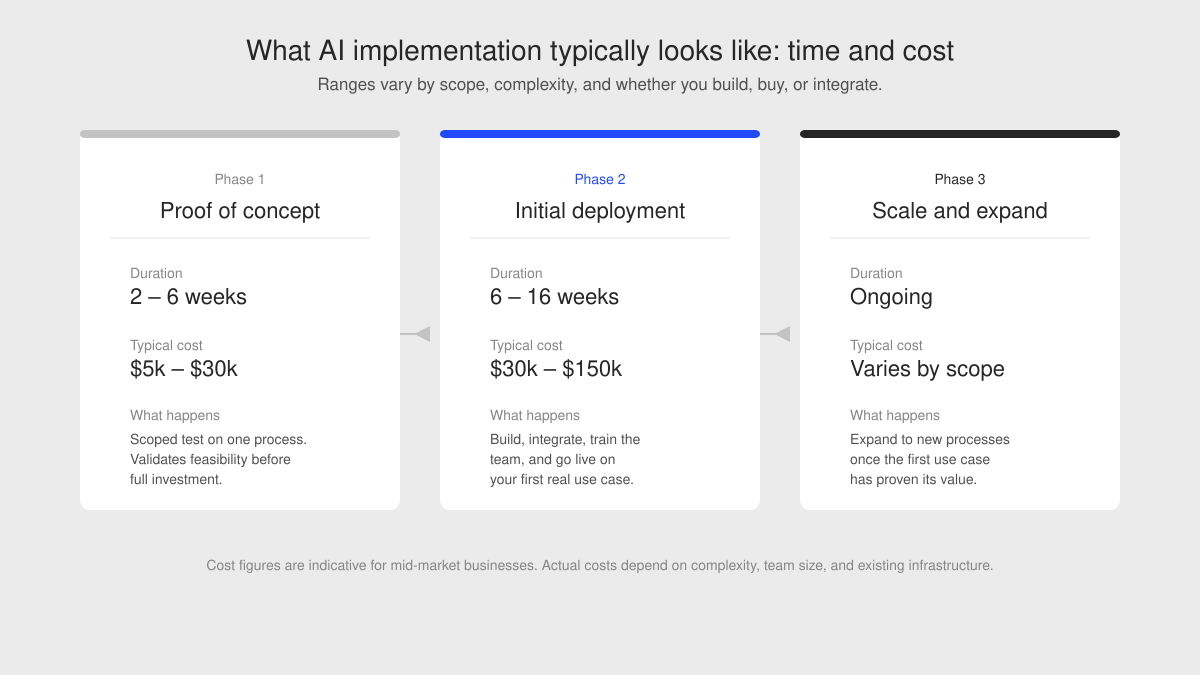
Step 5: Run a scoped proof of concept before committing
Even when you’re confident about the approach, don’t go straight to full implementation.
Run a proof of concept (PoC) first, a scoped, time-limited test that lets you validate your assumptions before committing to full-scale implementation.
A PoC should answer three questions:
Does the technology actually work with your data?
Does it produce the outcome you defined in step 3?
Can your team operate it without specialist support day-to-day?
Keep it tight.
Four to eight weeks is usually enough to get a meaningful signal.
If it works, you have the evidence you need to proceed with confidence. If it doesn’t, you’ve learned something valuable at a fraction of the cost of a full deployment.
Set realistic expectations with your board before you start, not after the first 90-day review.
Step 6: Get your team on board before go-live
This is where a lot of AI implementations quietly fail.
The technology works. The business case is clear. But the team doesn’t trust it, doesn’t understand it, or hasn’t been properly prepared, and so adoption never happens.
Strategy, governance, and change management account for the majority of failures, not the AI itself.
I can’t stress this enough: don’t treat change management as an afterthought.
Before going live, make sure your team understands why this change is happening, what it means for their roles, and how to use the new system.
Run training sessions. Appoint internal champions who can answer questions. Acknowledge the anxiety that comes with any significant change.
Let the AI support your team’s decisions first, before fully automating. This builds confidence and helps you find edge cases you might have missed.
Step 7: Measure the right things and know when to scale
Once the system is live, track the KPIs you defined in Step 3.
And not just technical metrics (uptime, processing speed), but business metrics:
Time saved per task or function
Error rate
Cost per transaction
Customer satisfaction scores (if relevant)
Review results at 30, 60, and 90 days.
If the numbers are trending in the right direction, you have your evidence for scaling. If they’re not, you need to understand why before you invest more.
McKinsey’s 2025 survey we mentioned in the intro also found that CEO oversight of AI governance is the single element most correlated with higher bottom-line impact from AI.
It’s more impactful than any technical factor.
If you’re a CEO or COO reading this, your involvement isn’t optional. Assign a business owner to the project and stay close to it.
When you’re confident the first use case is working, then scale, either by deepening that use case or expanding to a second process. Not before.
How long does AI implementation take and what does it cost?
Timelines and costs vary significantly depending on the complexity of the use case, the state of your data, and the approach you take.
For a straightforward SaaS integration, e.g. connecting an existing tool with AI capabilities to specific workflows, you might be looking at six to twelve weeks and a relatively modest budget.
For a custom-built solution that integrates across multiple systems, twelve months and a six-figure investment is realistic.
The honest answer is that cost is largely driven by data readiness and scope.
If your data is clean and centralized, and you’ve kept the scope tight, costs stay manageable.
If you’re also cleaning up years of messy data infrastructure at the same time, that adds to the bill.
A good development partner will give you a clear fixed-scope estimate after a discovery phase, typically two to four weeks, where they audit your data, map your processes, and validate the approach.
Be cautious of anyone who quotes a price before they’ve done that work.
Common AI implementation mistakes to avoid
Like we said, most AI projects fail for the same reasons. Here are the ones worth watching out for:
Starting too broad. Running three AI pilots simultaneously sounds ambitious. It usually means none of them get the attention they need.
Treating it as another IT project. AI implementation is a business transformation. It needs business ownership, not just a technical team to manage it.
Skipping the data audit. Discovering your data is siloed or inconsistent six months into a project is expensive. Do this first.
Measuring the wrong things. Tracking model accuracy is not the same as tracking business impact. Know what business outcome you’re measuring from day one.
Ignoring regulation. The EU AI Act entered into force in August 2024. If you operate in Europe, or handle data from European customers, you need to understand your compliance obligations before you deploy.
Expecting overnight results. Most AI investments won’t see measurable ROI within a year. It can take up to two to four years. AI is a medium-term investment, not a quick fix.
Most of these come down to the same thing: moving faster than your foundations allow.
Get the groundwork right first, and the project moves faster overall.
When to bring in an external AI implementation partner
You don’t need an in-house AI team to implement AI.
But you do need people who understand both the technology and the business problem. An external partner makes sense when:
You don’t have in-house developers with AI experience
Your use case involves integrating multiple existing systems
You need to move quickly and don’t have time to hire and onboard
You want someone to own the full delivery, from scoping to production
What to look for in a partner: industry experience relevant to your business, evidence of AI work that went to production (not just pilots), and a team that asks business questions as well as technical ones.
The first conversation with a good partner should be about your operations and your outcomes.
If it leads with technology, that’s a warning sign.
How to implement AI in your business: FAQs
Ask them to walk you through a project that failed, not just their best case study.
Good partners are direct about where things went wrong and why.
Also pay attention to the first conversation. If it starts with capabilities and products rather than your operations and your problem, that’s a reliable signal they’re selling, not solving.
Ask for references from clients with similar data complexity to yours, not just similar industries.
Go back to the outcome you defined before you started.
A PoC that produces impressive-looking outputs but doesn’t move the specific metric you defined isn’t a success. It’s a signal to investigate before you scale.
Watch for confirmation bias here: teams often see what they want to see in PoC results. If the improvement isn’t measurable against the target you set in Step 3, treat it as inconclusive.
Start by diagnosing why it didn’t work.
The most common culprits are scope that was too broad, data that wasn’t ready, a team that wasn’t brought along, or a project that didn’t have a clear business owner.
The technology has improved, but most failures aren’t technology failures. If the same conditions are in place, a new tool won’t change the outcome.
Looking for a development partner who understands your business, not just the tech?
If you’ve read this guide and you’re thinking “this makes sense, but I still don’t know where to start,” that’s exactly where most of our clients are when they first talk to us.
We’re DECODE, and we build and integrate software for mid-market companies that can’t afford to get it wrong.
Our teams are product-minded, which means every engineer we put on your project understands the business problem they’re solving, not just the Jira ticket in front of them.
And we have 14+ years of experience building complex software for some of the biggest companies out there.
And we’ve also built AI health platforms that handle structured assessments, personalized clinical recommendations, and AI-assisted clinical notes for healthcare providers.
These are complex, production-grade systems, not demos.
If you’re exploring AI implementation for your business and want a clear-eyed view of what’s possible, what it would cost, and how long it would take, that’s a conversation we’re more than happy to have.
A seasoned software engineering executive, Marin’s role combines his in-depth understanding of software engineering processes (particularly mobile) with product and business strategies. Humbly boasting 20+ years of international experience at the forefront of telecoms, Marin knows how to create and deliver state of the art software products to businesses of all sizes. Plus, his skills as a lifelong basketball player mean he can lead a team to victory.
When he’s not hopping from meeting to meeting, you’ll find Marin listening to indie rock, or scouring the latest IT news.
Agentic coding lets AI agents plan, write and test code end to end. Here is what it means for engineering teams and how to start using it without losing control.
A practical guide to AI software development for engineering teams. Covers the full SDLC, tool selection, team impact, and how to build an adoption strategy that holds.
A practical guide to legacy software modernization for CTOs. Compare approaches, understand costs, and learn how to structure programs that actually succeed.