Done right, it reduces your total cost of ownership, speeds up release cycles, and frees your team to focus on delivering new features and moving your business forward.
Let’s talk about what that actually looks like.
Key takeaways:
Legacy modernization works best when you treat it as a structured process, not a one-off rebuild. A clear path from planning to development, deployment, and support helps reduce risk and keeps disruption low.
The goal isn’t just to replace old software. Good modernization improves performance, security, maintainability, and user experience without disrupting your day-to-day operations.
There’s no single modernization approach that fits every system. Rehosting, replatforming, refactoring, and rebuilding each solve different problems, so the right choice depends on your goals and constraints.
Why legacy modernization costs you more than you think
The price of maintaining legacy software goes far beyond the salaries of the engineers keeping it alive.
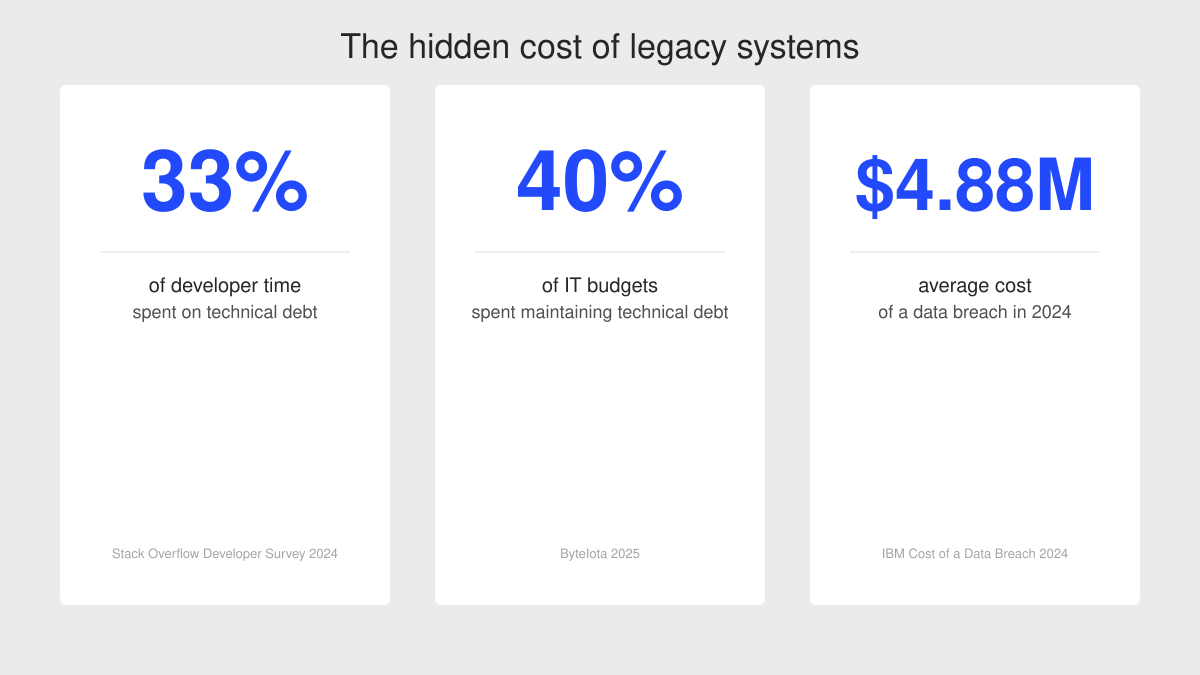
33% of developer time is spent on technical debt. That’s time not spent on new features or innovation.
The financial impact is massive. In 2025, companies on average spent 40% of their IT budgets maintaining technical debt.
On a $10 million IT budget, that’s $4 million per year going toward keeping the lights on instead of building for the future.
And it gets worse. 63% of developers cite technical debt as their top frustration at work.
That frustration leaks into recruitment, retention, and the quality of work they can do. Your best engineers start looking elsewhere.
And here’s another eye-watering statistic: the average data breach cost is $4.88 million in 2024, and 60% of breaches are linked to unpatched or outdated systems.
One breach can wipe out years of “savings” by not modernizing.
The bigger picture is this: only 21% of IT leaders report no significant technical debt. And 50% of tech leaders saw tech debt hit moderate-to-high severity in 2025, with the number expected to rise to 75% in 2026.
This isn’t a problem that stays small if you ignore it. It grows and compounds.
The six modernization approaches explained
Not all modernization is the same.
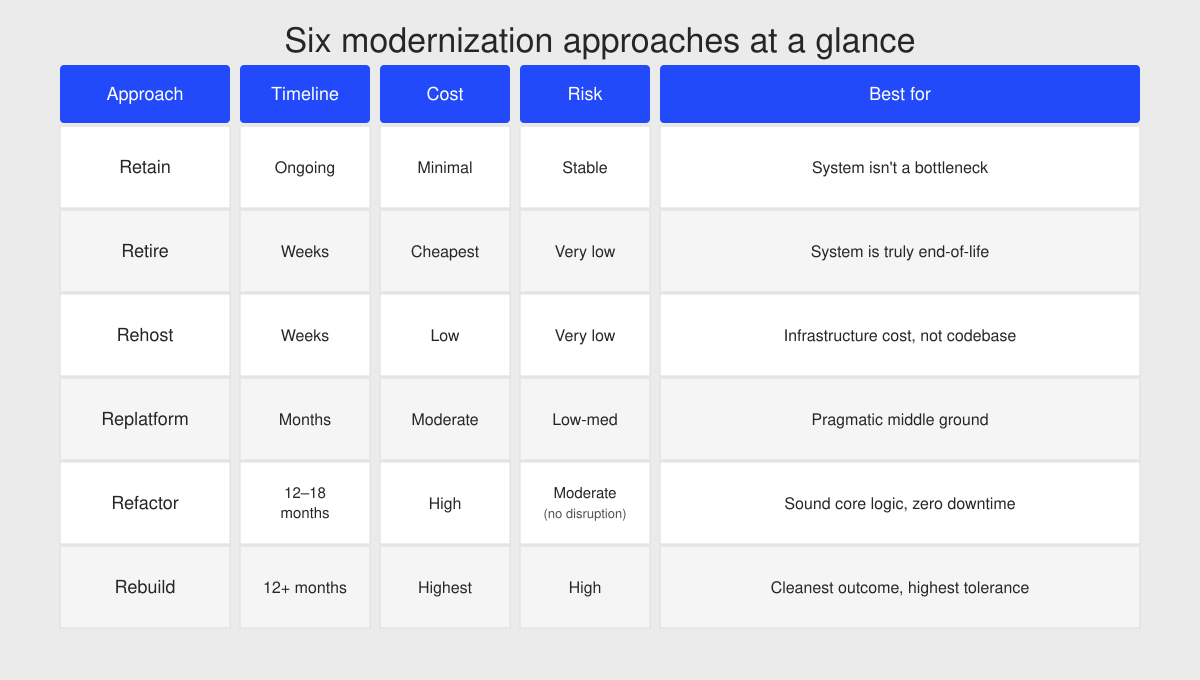
The cloud industry uses the “8 Rs” framework, but for simplicity, they cluster into 6 core approaches.
The choice ultimately comes down to your business constraints, the system’s architecture, and your risk tolerance.
Here’s what each approach does:
Retain. Keep the system as is. This works only if the system genuinely isn’t a bottleneck.
It’s stable, secure, and the business doesn’t demand new capabilities it can’t deliver. Be honest: if you’re reading this, retention isn’t your answer.
Retire. Kill it. The system is redundant, or its functions have moved elsewhere.
This is surprisingly common when companies merge or consolidate platforms. It’s also the cheapest option if the system’s truly end-of-life.
Rehost. Lift and shift. You move the application to a new infrastructure (usually the cloud) without changing the code. This works when your bottleneck is infrastructure cost or maintenance, not the codebase itself.
It’s fast (weeks, not months) and cheap, but it doesn’t solve architectural problems. Your legacy code still sprawls across your cloud infrastructure, running up compute bills.
Replatform. Move and optimize. You migrate to a new platform (like moving from on-premise to cloud) and make targeted improvements. Think: updated runtimes, newer databases, managed services.
It’s slower than rehosting (months, not weeks) but cheaper than rebuilding. For teams that can’t afford the cost of a full rebuild but need more than a lift-and-shift, it’s the pragmatic middle ground.
Refactor. Improve the code without changing its core structure. You modernize the language, frameworks, or architecture incrementally.
Refactoring takes the longest (12-18 months for an enterprise-grade system), but it leaves the application intact and operational the entire time. It’s your best option if the core business logic is sound and you can’t afford operational disruption.
Rebuild. Start over. You keep the business logic, the data, and the integrations.
But you write new code against a modern architecture. This gives you the cleanest result but also carries the most risk.
The best choice depends on your risk tolerance, timeline, budget, and how critical the system is to your daily operations.
Big bang vs. incremental: which modernization strategy wins
Here’s the big question: do you modernize the entire system at once, or piece by piece?
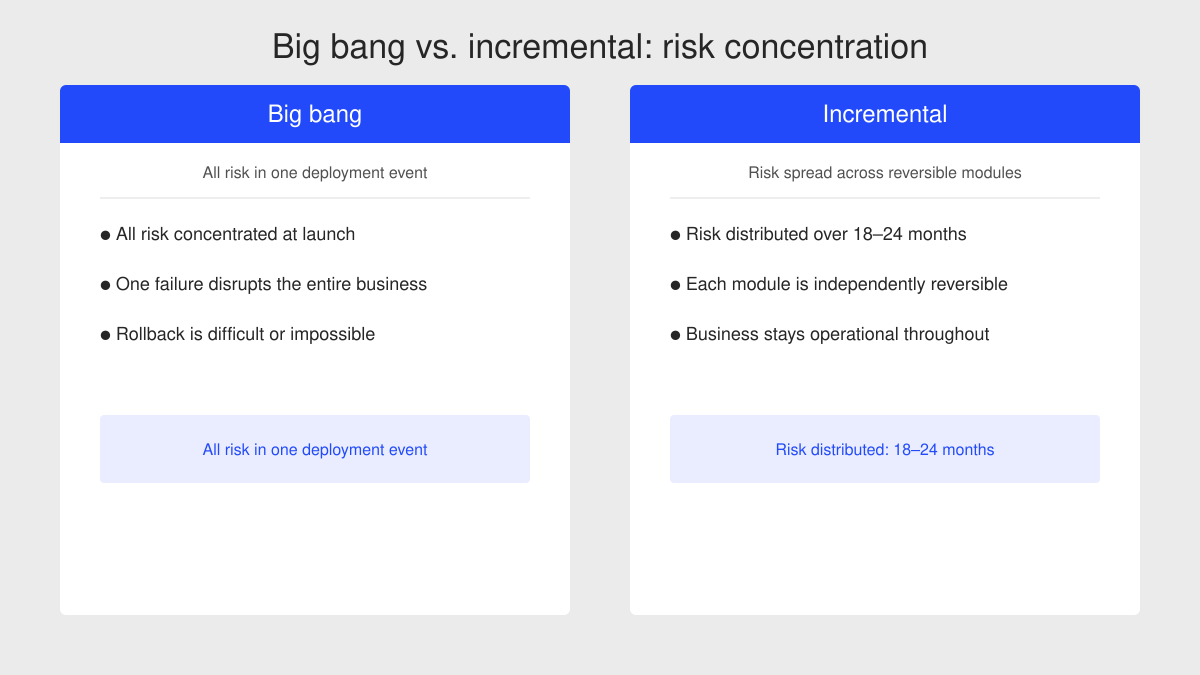
Big bang modernization looks attractive in a spreadsheet: one project, one completion date, one moment where the new system goes live and the old one switches off.
But it concentrates all your risk into a single event. If anything goes wrong, the whole business feels it. And things do go wrong.
Incremental modernization follows a different pattern. You identify specific functions or modules of the legacy system and replace them piece by piece, using what the industry calls the “Strangler Fig Pattern.“
In simple terms, new code wraps around old code and you gradually route traffic to the new system.
The old one doesn’t go anywhere until the new one is stable and proven. This approach spreads risk across many small deployments.
It lets you run both systems in parallel, which means you can roll back if something fails. It’s slower (18-24 months instead of 12), but it’s dramatically less risky.
Here’s the practical difference: a big bang migration asks “is the new system ready?” Incremental modernization asks “is this specific module ready?”
In most cases, incremental is the better choice.
You keep your business running, reduce the overall risk, and adjust your approach based on what you learn.
And your team doesn’t have to work double shifts to migrate everything in a narrow window.
How to structure a modernization program that sticks
A modernization program is a business initiative, not just a technical project. That’s the distinction most teams miss, and it’s often why modernization programs underdeliver.
Those are real numbers, but they require more than engineers shipping code. They require alignment across the business.
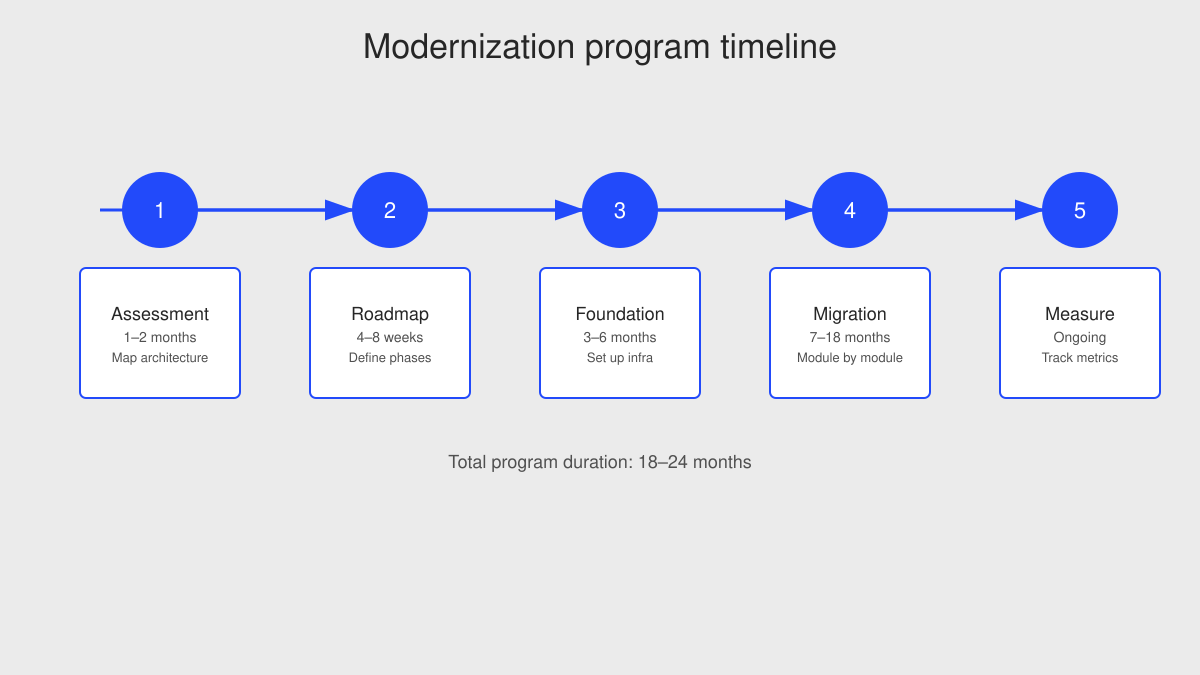
In our experience, here’s what a typical modernization program timeline looks like:
You should always start with a detailed assessment. Spend 1-2 months understanding what you actually have. This isn’t optional.
Map the system’s architecture, identify which components are bottlenecks, and understand the business processes that depend on the system. Interview the people who know how it really works.
After the assessment, build your initial roadmap.
This is where you pick your approach (out of the 6 core approaches) for each component, define phases and realistic estimates, and identify dependencies and risks.
A solid roadmap takes 4-8 weeks to complete and becomes your reference document for the next 18-24 months.
Then comes foundation work (3-6 months). You stand up your new infrastructure, set up CI/CD pipelines, establish your development environment, and get your team trained on the new tech stack.
This work is invisible to the business, but it’s load-bearing.
Then you migrate (7-18 months, depending on scale and approach). You work module by module, function by function.
Each piece goes through testing, staging, and production. Each deployment is small and reversible.
And your team learns as they go.
Throughout, you should be measuring key metrics.
Track metrics like deployment frequency, system reliability, time to fix bugs, and developer satisfaction to tell you if the modernization is actually delivering on its promise.
The cost of waiting: competitive pressure you can’t ignore
It’s tempting to believe modernization can wait.
The system works. Your business is profitable. Why spend 18-24 months and real money disrupting something stable?
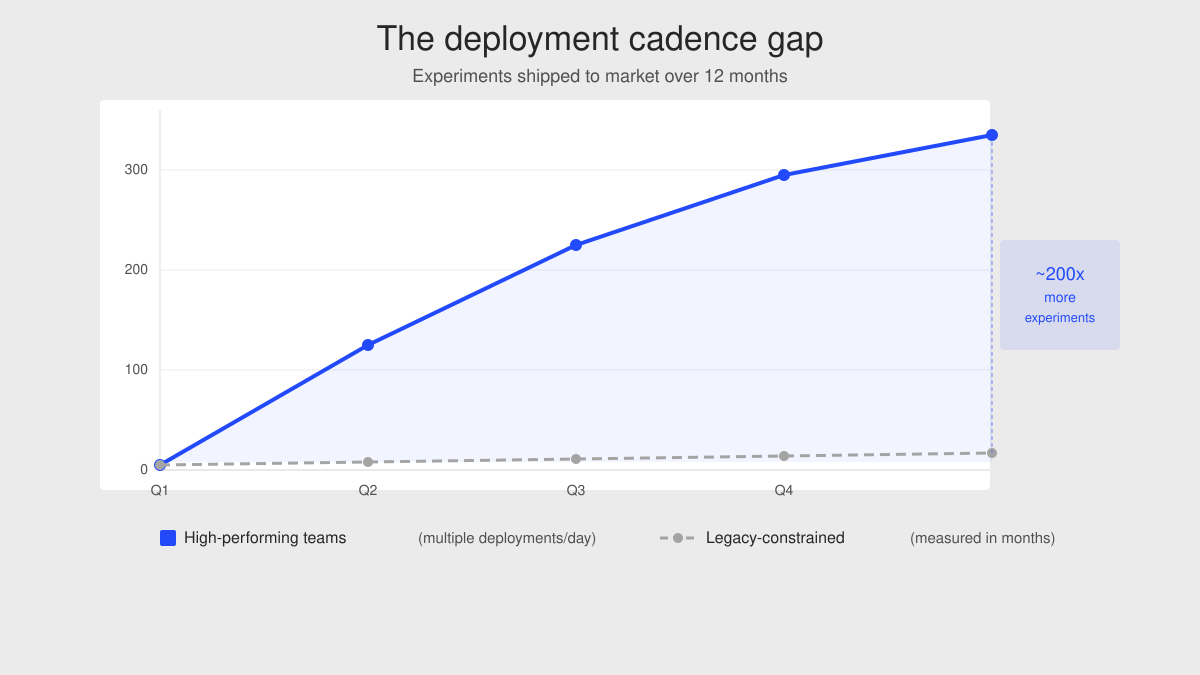
The answer is usually competitive pressure. Your competitors aren’t waiting. They’re deploying new features in weeks. And you’re stuck deploying them in months.
They’re experimenting with AI, with new data structures, with novel user experiences. You’re asking your team to figure out how to do the same within the constraints of 20+ year-old code.
That difference doesn’t sound like much until you realize it means your competitor ships 200 experiments to market for every one you try.
This also affects your ability to attract and retain top developers.
Developers, especially the best ones, don’t want to spend their careers working on clunky legacy systems.
They want to work on interesting problems, use modern tools, and see their work have a real impact.
If your technical environment is defined by “maintaining something old,” you’ll lose people to companies building new things.
The cost of waiting is mostly invisible until the day you realize you’ve lost developers you can’t replace or market share to a company that can move faster.
Metrics and milestones: measuring modernization success
A modernization program that lasts 18-24 months needs actual metrics that tell you if you’re on track and delivering value.
Here are some metrics that matter:
Deployment frequency. How often can your team ship code to production? In legacy systems, it’s often monthly. Modern systems should allow weekly or daily deployments. This metric is directly tied to your ability to iterate and compete.
Mean time to recovery (MTTR). When something breaks, how long until it’s fixed? Legacy systems often have long MTTR because the code is hard to understand and changes are risky. Modern systems should have MTTR measured in minutes, not hours.
System reliability. How often does the system experience outages or degradation? Legacy systems often have reliability in the 99% range. Modern systems should reach 99.9% or better.
Developer velocity. How many features does your team ship per sprint? This should climb throughout modernization as the new architecture removes friction.
Technical debt ratio. Code quality, test coverage, and dependency freshness. All should improve as you modernize.
Cost per transaction. For data-heavy systems, this shows if your new infrastructure is actually cheaper to run.
These metrics do two things. First, they give you confidence that the program is working. Second, they justify the investment to the business.
And you can only realize that value if you actively measure it.
Building your modernization team: internal, external, or hybrid?
This is where a lot of companies get stuck. Modernization requires knowledge of both the legacy system and the target architecture.
Your internal team has deep knowledge of the legacy system but little experience with a new tech stack and might not have time for a complex refactor or rebuild.
External partners have modernization expertise, sure. But they have to learn your legacy system from scratch.
So, how do you bridge that gap? The answer for most companies is a hybrid approach.
Your team knows the product, the business logic, and the current system. They set the direction.
An external engineering partner adds the modernization experience needed to design the target architecture and keep the migration moving.
There are also different staffing models to consider:
Do you hire contractors to supplement your team?
Do you partner with a full-service firm?
Do you split the work between internal and external?
The answer depends on your internal team’s capacity, your timeline, and your budget. And the specifics often change mid-way.
The key thing to remember is this: no matter how you staff the program, someone on your team needs to own it.
That person translates between the business and the engineering team, chases blockers, communicates progress, and adjusts the roadmap when circumstances change.
Without ownership, modernization becomes a floating initiative that never quite lands.
Looking for an experienced modernization partner?
If your business depends on software that’s become harder to maintain and more expensive to support, your priority should be modernizing it without disrupting daily operations.
But to get there, you need the right modernization partner. Luckily, you’re in the right place.
At DECODE, we modernize legacy systems in a structured way that keeps your business running.
We start by understanding what you have, where the risks are, and what matters most to your team.
From there, we build a clear roadmap and deliver in phases, with a focus on clean code, stronger security, better performance, and minimal disruption throughout the transition.
The goal is simple: lower maintenance overhead, faster release cycles, and a system that is easier to scale, integrate, and build on.
Your team stays in control, we handle the complexity.
If that sounds like something you need, feel free to reach out and we’ll set up a quick meet to discuss your needs in more detail.
Ante is a true expert. Another graduate from the Faculty of Electrical Engineering and Computing, he’s been a DECODEr from the very beginning. Ante is an experienced software engineer with an admirably wide knowledge of tech. But his superpower lies in iOS development, having gained valuable experience on projects in the fintech and telco industries.
Ante is a man of many hobbies, but his top three are fishing, hunting, and again, fishing. He is also the state champ in curling, and represents Croatia on the national team. Impressive, right?