But, this begs a few more questions – where in the world should you hire your team from? And how do you choose the right company to partner with?
With that in mind, we’ve compiled a list of the 13 best countries for offshore development and a short guide on how to pick the right development partner.
Let’s dive in!
Key takeaways:
Cost efficiency matters more than just finding the cheapest rates. The right offshore country balances competitive hourly rates with English proficiency, cultural fit, and a stable business environment. Hiring the cheapest team available often costs far more in rework and delays down the line.
Central and Eastern Europe consistently delivers strong value. Countries like Croatia, Poland, and Romania offer engineers at $30-65/hr, rank high on the EF English Proficiency Index, and operate under EU legal frameworks, giving Western clients both cost savings and low collaboration risk.
Communication quality is the most over looked factor. Around 60% of outsourced projects fail because of poor cultural compatibility. Prioritizing English proficiency and shared working norms when evaluating countries is what separates a successful offshore engagement from a frustrating one.
Every country on this list was assessed against six criteria.
These aren’t arbitrary. They reflect what consistently separates successful offshore partnerships from expensive mistakes:
Developer talent pool. Total number of active software developers, annual graduate output, and breadth of specializations available. A country with 50,000 developers looks different at scale than one with 500,000.
English proficiency. We use the EF English Proficiency Index (EF EPI) 2025 edition as our primary benchmark. Covering 123 countries, it’s the most widely cited independent measure of workplace English ability. Countries rated “high” or “very high” communicate with substantially less friction on complex technical projects.
Hourly rates. We use verified 2026 market ranges by role. Rates reflect mid-to-senior talent at established agencies. Freelance platforms often show lower figures that don’t hold at project scale.
Political and economic stability. Ongoing conflict, currency volatility, and regulatory risk all affect delivery. We flag these directly.
IT market maturity. Years of export-oriented software delivery, presence of global delivery centers, and quality of engineering education. A country where the IT sector has been exporting for 20+ years is structurally different from one that’s been doing it for five.
Time zone overlap. Defined as hours of shared working-day overlap with US East Coast (UTC-5) and Western Europe (UTC+1). Fewer than two hours of overlap means you’re managing an async relationship by default. Some teams do this well. Many don’t.
Each country was scored against all six criteria, not just the ones where it excels.
That’s why you’ll find honest cons listed alongside the pros for every entry on this list.
Average offshore development rates: comparison by role and region
Before diving into individual countries, here’s how rates compare across major offshore regions.
These are 2026 market ranges for mid-to-senior talent at established agencies.
Region
Software engineer
Solution architect
UX/UI designer
Project manager
Western Europe
$100-160
$130-220
$80-140
$100-160
Central Europe
$30-65
$45-90
$25-55
$35-70
Eastern Europe
$25-55
$40-70
$20-40
$30-55
Asia
$18-60
$30-85
$18-55
$25-70
North America
$80-150
$100-200
$70-120
$75-140
Latin America
$25-60
$40-80
$20-45
$30-65
Africa
$15-45
$25-65
$15-35
$20-55
So, a developer from Eastern Europe could be up to 5 times cheaper than a developer from Western Europe or North America.
Let’s say you need a team for a 90-day project which consists of:
3 software developers
a solution architect
a UX/UI designer
a project manager
A team like this from Eastern Europe could cost you as little as $118,800 while the same team from North America could cost as much as $655,200 – that’s 82% cheaper!
Of course, this is just a thought experiment and in the real world the difference between the two teams likely wouldn’t be as stark.
Still, it proves that outsourcing development offshore can drastically reduce development costs.
Best countries for offshore development in 2026
Now, we’ll discuss the best countries for offshore development in more detail. Use the map to compare them at a glance, or jump straight to the country you’re interested in.
Interactive map
13 offshore development destinations at a glance
Select a country to see its average developer rate, time zone and English level, then jump to its section.
DECODE HQ
13 best countries for offshore development: key facts, 2026
Country
Region
Average developer rate
Time zone
English proficiency (EF EPI 2025)
Poland
Central and Eastern Europe
$45-65/hr
UTC+1/+2
15th of 123, high proficiency
Ukraine
Central and Eastern Europe
$30-55/hr
UTC+2/+3
45th of 123, moderate proficiency
Croatia
Central and Eastern Europe
$30-55/hr
UTC+1/+2
2nd of 123, very high proficiency
Czech Republic
Central and Eastern Europe
$35-55/hr
UTC+1/+2
23rd of 123, high proficiency
Romania
Central and Eastern Europe
$25-50/hr
UTC+2/+3
11th of 123, very high proficiency
Serbia
Central and Eastern Europe
$25-45/hr
UTC+1/+2
25th of 123, high proficiency
India
Asia
$18-40/hr
UTC+5:30
74th of 123, moderate proficiency
Vietnam
Asia
$20-40/hr
UTC+7
64th of 123, moderate proficiency
China
Asia
$50-80/hr
UTC+8
86th of 123, low proficiency
Philippines
Asia
$20-45/hr
UTC+8
28th of 123, high proficiency
Argentina
Latin America
$25-45/hr
UTC-3
26th of 123, high proficiency
Brazil
Latin America
$30-55/hr
UTC-3
75th of 123, moderate proficiency
Mexico
Latin America
$35-60/hr
UTC-6
103rd of 123, low proficiency
Rates are average 2026 hourly ranges for mid-to-senior developers at established agencies. Working-hour overlap assumes a 9:00 to 17:00 day on both sides and today’s daylight saving settings. English rankings come from the EF English Proficiency Index 2025, which covers 123 countries. Updated October 2026.
Polish universities produce strong engineering graduates year over year, and the country’s IT proximity to Western Europe in both time zone and culture makes collaboration straightforward.
Time zone is UTC+1/+2.
Average hourly rates by role in Poland
Role
Average hourly rate ($)
Software engineer
$45-65
Solution architect
$65-90
UX/UI designer
$35-55
Project manager
$50-70
Pros and cons of offshoring development to Poland
Pros
High-quality education system
One of CEE’s largest tech talent pools
Well-developed IT infrastructure
Favorable time zone for Western European clients
Cons
Higher costs compared to Eastern Europe
Growing domestic demand is putting upward pressure on rates
Ukraine
Ukraine is one of those countries that’s almost synonymous with offshore software development.
Despite the ongoing war, Ukraine’s tech sector has shown remarkable resilience. Over 363,000 IT professionals remain active in the industry, which now accounts for nearly 5% of GDP and $7+ billion in annual exports.
More than 2,300 tech companies operate in the country.
The talent is genuinely strong. Ukrainian engineers have deep roots in mathematics and computer science, and the country has produced globally recognized companies like Grammarly, GitLab, and Preply.
Offshore software development in Ukraine: overview
Time zone is UTC+2/+3, giving solid overlap with Western Europe but only about an hour with a US East Coast working day.
Average hourly rates by role in Ukraine
Role
Average hourly rate ($)
Software engineer
$30-55
Solution architect
$50-70
UX/UI designer
$25-40
Project manager
$35-55
Pros and cons of offshoring development to Ukraine
Pros
Large talent pool with strong technical depth
Competitive rates across all seniority levels
High output in complex domains: fintech, healthtech, enterprise software
Cons
Ongoing military conflict significantly increases operational risk
Lower English proficiency levels
Croatia
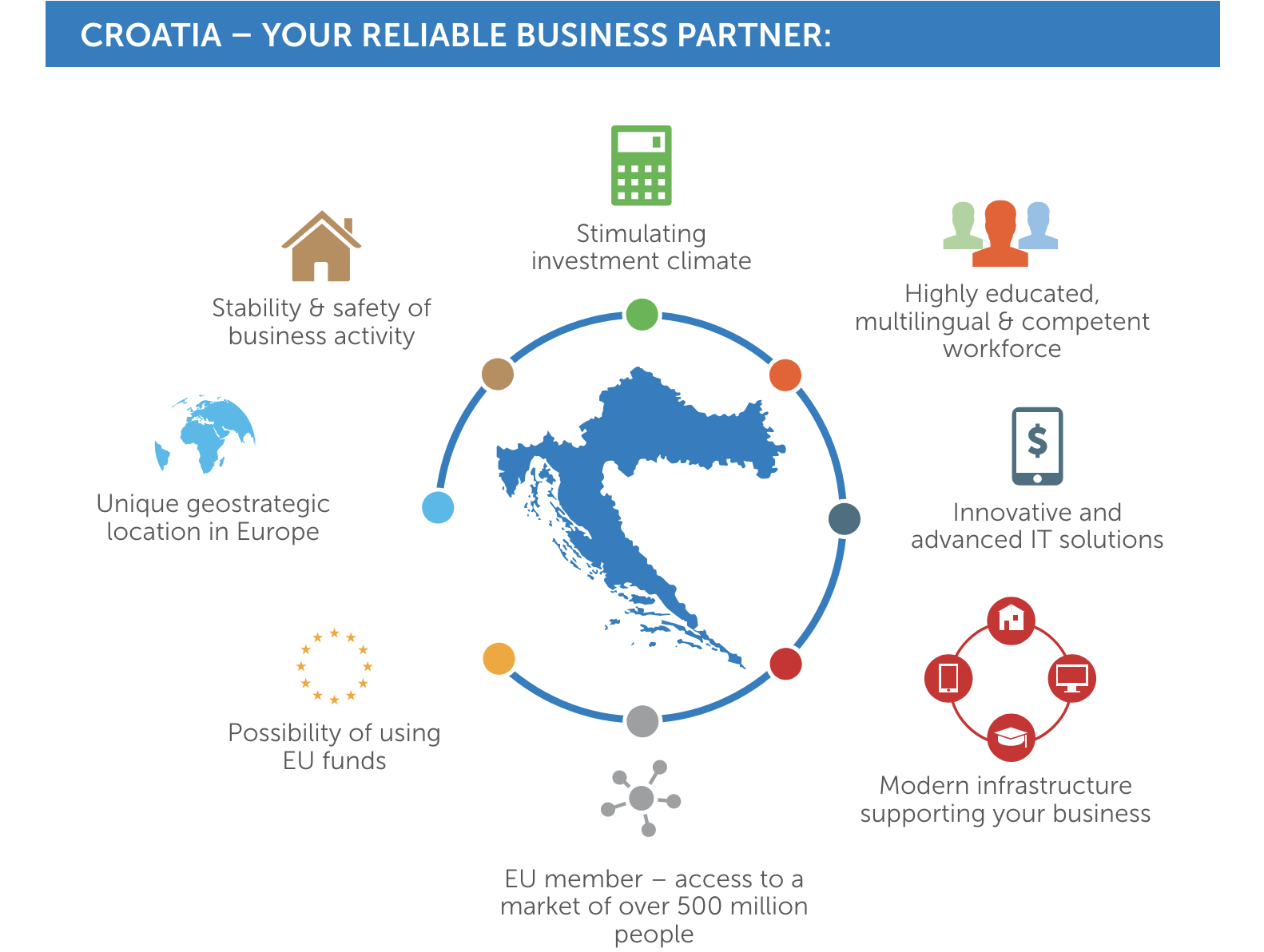
Croatia is a top choice if you want to outsource your development offshore – and that’s not just our bias talking.
It ranks 2nd out of 123 countries in the EF EPI 2025, the best result ever recorded by a Central or Eastern European country. English communication is genuinely excellent, which changes the dynamic of day-to-day collaboration.
The IT sector is worth €3.2 billion in 2026 and has been growing at a CAGR of 12.6%.
Croatia joined the EU in 2013 and adopted the euro in 2023, giving it structural advantages around IP protection and data governance that most offshore destinations can’t match.
The startup scene has produced two unicorns — Infobip and Rimac — which between them have significantly raised the bar for engineering ambition in the country.
Time zone is UTC+1/+2, making it ideal for Western European teams.
Offshore software development in Croatia: overview
Bucharest, Cluj-Napoca, Timișoara, and Iași are well-established delivery hubs with mature agency infrastructure.
Romania is an EU member, which matters if data governance is non-negotiable. Time zone is UTC+2/+3, one hour ahead of Central Europe.
Average hourly rates by role in Romania
Role
Average hourly rate ($)
Software engineer
$25-50
Solution architect
$40-65
UX/UI designer
$20-35
Project manager
$30-50
Pros and cons of offshoring development to Romania
Pros
Competitive rates across all roles
Significantly improved English proficiency, now 11th globally
Deep enterprise software and fintech expertise
Large talent pool
Cons
Complex bureaucracy
Growing demand is tightening availability of senior engineers
Serbia
Serbia doesn’t have the brand recognition of Poland or Romania, but the numbers tell a compelling story.
The ICT sector is growing at a 22.8% CAGR and now contributes around 10% of GDP.
IT exports hit a record $4.3 billion in 2024. Belgrade has evolved into a genuine tech hub with a growing cluster of international-facing development companies.
What often surprises clients is the English level. Serbia ranked 25th out of 123 in EF EPI 2025.
The developer community is particularly strong in gaming, embedded systems, and enterprise software.
At this scale, you can find experts in virtually any technology stack, and the country’s decades of export-oriented IT delivery mean agency infrastructure is mature and well-documented.
Bengaluru, Hyderabad, Pune, Chennai, and Mumbai are the primary hubs.
Major global technology companies (Google, Microsoft, Amazon) run large engineering operations in India, too.
That said, the EF EPI 2025 places India at 74th out of 123 countries for English proficiency.
And India’s time zone is UTC+5:30. India is 3.5 to 5.5 hours ahead of Europe and 9.5 to 13.5 hours ahead of the US, which makes real-time collaboration with US teams challenging.
Average hourly rates by role in India
Role
Average hourly rate ($)
Software engineer
$18-40
Solution architect
$35-60
UX/UI designer
$18-40
Project manager
$25-50
Pros and cons of offshoring development to India
Pros
Huge, deep talent pool
Cost-effective rates across all roles
Extensive outsourcing experience
Cons
Significant time zone differences
Varying levels of English proficiency
Inconsistent quality
Vietnam
Vietnam has moved decisively beyond its reputation as a cheap destination.
The country now has over 530,000 software developers, with approximately 57,000 new IT graduates entering the market annually.
The IT sector is growing at 11-17% annually and Roland Berger estimates it will reach approximately $13 billion in 2026.
Increasingly, you’ll find strong specialization in AI/ML, cloud infrastructure, and data engineering alongside the traditional web and mobile stacks.
Offshore software development in Vietnam: overview
That said, the tradeoffs are real. EF EPI 2025 ranks China 86th/123, which means English-language communication is harder than with almost all European or Latin American destinations.
IP protection frameworks are very different from Western norms, and geopolitical considerations are increasingly relevant for US-based clients particularly.
Time zone is UTC+8, which leaves one to two hours of overlap with a Central European working day and none with the US.
Average hourly rates by role in China
Role
Average hourly rate ($)
Software engineer
$50-80
Solution architect
$70-100
UX/UI designer
$40-70
Project manager
$50-85
Pros and cons of offshoring development to China
Pros
Massive talent pool
Strong government investment in AI, cloud, and emerging technologies
Deep specialization in hardware-adjacent software and consumer platforms
Cons
Cultural differences
Language barriers
Geopolitical risk is increasingly relevant for US-based clients
Philippines
The Philippines has been a technology and services export country for decades, and its developer community is now 1.3 million strong.
English is an official language, which shows up clearly in the rankings: the Philippines placed 28th out of 123 in EF EPI 2025, scoring “high proficiency.”
Cultural compatibility with Western clients (particularly US-based teams) makes onboarding and communication consistently smoother than comparable Asian destinations.
Metro Manila and Cebu are the main development centers, supported by a well-established IT and BPO (business process outsourcing) infrastructure. The IT services market was valued at $5.7 billion in 2025.
Time zone is UTC+8, which leaves no overlap with a standard US working day. Many Filipino teams shift their hours for US clients, but plan for async workflows either way.
Average hourly rates by role in Philippines
Role
Average hourly rate ($)
Software engineer
$20-45
Solution architect
$35-60
UX/UI designer
$18-35
Project manager
$25-50
Pros and cons of offshoring development to Philippines
Pros
Strong English proficiency
High cultural compatibility with US and Western clients
Established IT and BPO infrastructure
Cons
Time zone differences
Smaller talent pool for specialized senior roles
Argentina
Argentina has one of Latin America’s strongest engineering cultures, built on a university system that emphasizes computer science fundamentals.
The Buenos Aires startup scene has produced Globant (a $2.4B NYSE-listed engineering company) and Mercado Libre, Latin America’s largest technology platform by market capitalization.
Offshore software development in Argentina: overview
For US-based clients, Argentina is one of the better-aligned offshore options: Buenos Aires runs on UTC-3, giving six to seven hours of overlap with US East Coast and three to four with US West Coast.
Rates remain competitive despite inflationary pressures, and senior engineers are genuinely strong in complex domains.
Average hourly rates by role in Argentina
Role
Average hourly rate ($)
Software engineer
$25-45
Solution architect
$40-65
UX/UI Designer
$20-40
Project Manager
$30-55
Pros and cons of offshoring development to Argentina
Pros
Excellent time zone overlap with North America
High English proficiency
Strong technical education and deep computer science fundamentals
Cons
Economic instability and persistent high inflation
Currency volatility can affect long-term contract structures
The startup ecosystem is maturing fast: Mexico had $1.8 billion raised in 2025 across 1,460 active startups, and unicorns like Kavak and Bitso have put the country on the global map.
One area to watch: English proficiency. Mexico ranks 103rd/123 in EF EPI 2025.
This is low proficiency at the population level, though senior engineers and international-facing companies typically operate at a much higher standard.
Verify English fluency at the individual or team level before committing.
Average hourly rates by role in Mexico
Role
Average hourly rate ($)
Software engineer
$35-60
Solution architect
$50-80
UX/UI designer
$25-45
Project manager
$40-65
Pros and cons of offshoring development to Mexico
Pros
Best time zone overlap with US-based clients
High cultural compatibility with North American clients
Rapidly growing startup ecosystem
Cons
Higher rates compared to other Latin American countries
Low English proficiency at the population level
How to choose the right country for offshore development
Picking a country is really about matching your constraints to what each market actually delivers. A few criteria matter more than most.
Rates vs. total cost
The hourly rate you see is only part of the equation.
Factor in coordination overhead, ramp-up time, and quality control requirements.
A $20/hr team that needs significant management overhead can cost more than a $45/hr team that runs autonomously.
Time zone and collaboration style
If your working model requires daily standups, live code reviews, and rapid async response times, you need a country with at least four hours of shared working-day overlap.
European destinations offer this for European clients; Latin America offers it for US clients. Most of Asia is an async-first model by default.
English proficiency and communication quality
Miscommunication compounds over time.
A spec that gets slightly misunderstood in week one becomes a significant rework in week six.
The EF EPI rankings give you a country-level benchmark, but they’re averages.
An agency that works exclusively with English-speaking clients will perform much better than the national average suggests.
Ask for references from similar engagements.
IP protection and data governance
If your product handles personal data, financial records, health information, or proprietary algorithms, your offshoring choice carries legal weight.
EU member countries — Poland, Croatia, Romania, Czech Republic — operate under GDPR by default, which significantly simplifies data processing agreements.
For non-EU countries, you’ll need to assess the vendor’s specific data handling practices, certifications such as ISO 27001, and contractual IP assignment frameworks carefully.
Political and economic stability
For long-term partnerships, country risk matters.
Currency volatility (Argentina, parts of Latin America), active conflict (Ukraine), and geopolitical exposure (China, for US clients) all affect business continuity planning.
This doesn’t mean avoiding these countries outright. You just have to price in the risk and build appropriate contingency plans.
Talent pool depth and specialization
If you need one senior React developer, most countries on this list will do.
If you need a team of 25 covering backend, ML, DevOps, and data engineering, the pool size starts to matter.
Poland, India, and Brazil offer genuinely large pools. Croatia, Serbia, and Romania are strong but smaller.
Smaller pools mean longer hiring timelines and more competition for senior talent.
How to choose the right offshore software development company
Once you’ve picked a country, selecting the right development partner is where the real decision happens. Ultimately, the company matters more than the geography.
Look for genuine seniority
Most agencies claim “senior engineers.”
The ones that mean it will show you the actual CVs of the team you’ll work with, not generic bios.
Ask what percentage of engineers hold a postgraduate degree, how many years of production experience they average, and whether you’ll be working with the same people throughout the engagement.
Check their engagement models
Staff augmentation, dedicated teams, and fixed-scope project delivery are fundamentally different models with different risk profiles.
Staff augmentation gives you flexibility but puts coordination burden on your side.
Dedicated teams work best when you want the productivity of a close team without the overhead of building one in-house.
Fixed-scope projects require extremely clear requirements upfront and rarely suit complex or evolving products.
Verify their delivery process
Ask to see how they run sprints. Ask what their code review process looks like. Ask how they handle scope change.
Agencies that are genuinely process-mature will answer these questions specifically.
Vague answers about “agile methodology” and “transparent communication” without specifics are a huge red flag.
Ask about security and compliance certifications
For any project involving user data, financial transactions, or sensitive business logic, ISO 27001 certification is the minimum bar worth looking for.
It tells you the company has implemented a documented information security management system, not that they informally promise to be careful with your data.
Talk to their clients
Case studies are marketing. Client references are due diligence.
Ask for two or three references from projects with comparable complexity and team size to yours.
Ask those references specifically about how the company handled problems, not just whether the project succeeded or not.
Need an offshore development partner?
Do you want to outsource development offshore but are struggling to find a company that’s the right fit?
Well, you’re in the right place.
We can help you build a product from the ground up or update your existing product and take it to new heights.
If you want to learn more, feel free to reach out and we’ll set up a quick intro call to discuss your needs in more detail.
Ante is a true expert. Another graduate from the Faculty of Electrical Engineering and Computing, he’s been a DECODEr from the very beginning. Ante is an experienced software engineer with an admirably wide knowledge of tech. But his superpower lies in iOS development, having gained valuable experience on projects in the fintech and telco industries.
Ante is a man of many hobbies, but his top three are fishing, hunting, and again, fishing. He is also the state champ in curling, and represents Croatia on the national team. Impressive, right?
Poor communication, time zone gaps, cultural differences, and more - these are the 7 offshore software development challenges you will face and how to solve each one.