
How DECODE runs R&D: how we turn bench time into real value
How DECODE turns bench time into focused R&D that grows our team and strengthens every client project.
The leap from senior engineer to CTO is seductive. You’ve proven you can build systems that scale, mentor junior developers, and solve hard problems.
The board sees this. The CEO sees this. So they hand you the title and a seat at the table.
What they don’t hand you is a manual for the thing that actually matters: leading people.
Most new CTOs have deep technical ability.
But, the same instincts that made them brilliant engineers work against them as leaders. The habits that built their reputation as individual contributors become landmines.
Over the years, we’ve worked alongside CTOs and VP Engineering leads at companies across every industry. We’ve seen the same patterns repeat.
And I’ve experienced the transition myself.
The mistakes aren’t random. They’re predictable and, crucially, they’re fixable if you see them coming.
Here’s what I’ve learned about the transition and the biggest pitfalls you’ll face.
Let’s dive in!
Key takeaways:
Table of Contents
You know what it feels like to ship clean code. You understand the discipline it takes to avoid shortcuts.
You’ve seen firsthand what happens when you don’t: out of control technical debt, velocity drops, the codebase becomes a weight the team drags around.
So when you become CTO, your instinct’s will tell you: demand the same standard you set for yourself.
Then you enforce it and review pull requests ruthlessly, push back on timelines that feel loose, and make sure the team gets it right.
The problem is that technical excellence and leadership excellence are not the same thing.

100+ projects delivered. We’re ready for yours. Let’s talk →
You’ll be talking with our technology experts.
89% of hiring failures are due to attitudinal factors, including:
Crucially, it’s technical skills.
When you treat leadership as “just be a better engineer,” you’re selecting for the wrong thing. You’re also exhausting your team.
A developer who writes good code might be a poor communicator, or impatient, or unable to work across team boundaries.
A brilliant architect might have never thought about how to unblock a junior developer without crushing their confidence.
These are skills. And they need to be learned.
Your job as a leader is not to be the best engineer in the room.
It’s to make your engineers better. That requires a completely different skillset, one that doesn’t naturally follow from writing good code.
New CTOs do this because it feels productive. You can point to the code you shipped and the problems you’ve solved.
You still feel like an engineer.
But the moment you become CTO, the highest-value use of your time changes.
It’s no longer writing code. It’s making decisions, giving clarity, and being available when the organization needs you.
When you stay too deep in engineering work, you rob the organization of the thing it actually promoted you for. You also rob your team of space to grow into their own leadership.
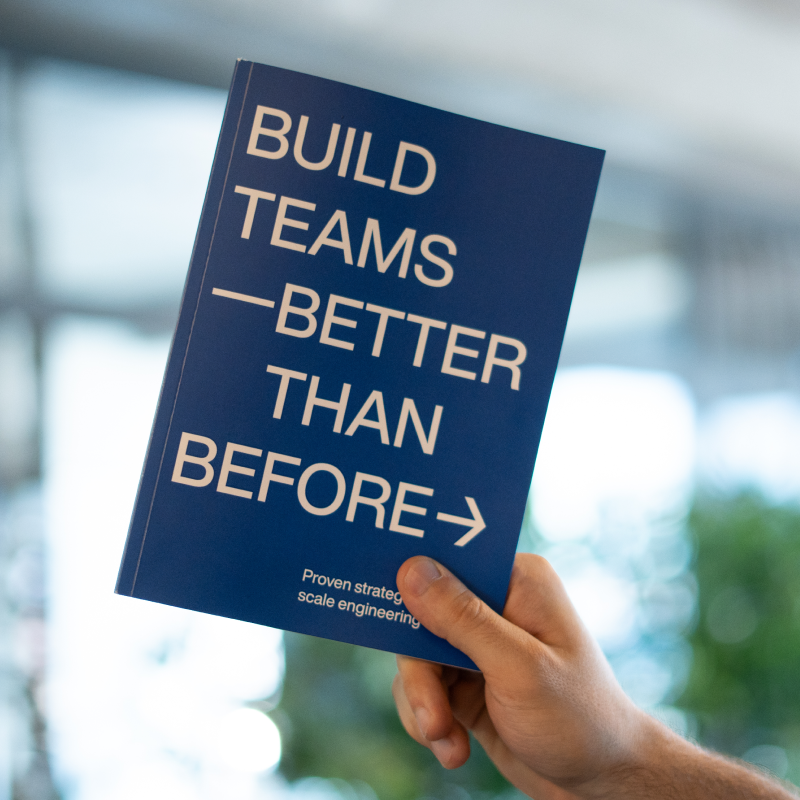
How to build & scale engineering teams. Revealed by experts.
Here’s what happens: a developer brings you a hard problem instead of struggling with it themselves. You jump in and solve it. They feel relieved.
They also feel less capable. Over time, they stop trying to figure things out and wait for you to solve the problem.
Your team’s problem-solving muscle atrophies. And you become the bottleneck.
The best CTOs maintain technical credibility: they stay current, they code in small, specific areas, but they’re ruthless about not letting technical work crowd out leadership responsibility.
They know the difference between “staying sharp” and “avoiding the hard parts of the job.”
This is painful at first. It’s normal to feel less productive.
That feeling is misleading. You’re productive in a different way, and the output is harder to measure.
You’ve spent your entire career in engineering. You think in systems and tradeoffs. You know what “technical debt” means.
You know why it matters and you’ve seen projects grind to a halt because of it.
Your CFO doesn’t. Your board doesn’t. Your CEO might not.
When you become CTO, part of your job is translating the engineering reality into business language. Not dumbing it down. Translating it.
There’s a difference.
If you don’t, a few things happen:
And inevitably, something breaks.
New CTOs often interpret this as the business “not getting it,” as if a better explanation would help. Sometimes that’s true. But often, the problem is that you’re speaking engineering.
You need to speak business. That means connecting engineering problems to business outcomes. It means quantifying risk.
And it means explaining why technical debt matters in terms of customer impact, not architectural purity.
When you can do this fluently, you stop being a specialist who occasionally gets heard. You become a peer to the rest of the executive team.
You got to where you are because you’re good at your job. You probably didn’t need much hand-holding.
You read books, you built things, and you learned by doing.
When you become CTO, the temptation is to expect the same trajectory from your team. If you could figure it out, so can they. Just give them hard problems and let them swim.
Some of them will swim, sure. Others will drown. And you’ll mistake drowning for laziness.
The truth is that your early career was shaped by a specific set of advantages:
Other people have different needs and circumstances.
When you don’t actively develop your team, a few things happen. Junior and mid-level engineers stop growing and get frustrated.
Then they leave. And your senior engineers become isolated and overloaded because there’s nobody coming up to share the load.
Each developer turnover sets a team back 4–8 weeks in delivery time, and onboarding a new software engineer costs roughly 6–9 months of their salary.
So not only are you losing talent, you’re losing time and money.
Effective CTOs build intentional mentorship into their leadership.
They create pathways for engineers to grow. They invest in people who aren’t ready yet, knowing that paying the cost now prevents a much larger cost later.
You have a clear vision for the technical direction of the company.
Better architecture. Cleaner code. Fewer dependencies. A better platform.
You’ve thought about it deeply.
The problem is that your vision might not be aligned with what the business actually needs right now.
The business needs new features faster. The CEO is under pressure to hit revenue targets.
And you’re proposing a six-month platform rewrite to solve a problem the business doesn’t yet know it has.
This is where new CTOs get it wrong. They treat engineering strategy as a technical problem with a technical solution.
But engineering strategy is only half technical. The other half is business reality.
67% of strategies fail because they’re not executed successfully.
Often the failure isn’t the strategy itself: it’s a mismatch between what the organization says matters and what it’s actually prioritizing.
When you become CTO, your job is to understand both. You need to know what the business needs in the next 12 months and where the technical risks are.
And you need to find the path that addresses both.
Sometimes that means deferring your perfect architecture. And sometimes it means pushing back on an aggressive timeline because the team will burn out.
The skill is knowing when to compromise and when to hold the line, while being able to articulate why to the rest of the executive team.
You trust your team. But you also know that not all decisions are equal, and some problems are too important to get wrong.
So you create a review process. Everything goes through you and you’re the final gate.
For a while, this works. You catch mistakes, make sure standards are met, and maintain control over the technical direction.
Then your team grows. Or the roadmap gets packed. Or maybe both of those things happen.
And suddenly you’re approving 40 pull requests a week. You’re in meetings all day and nothing moves without your sign-off.
You’ve become a bottleneck, and your team knows it.
70% of employees consider quitting when micromanaged, while 30% follow through.
Even worse, 55% of people who experienced micromanagement said it hindered their productivity.
This is the irony: by trying to maintain quality through control, you’re actually reducing quality.
You’re slowing down decision-making and preventing people from owning their work.
And you’re also signaling that you don’t trust their judgment. And they’re proving you right by checking out mentally and waiting for you to tell them what to do.
The antidote is clear ownership and delegation. Define what decisions you actually need to make. Give your team the authority to make everything else.
Trust them to escalate when they’re unsure. This is terrifying at first and you’ll make mistakes. And so will the team.
But the cost of those mistakes is almost always less than the cost of you becoming a bottleneck.
You’re pushing hard because the roadmap is aggressive and the market is competitive. Your team is pushing with you and shipping fast.
Velocity is up. Everyone’s stressed, but that’s how it is at growing companies, right?
Wrong. Only 1 in 5 professional developers are happy with their current job.
And teams with high psychological safety show 19% higher productivity, 31% more innovation, 27% lower turnover, and 3.6x more engagement.
When you ignore burnout signals, people leave quietly before they leave loudly.
Someone misses a standup and you don’t think about it. Someone’s PR reviews get shorter and more perfunctory. Someone takes a sick day they didn’t mention beforehand.
These are signals you need to watch out for.
New CTOs often interpret these as minor management problems: just have a conversation, reset expectations, and move on.
But they’re usually signals that someone is close to leaving, or worse, that the whole team is close to breaking.
Recognizing this isn’t weakness. The best CTOs regularly check in with their teams.
They ask directly: How are you? Are you still challenged or are you burned out? Do you feel like you own your work?
They listen to the answers. And they’re willing to adjust course if they need to.
The good news is that none of these are unfixable. The bad news is that they require unlearning.
They require you to deliberately choose a leadership approach that doesn’t come naturally.
Here’s what actually works:
Don’t think of the transition from senior engineer to CTO as a straight promotion. It’s a career change.
You’re good at building systems, but now you’re building an organization. They use similar thinking, but they’re not the same thing.
The CTOs who do this well are the ones who accept this early, get uncomfortable, and keep showing up anyway.
A lot of the mistakes in this article come from the same place. A CTO is pulled in too many directions at once.
You’re expected to set direction, support the team, make good decisions, and still keep delivery moving.
That gets much harder when your team is stretched or lacks critical skills.
That’s where the right development partner can help. Not by adding more noise, but by giving you senior engineering capacity you can trust.
A partner should reduce bottlenecks, strengthen delivery, and give your team room to focus on the work that actually needs their attention.
At DECODE, we work with CTOs and engineering leaders who need to move faster without lowering the bar.
We join as a hands-on development partner, bringing senior mobile, web, and platform engineers who can integrate quickly and start contributing right away.
If that sounds like the kind of support you need, let’s talk

Mario makes every project run smoothly. A firm believer that people are DECODE’s most vital resource, he naturally grew into his former role as People Operations Manager. Now, his encyclopaedic knowledge of every DECODEr’s role, and his expertise in all things tech, enables him to guide DECODE's technical vision as CTO to make sure we're always ahead of the curve. Part engineer, and seemingly part therapist, Mario is always calm under pressure, which helps to maintain the office’s stress-free vibe. In fact, sitting and thinking is his main hobby. What’s more Zen than that?
How DECODE turns bench time into focused R&D that grows our team and strengthens every client project.

A CTO's guide to hiring, building and supporting a high-performing software development team.

We break down team structures, team topologies, and scaling tips for software teams of any size.