Most “AI for front-end development” guides are out of date the day they publish. This one was too, until I sat down and rebuilt it from scratch.
Two years ago, the state of the art was autocomplete: GitHub Copilot finishing the line you’d already started typing.
Today I can describe a checkout screen in plain English and watch Cursor or v0 build most of it before my coffee’s ready.
That change, from suggestion to agent, is the real story in front-end development right now.
If you’re still judging AI tools by what they could do in 2024, you’re missing what matters now.
Like everyone at DECODE, I’ve spent the last year rebuilding parts of my own workflow around agentic tools.
Some stuck. Some I dropped within a week because the output looked right and wasn’t.
This article covers what’s worth your time in 2026, from instant personalization to catching bugs before they even reach QA.
Key takeaways
To get real value from AI in front-end development, focus on six areas:
Generating full interfaces from a prompt: Agentic tools like Cursor, Claude Code, and v0 can build, edit, and ship whole interfaces from a single instruction, not just suggest the next line of code.
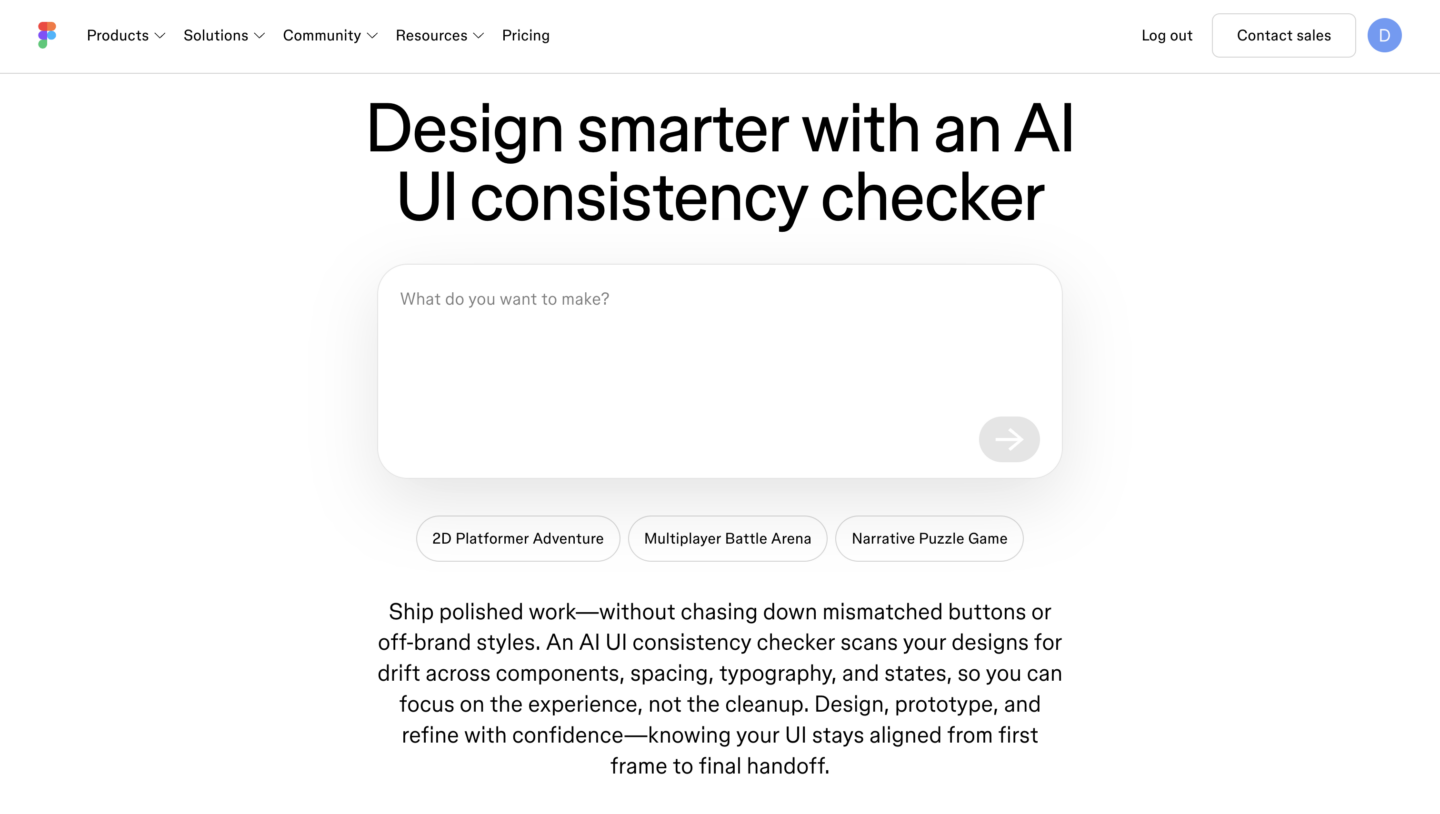
Catching UI inconsistencies: Figma’s AI UI Consistency Checker and Chromatic catch the gap between what your design system specifies and what actually gets built.
Real-time UX personalization: Managed services like Amazon Personalize deliver real-time recommendations without a custom-trained model.
Auditing accessibility: AI can meaningfully improve accessibility, but one-click overlay tools carry real legal risk. Use AI to audit and fix your source code directly instead.
Reviewing and refactoring AI-generated code: AI code review tools catch what AI-written code gets wrong before it reaches production.
Catching bugs and security issues before QA: AI testing tools like TestSigma, CodeQL, and Snyk find test scenarios and vulnerabilities automatically, well before a human tester opens the app.ers are using the tool, not that software reaches production any sooner.
Generating code faster isn’t the same as shipping it faster. Every use case on this list still needs the same review you’d give a human engineer’s pull request before it’s safe to merge to production
The biggest change in front-end tooling is tools that operate directly on your repository, terminal, and file system, the way engineers do.
They don’t just suggest a line, they plan a task, edit across multiple files, run your tests, and report back.
Cursor is an IDE built around this idea from the ground up. It reads your whole codebase for context and can make multi-file changes from a single instruction.
Claude Code works differently but aims at the same problem. It’s a terminal-based agent that can plan a task, write and edit code across a project, run commands, and commit changes. You approve the plan before it does anything.
Then there’s the prompt-to-UI category, which didn’t exist in any real form the last time we wrote about this topic.
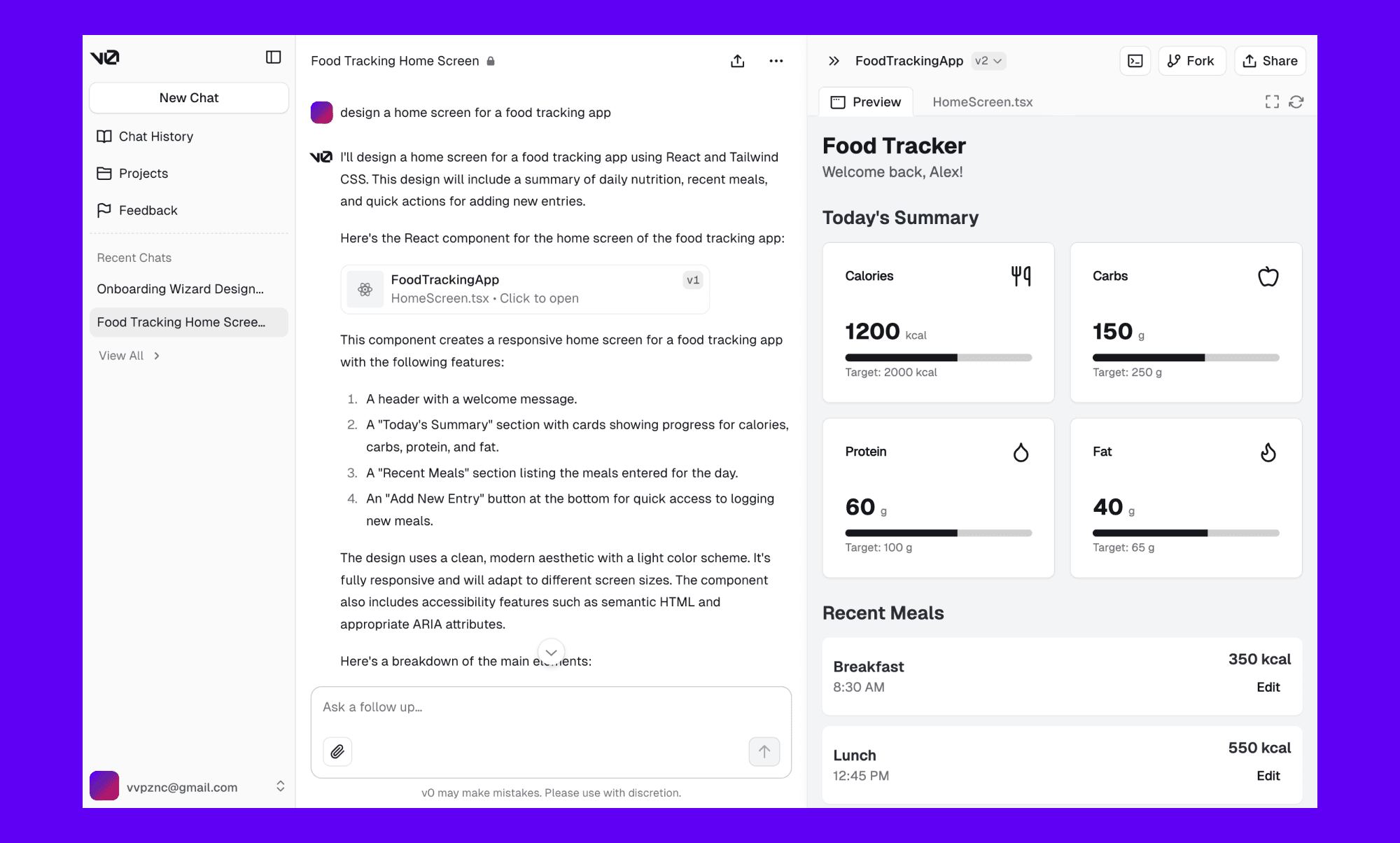
Vercel’s v0 turns a text description or a screenshot into working React and Next.js code.
Builder.io does something related but design-led. It can turn a Figma file into production code and plug straight into a CMS. Bolt and Lovable go further still, generating a full working app, front-end and backend scaffolding included, from a plain-language brief.
I’ve tried out all of these tools, standardizing around Claude Code, and I still don’t let anything merge to main unsupervised.
Developer trust in AI output accuracy dropped from 40% to 29% year over year, even as adoption numbers rose.
That matches exactly what I see day to day: fast output, uneven quality. The tools are genuinely useful, but treating their output as finished work without review is how you get burned.
Here’s where I’d reach for one of these tools:
Prototyping a new feature or screen when you want something clickable in minutes.
Scaffolding a page or component from a design file or a plain description of what it needs to do.
Generating a first draft of repetitive UI (user interface) patterns, like forms, tables, or modals.
Every line an agent writes still goes through the same standard I’d hold a junior engineer’s pull request to, which I’ll talk about a bit more later.
Catching UI inconsistencies
A design system only holds up if someone’s enforcing it.
This is a different problem from the agentic tools above. Instead of generating new UI, this is about catching the gap between design specs and shipped code.
It scans your design files for inconsistencies across components, tokens, spacing, typography, and states, comparing everything against your team’s established components and styles.
I’d draw a clear line between this and the general visual-regression testing I cover later in this article. Applitools and similar tools are asking “did something visually break?”
Figma’s checker and Chromatic are asking a narrower, more specific question: “does this still match what design intended?”
100+ projects delivered. We’re ready for yours. Let’s talk →
You’ll be talking with our technology experts.
Whether this is worth setting up depends entirely on scale. If you’re building a single landing page, this is overkill, and I’d skip it.
But if you’re maintaining a design system across dozens of components and multiple products, I’d treat this as almost non-negotiable. By the time someone notices the inconsistency, it’s usually spread across a dozen screens already.
A few things I’d build into that workflow:
Run Figma’s consistency check before every developer handoff.
Wire Chromatic into your CI pipeline so drift gets flagged on every pull request, not discovered in a quarterly design audit
Treat every flagged inconsistency as a decision point, not automatic noise. Sometimes the code is right and the design system is the thing that’s out of date
Catching inconsistencies early is much, much cheaper than fixing them once they’re spread across a dozen screens and you’ve already copied the incorrect patterns.
Real-time UX personalization
Personalization is still one of the highest-return uses of AI in front-end development.
And the best part? You don’t need a custom-trained model to get most of that value.
Amazon Personalize is a managed recommender service that analyzes user behavior and returns real-time recommendations through an API, which your front end calls the same way it calls any other backend service.
No machine learning experience required.
The payoff is real. 93% of shoppers say they’re likely to keep shopping with a brand that personalizes their experience well.
We saw a version of this firsthand building an AI health platform for Supplentia. Personalized supplement plans and structured assessments were the product itself, not just a nice-to-have feature.
I’d skip building a custom model unless personalization is genuinely core to what you’re selling.
For most products, a pre-trained service gets you most of the value for a fraction of the engineering cost, and you can always switch to something custom if you need to.
A few things worth getting right from the start:
Start with a managed model. Pre-trained services get you real-time personalization without building an AI model from scratch.
Feed it clean data. Personalization is only as good as the user data behind it, so get your data quality right before you optimize the model.
Retrain regularly. User behavior shifts, and a model that isn’t refreshed with new data will get worse over time.
Personalization, when done well, feels invisible to the user. That’s the goal: an experience that just fits.
Auditing accessibility with AI
AI can meaningfully improve accessibility, if used correctly.
The stakes are real. An estimated 1.3 billion people, 16% of the world’s population, live with a significant disability.
Building an accessible front-end starts with following the Web Content Accessibility Guidelines (WCAG). AI tools can be a tremendous help here through voice interfaces, real-time translation, and image description for screen readers.
But there’s something you should keep in mind: overlay tools like UserWay promise instant WCAG compliance by injecting a script on top of your existing site. It’s an appealing shortcut.
Overlays patch the surface without fixing the underlying markup, and courts have increasingly agreed that’s not good enough.
Use AI for what it’s good at here: scanning your UI for accessibility issues and flagging where your code falls short of WCAG.
I wouldn’t ship an overlay as my only accessibility measure, and I’d push back hard if a client asked me to. It’s a real reputational and legal risk dressed up as a shortcut.
What I’d prioritize:
Run AI-assisted audits early and often.
Fix issues in your source code and markup,.
Test with real assistive technology and real users. Don’t just rely on automated scans.
Accessibility that’s directly built into your code holds up under scrutiny. Accessibility bolted on with a script does not.
Reviewing and refactoring AI-generated code
The bottleneck in frontend AI work has moved. Code review is the bigger bottleneck now.
Generating code got fast and cheap. Knowing whether that code is safe to ship is now the harder, more valuable problem.
Dedicated AI code review tools exist specifically to solve that problem.
My colleague Vlado, an engineering manager here at DECODE, went deep on this exact category and it’s a better breakdown than anything I could fit in a few paragraphs: AI code review tools.
Here are 6 tools worth knowing about, per his research:
CodeRabbit — The most purpose-built of the group, designed specifically for pull request review.
GitHub Copilot code review — The zero-setup option if you’re already paying for Copilot, since it comes with the subscription.
Qodo Merge — Reviews through four specialized agents working in parallel: bug detection, security analysis, code quality, and test coverage.
Greptile — Takes a graph-indexing approach to understanding your codebase, and learns from your team’s own review history over time.
SonarQube — The established static-analysis tool, now paired with an AI CodeFix engine on top of its existing security scanning.
Ellipsis — Focused on one job: catching bugs and fixing them directly, not just flagging them for a human to handle.
These tools catch real problems. GitHub’s own 2026 data puts 71% of Copilot’s code reviews as producing genuinely actionable feedback.
But, in reality they’re noisier than that number suggests.
Graphite’s research found false-positive rates running 5-15% across tools, with around 40% of the alerts they raise getting ignored by the teams using them.
A near-half ignore rate isn’t a reason to drop AI review tools. It’s a sign you’ve not configured them well.
A few things I’d keep in mind before picking one up:
Match the tool to how your team already works. Copilot review if you’re already paying for Copilot, a dedicated tool like CodeRabbit if you’d rather keep review separate from wherever you write code.
Run it on one repository before rolling it out everywhere, so you learn where it’s sharp and where it’s off before it’s reviewing every pull request in the company.
Treat its comments as a first pass, not as a final verdict, especially on anything architectural. That judgment should still be yours.
These tools have gotten good at catching what’s mechanically wrong with your code: inconsistent naming, missing coverage, an edge case nobody thought about.
Deciding whether the underlying approach is the right one at all is still your job, and no tool on this list can do it for you.
Catching bugs and security issues before QA
The cheapest bug is the one nobody has to find manually.
AI testing tools can identify test scenarios, write scripts, and run them around the clock, catching problems long before a human tester opens the app.
TestSigma is a solid choice for AI-generated and maintained test scripts across unit, integration, and regression testing.
Applitools specializes in visual testing, catching UI regressions that standard functional tests miss entirely, like a button that technically still works but silently shifted three pixels to the left.
For security, CodeQL and Snyk scan your codebase for vulnerabilities well before it reaches quality assurance (QA).
I integrate these tools from day one of a project. Retrofitting test coverage onto a shipped feature always costs more than building it in from the start, and I’ve never seen that trade-off go the other way.
A few habits worth building in:
Let AI analyze historical test data to trim redundant test cases.
Add visual testing alongside functional testing to catch what a passing test still misses.
Build test coverage in from the start of a project and plan for it from the beginning.
Automated testing won’t catch everything. It will catch the bugs that are boring, repetitive, and entirely preventable – which is most of them.
6 ways to use AI in front-end development: FAQs
No, not in any way that matters for the next several years. AI tools are excellent at generating a first draft of a screen or component, but someone still has to decide what to build, catch the edge cases AI misses, and take responsibility for the end-result.
The job itself is shifting toward review, architecture, and judgment. I spend much more time reading and correcting AI output today than I did writing code from scratch two years ago.
Only after it goes through the same review process you’d apply to any other code.
AI-generated code often looks correct at first glance and fails on an edge case, a security check, or an accessibility requirement. Treat it as a fast first draft from a capable but unsupervised contributor that still needs a second set of eyes before hitting production.
You need less coding experience to get something on screen than you did two years ago. You still need engineering judgment to know if what you got is any good.
Prompt-to-UI tools will happily generate a working screen for someone who’s never written a line of code. Whether that screen handles a failed API call, works for a screen reader, or holds up once real users start clicking around it, is a different question entirely. That’s where experience and engineering judgment still decide the outcome.
Looking for a development team that uses AI without cutting corners?
If you’ve read this far, you’ve probably already tried a few of these tools yourself, and you’ve probably also seen how quickly confident-looking AI output can turn into a mess if nobody’s checking it.
That instinct is correct. It’s exactly why we’re deliberate about how we use AI at DECODE.
We’re not vibe coders, and we don’t want to be.
Our engineers use agentic tools like Cursor and Claude Code the same way I described above: to make repetitive work faster, never as a replacement for engineering judgment.
Every senior engineer on our team reviews AI-generated code with the same rigor they’d apply to any pull request from a colleague. That’s the part of the job that determines whether a product actually holds up in production.
That approach is how we’ve built AI-powered platforms like the one we shipped for Supplentia, where personalization and structured, AI-assisted workflows had to hold up in production.
If you need a product that holds up from day one, that’s exactly the kind of work we do at DECODE. Feel free to reach out to use and we’ll set up a quick meet to see how we can make it happen.