
Improve team chemistry in your software development team: 6 strategies that work
6 practical ways to improve team chemistry in your software development team and build stronger day-to-day collaboration.
An emergency hits production. An outage cascades across systems. A critical security vulnerability surfaces at 3 a.m.
Your team springs into action, dropping everything to fight the fire. The next 12, 24, maybe 72 hours are brutal.
How you lead during those hours, how you communicate and make decisions, shapes team morale for months afterward.
Engineers remember who had their back during crunch. They remember whether blame landed on individuals or whether the focus stayed on solving the problem.
And they remember if you stayed calm or panicked. They remember if you recognized their effort or just moved on.
Crisis periods test culture as much as technical skills.
For engineering leaders, the stakes are real. 83% of developers suffer from burnout, and nearly half of employees experiencing burnout are seeking to leave their organizations.
In this article, we’ll walk you through the full arc: how to build the foundation before the crisis, what to do during the crisis itself, and how to recover and rebuild trust in the aftermath.
Key takeaways:
Table of Contents
Emergencies are different. Under normal pressure, good processes and clear communication go a long way.
During a crisis, everything becomes visible.
Gaps in trust, unclear decisions, blame culture, burnout: all of it surfaces fast.
A production outage creates acute stress.
Your team is problem-solving under time pressure, with high stakes and uncertainty. They’re operating on adrenaline and reduced sleep.
Their capacity for handling unclear direction, ambiguous authority, or feeling undervalued drops dramatically.
Your team needs clarity about what matters right now. They need to know their contribution is valued. They need to trust you won’t let them burn out.

100+ projects delivered. We’re ready for yours. Let’s talk →
You’ll be talking with our technology experts.
The psychological weight is different, too.
An engineer working through an outage is often running on fear: fear of customer impact, fear of being blamed, fear of the unknown.
That fear can drive focus in the short term, sure. But it quickly turns toxic if sustained for a longer period.
Your job is to acknowledge the reality of the crisis while creating enough psychological safety that people can think clearly and work effectively.
High workloads (47%), inefficient processes (31%), and unclear goals (29%) are the primary drivers of developer burnout.
During a crisis, all three spike. You can’t eliminate the high workload, but you can fight the other two hard.
Before any emergency hits, you need to build a culture where psychological safety is the default.
Google’s Project Aristotle found psychological safety is the single most important factor in high-performing teams. It’s what allows people to speak up, admit mistakes, ask for help, and challenge decisions without fear of punishment.
In a crisis, psychological safety becomes essential.
A team with strong psychological safety brings issues to the surface early. They collaborate openly and focus entirely on solving the problem rather than protecting themselves.
Build this long before the emergency. Start with creating a blame-free incident culture.
When something goes wrong in production, your response to the first person who reports it matters enormously.
If you react with anger or blame, you’ve taught every engineer on your team that reporting problems is dangerous. Blame-focused incident cultures delay incident reporting and prolong outages.
Normalize the opposite: when someone surfaces a problem, thank them. Focus on what happened, not who happened to be on-call when it surfaced.
After an incident, run a structured retro focused on what happened and why, not who to blame. Ask yourself:
Blameless postmortems drive collaboration and information sharing, which improve team innovative performance.
This is where your culture gets built or destroyed. You have to model the behavior you want.
In a crisis, your team will take cues from you. If you stay calm, admit when you don’t know something, and focus on the next step, they will too.
And in general, make it safe to push back on unrealistic timelines.
Even outside a crisis, if an engineer doesn’t feel safe saying a timeline is unrealistic, you’re missing critical information.
During a crisis, you need even more honesty. People will overcommit and burn out unless you actively protect them.
Building this foundation takes time. Start now, before you need it.
Next, we’ll cover some key tips on how to keep your team motivated through a crisis.
During a crisis, information vacuums quickly get filled with rumors.
Your team will worry more if you’re silent than if you give them honest updates, even when the update is “we don’t know yet.”
Here’s what works:
Organizations with effective communication experienced 4.5x higher employee engagement.
And during a crisis, clear communication is actually more valuable: it’s what keeps people working effectively under stress.
During a crisis, confusion about authority is paralyzing. You can’t have three people deciding what to roll back. You can’t have an engineer waiting for approval to restart a service.
Before an emergency, establish an incident response structure.
First, name an incident commander.
This person is in charge of the response for this incident. They decide what to investigate next, what gets tried, what gets rolled back. They don’t need to be the most senior engineer.
Everyone else knows: if you have a recommendation, give it to the incident commander. But they make the final call.
Next, clearly define other roles. Along with an incident commander, name:
Crucially, give people explicit authority within their role.
The incident commander should be able to make decisions about deployment and rollback without asking for approval.
The technical lead should be able to make calls about what to investigate and how.
Finally, make runbooks and playbooks living documents.
Well-maintained runbooks can reduce MTTR by 30–40% and improve on-call team morale. If the last incident was a surprise, document the response:
The next time an incident happens, that knowledge is available immediately.
Autonomy during a crisis prevents decision bottlenecks and reduces the cognitive burden on your team.
People know what they can do without waiting for approval, so they act faster.
Burnout doesn’t start during a crisis. It starts weeks or months before, when workloads are high and rest is rare.
A crisis is just where it becomes visible.
Developers waste up to 8 hours weekly on inefficiencies, representing 20% of engineering capacity.
If your team is already running at capacity under normal circumstances, a crisis will break them. Audit what’s eating time and change it:
Productivity per hour drops sharply after 50 hours per week and output at 70 hours is barely higher than at 55, according to Stanford research.
People working 70-hour weeks are slightly more productive but much more burned out. If your team is regularly working evenings and weekends, you’re in trouble.
And during the crisis, manage the hours carefully.
If this is going to be a 48-hour push, be explicit about that.
“We need everyone for the next two days, then we’re taking time to recover.” People can handle acute stress if they know it’s temporary.
Also, make sure to rotate people off incident response if it goes long.
If your outage is still running at hour 20, pull people off to sleep.
Mistake rates increase by up to 27% during extended shifts. A fresh person will solve the problem faster than someone running on fumes.
Lastly, after the crisis, actually give people time off.
If your team just worked through a weekend, don’t expect them Monday morning at 9.
Let them recover. This is leadership, not soft management: it’s the only way to avoid burnout that leads to resignations.
During a crisis, people will overextend themselves because the work feels important. Your job is to protect them from themselves.
Recognition during normal work matters. During a crisis, it’s essential.
When people are running on adrenaline and stress, what keeps them going is knowing their effort is seen and valued.
Burnout studies consistently show lack of recognition is a major source of workplace stress.
Thank people during the crisis, not just after. Don’t wait for the postmortem.
When someone makes a key insight while things are chaotic, acknowledge it immediately with something concrete. Five seconds of recognition changes how someone feels about the next 12 hours.
And be specific about what you’re recognizing.
“Thanks for working hard” is generic.
“You stayed calm when the database started cascading failures and methodically worked through the logs until you found the culprit: that’s exactly what we needed” is real. Specificity shows you were paying attention.
In the incident channel, call out specific contributions by name:
This builds respect and models what good work looks like under pressure.
After the crisis subsides and people have recovered, follow up with them.
Let them know how their work mattered and connect their effort to the outcome.
How you handle the aftermath of a crisis determines whether your team trusts you for the next one.
The postmortem is where many leaders get this wrong.
If it becomes a blame session or a witch hunt, you’ve confirmed to your team that crises are dangerous places. If it’s a genuine learning conversation, you’ve strengthened your culture.
First things first. run a proper blameless postmortem.
Schedule it for at least a week after the incident. People need time to recover before analyzing what happened.
In the meeting, focus on systems and decisions, not people.
How to build & scale engineering teams. Revealed by experts.
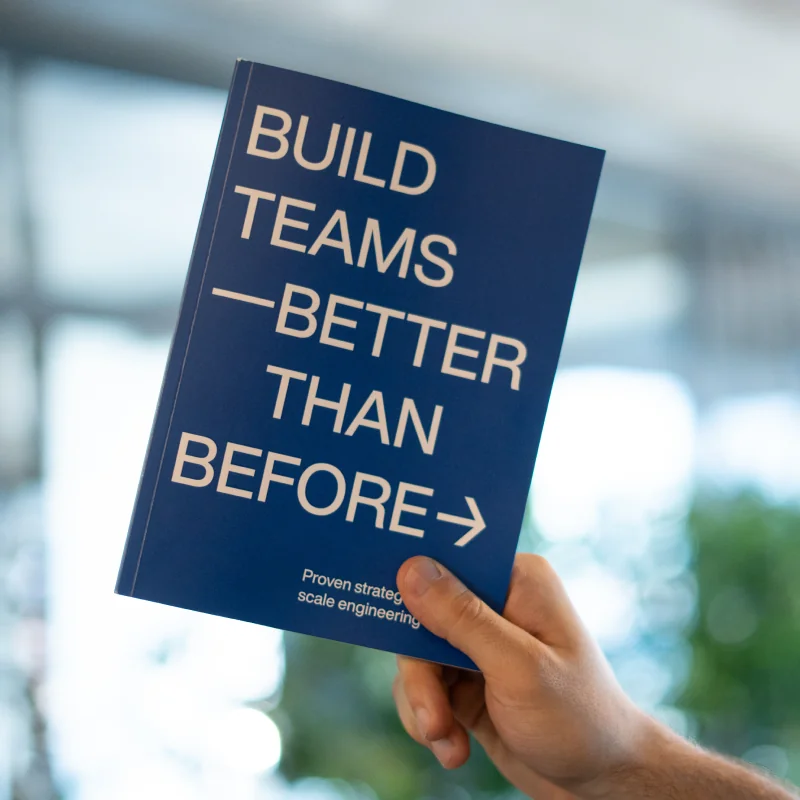
“Why did we deploy to production without running the test suite?” is the right question. “Who forgot to run the test suite?” is corrosive.
Everyone who was involved should have a voice.
A junior engineer who spotted something during the chaos should feel comfortable sharing that insight.
Then, you need to actually implement the findings.
If the postmortem identifies a process gap, fix it. Create documentation if it’s missing, upgrade tooling if it’s broken.
Teams with high turnover accumulate 37% more technical debt and spend 22% more time debugging, often because incidents never drive real improvement.
Afterwards, share the postmortem with the rest of your organization, not just the incident team.
Let people see that you take learning seriously and that improvements come from transparency.
Postmortems are where leaders either build or erode trust. And you can’t afford Do them well.
The crisis is over. Your systems are stable. But your team is exhausted.
This is where many leaders fail: they declare victory and move on, leaving their team depleted.
Recovery is its own phase. And here’s a couple of tips on how to get it right.
Give people real time off
A two-day crisis that ate a weekend should result in a flexible Friday or Monday off.
A week-long outage should mean people should have a lighter workload the following week.
This is recovery, not a perk.
Re-establish normal rhythms
If you’ve been in crisis mode, meetings have turned informal, you’ve skipped daily standups, and paused planning.
Bring that structure back deliberately.
This helps people shift out of crisis thinking and back into normal work.
Run a team retrospective separate from the incident postmortem
The incident postmortem is about what happened technically.
A team retro is about how people experienced it: what they need to feel better, what the team learned about itself.
Ask what was hardest, what they needed but didn’t have, and what someone did that really helped.
Celebrate recovery
When systems stabilize, mark it with genuine acknowledgment. Don’t use empty praise; tell them you got through something hard. People need to see stability return and know the effort is over.
Invest in the things you identified as gaps
In the postmortem, you probably found areas to improve: documentation, tooling, process.
Invest in those.
People want to see that the crisis created learning and improvement, not just more work.
Watch for hidden burnout in the weeks after the crisis
The crisis is over, but some people will struggle. Their cortisol won’t reset immediately; they might get sick or seem quiet or withdrawn. Check in.
Some people need space to decompress; others need to feel trusted again. Figure out who needs what.
The teams that survive crises intact are the ones where leaders treat recovery as seriously as response.
Crises put pressure on the parts of a team that are usually easier to ignore.
And when your team is already stretched, even good leaders can end up stuck between protecting people and keeping delivery moving.
That’s where the right development partner can help.
Not by adding noise in the middle of a high-pressure situation, but by bringing senior engineers who communicate clearly, take ownership, and work well inside an existing team.
At DECODE, we work with CTOs and engineering leaders who need dependable support when the stakes are high.
We bring senior, high-caliber engineers who integrate quickly, stay calm under pressure, and help you keep moving without creating more friction.
If you’re looking for a development partner your team can rely on, we’d be glad to talk.

With a strong technical background and 11+ years of experience in software development and product management, Boris brings a wealth of expertise to every project. Armed with a keen eye for detail and a variety of industry certifications, he has what it takes to turn complex ideas into functional products. Outside the office, you'll find him enjoying long walks in nature or the latest PS5 games. His dream office? A cozy space in the heart of Zurich, savoring the fresh alpine air.
6 practical ways to improve team chemistry in your software development team and build stronger day-to-day collaboration.

Common mistakes new CTOs make, and how to lead with more clarity, trust, and impact.

A CTO's guide to hiring, building and supporting a high-performing software development team.